
1000 – 1065 (another tradition gives 1082/1089)·Feast September 4
St. Irmgardis
Countess of Aspel and Pilgrim of Cologne
Overview
Irmgardis, also known as Saint Irmgard of Süchteln, was born in the year 1000 and became a medieval saint and sovereign Countess of Aspel on the Lower Rhine, ruling from 1013. The sources present her as a reigning countess who, after the death of her parents, renounced the enjoyment of her inheritance and gave her fortune away to hospitals, churches and works of charity. Her own manner of life was simple and solitary, and three times she journeyed as a pilgrim to Rome, that great act of medieval devotion which carried her across the Alps to the tombs of the Apostles. Her final years were passed in Cologne, whose chapters and convents enjoyed her support, and there her life closed, the year of her death being given as 1065 by one tradition and as 1082 or 1089 by another. Her relics are preserved in a sarcophagus in the altar of Cologne Cathedral, her major shrine. Her feast is kept on September 4. Her memory has remained alive on the Rhine: a chapel and a hospital at Süchteln, a school in Cologne, a kindergarten in Viersen and a brotherhood founded at Kevelaer in 1663 all bear her name.
The Complete Life
A Countess Who Gave Away Her Inheritance
Irmgardis was born about the year 1000 and, while still young, found herself a sovereign. The sources show her as the reigning Countess of Aspel, a lordship on the Lower Rhine in Germany, holding that dignity from 1013 onward across a long tenure. Sovereignty in such a house meant land, rents and the means of considerable personal wealth, and Irmgardis possessed all of these. What set her life on another course was the death of her parents, which left her mistress of the family's fortune. Rather than treating the inheritance as an ornament of her rank, she resolved to turn it entirely to the service of God in the persons of the needy. She scattered her fortune among hospitals, churches and the social institutions of her day, the whole network of care that medieval Christendom maintained for the sick, the traveller and the destitute. At the same time she embraced personal poverty of another kind, living a simple life in solitude amid the duties of her station. The countess who commanded a territory became known instead for the renunciation with which she commanded her own possessions.
§ Introduction
Pilgrim and Benefactor
Two forms of devotion marked Irmgardis's long life: the pilgrim's road and the benefactor's gift. Three times, the sources relate, she made the pilgrimage to Rome, joining the great stream of medieval travellers who crossed the mountains to pray at the shrines of the Apostles; such journeys demanded months of hardship and were counted among the great works of a penitent life. Her generosity, meanwhile, flowed steadily toward the institutions of the Church and the relief of suffering. Hospitals and churches received her alms, and her care extended to the social bodies that supported the poor of the Rhineland. In her last years she settled in Cologne, then the greatest city of the German northwest, and there her benefactions took a more specifically ecclesiastical form: she supported chapters and convents, the communities of clergy and religious whose liturgy and teaching sustained the Church of the city. The countess who had begun life as a ruler ended it as a patron of prayer and a friend of the poor, her own wants few and her liberality unbounded, until her death closed a life of nearly a century by some reckonings.
§ Introduction
Last Years and Death in Cologne
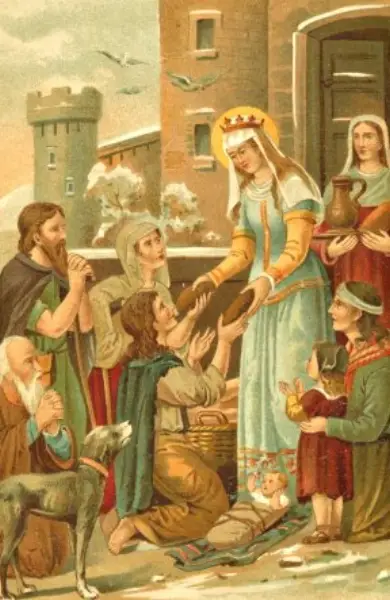
Irmgardis chose Cologne for the close of her earthly pilgrimage. Having distributed her possessions and blessed the poor of the Rhineland, she spent her remaining years in that archiepiscopal city, close to its chapters and convents, which she continued to support from her resources. Even the date of her death is a matter of divergent traditions, a sign of how long and how variously her memory was kept: one line of sources gives the year 1065, while others place her passing in 1082 or 1089, in extreme old age whichever date is preferred. What no tradition disputes is the honour paid to her remains. Her relics were laid in a sarcophagus set in the altar of Cologne Cathedral, the great Gothic church on the Rhine, where her shrine became the centre of her veneration and her major shrine to this day. The image that grew around her memory shows the saint among the poor, the company she had chosen over the court, and the people of the Lower Rhine embraced her from the first as one of their own holy women.
§ Introduction
Veneration on the Lower Rhine
Irmgardis never passed through the formal processes of papal canonization; she belongs to the long company of pre-congregation saints, raised to the altars by the devotion of the people among whom she lived. On the Lower Rhine she was honoured as a Volksheilige, a saint of the people, and her cult fixed itself at the two poles of her life: the lands of her county around Aspel and Süchteln, and the cathedral city of Cologne where she died and where her relics rest. Her feast was assigned to September 4 and has been kept from an early date. Medieval and later writers recorded her life in Latin and German: the seventeenth-century hagiographical tradition preserved her in the great lives of the saints, and the scholars of the Rhineland returned to her again and again, from Peter Norrenberg's study of 1894 and Josef Kleinermanns's monograph of 1900 down to the modern entries in the Biographisch-Bibliographisches Kirchenlexikon by Klaus-Gunther Wesseling and Ekkart Sauser, and Arie Nabrings's biography of 1995 and his article in the online Portal Rheinische Geschichte. The date of September 4 has carried her name through the sanctoral books of the Rhineland, and the cathedral of Cologne remains the goal of pilgrims who seek the tomb of the countess who chose the poor.
§ Introduction
Institutions That Bear Her Name
Few saints of the German Middle Ages left so practical a legacy in the everyday life of their region. At Süchteln, near Viersen, the Irmgardis-Kapelle keeps her name over a church, and the St. Irmgardis-Krankenhaus carried it into the care of the sick, a fitting continuation of the hospitals her alms once supported. In Cologne, the city of her last years and her shrine, the Irmgardis-Gymnasium educates the city's young under her patronage, while at Viersen the Kindergarten St. Irmgardis extends her name to the smallest of the city's children. At Kevelaer, one of the great pilgrimage towns of the Lower Rhine, the St. Irmgardis-Bruderschaft, a brotherhood founded in 1663, has kept her memory in solemn association for more than three and a half centuries. Together these foundations trace the geography of her life and cult, from the county of Aspel through Süchteln to Cologne, and they show how a countess who gave away her wealth in the eleventh century continued to endow schools, hospitals and works of charity in her own name a thousand years later. In all these places her cult has never wholly died out: the brotherhood of Kevelaer still gathers her clients, and the chapel at Süchteln still draws the faithful who ask the countess of Aspel to remember them before God.
§ Introduction
Timeline
- 1000
Is born; medieval sources date her birth to this year
§ Introduction
- 1013
Becomes sovereign Countess of Aspel, beginning the reign the sources assign to her
§ Introduction
- 1065
Dies at Cologne according to one tradition of her death
§ Introduction
- 1089
Alternative date given for her death, which sources place in 1082 or 1089
§ Introduction
- 1663
The St. Irmgardis-Bruderschaft, a brotherhood under her patronage, is founded in Kevelaer
§ Introduction
The Record
- Symbols
- Depicted among the poor
- Canonization
- Pre-congregation; venerated as a popular saint (Volksheilige) of the Lower Rhine, with her shrine in Cologne Cathedral
Prayer
Bibliography
Show 5 sources
- Nabrings, Arie. Irmgardis von Süchteln, Volksheilige. Online-Portal Rheinische Geschichte, 8 March 2013
- Kleinermanns, Josef. Die h. Irmgardis von Aspel und ihre Beziehungen zu Rees, Süchteln und Köln. Stauff, Köln 1900
- Nabrings, Arie. Die hl. Irmgardis von Süchteln. Rheinlandia, Siegburg 1995, ISBN 3-931509-01-X
- Norrenberg, Peter. Die heilige Irmgardis von Süchteln. Aus der rheinischen Geschichte, Band 19. Bonn 1894
- Wesseling, Klaus-Gunther. Irmgard von Köln. In: Biographisch-Bibliographisches Kirchenlexikon (BBKL), Band 2, Bautz, Hamm 1990, Sp. 1334-1335
Profile text adapted from the Wikipedia article, licensed CC BY-SA 4.0.
Pray with this saint every day
Save St. Irmgardis to your favorites, read the full profile, and get feast-day reminders in the Saints app.
Get the Saints AppFree on the App Store for iPhone and iPad