
died 720·Feast January 3 (December 24 in some sources)
St. Irmina of Oeren
Abbess of Oeren and Benefactor of Echternach
Overview
Irmina of Oeren, recorded also as Ermina and Hirmina, died in 720 after a life that joined the highest Frankish nobility to the founding of monasteries on both sides of the Moselle. She established and governed the convent at Oeren near Trier, which came to bear her name, and she joined her resources with Willibrord's in bringing the abbey of Echternach into being in 697 or 698. Twelfth-century biographies attach to her a splendid and disputed pedigree, making her a daughter of one Dagobert or another, but modern hagiographers warn that the legends of her family tree grew beyond control. What is secure is her standing: Ian Wood judges her, probably rightly, the mother of Plectrude, wife of Pippin of Herstal. The sources tell of a first betrothal broken by murder, a marriage to the magnate Hugobert, a flock of influential daughters, and a widowhood devoted to the cloister. Generous to Celtic and Saxon missionary monks, she died in 720 at the monastery of Weissenburg. Her feast is kept on 3 January, though some sources give 24 December.
The Complete Life
Origins and First Betrothal
Whatever the truth of her pedigree, Irmina belonged to a house that stood among the mightiest in the Frankish realm, yet even her contemporaries' accounts disagree about exactly where she belongs in its tangled tree. One tradition makes her Saint Primina, daughter of Dagobert I and sister of Modesta; another names her a daughter of Dagobert II and sister of Adela of Pfalzel. The hagiographer Basil Watkins regards her twelfth-century biography as unreliable and observes that legends about her ancestry grew out of all proportion, but her eminence is beyond doubt, and the historian Ian Wood considers her, traditionally and probably correctly, the mother of Plectrude. The story of her youth carries a dark note. Many versions of her life relate that at the age of fifteen she was betrothed to a man called Count Hermann, but before the wedding could take place he was killed by one of his own servants in a murder-suicide, a servant said to have admired Irmina and to have been unable to bear the thought of his master possessing her. Thus early she learned that rank offered no shelter from violence, and the girl promised to a murdered count would soon be sought in marriage again.
§ Introduction
Marriage and Family
Irmina's second betrothal ended in a wedding that shaped the history of the Franks. Her husband was Hugobert, a magnate of the middle Moselle country who held the offices of seneschal and count palatine at the Frankish court in the days of Theuderic III and Childebert III. The union bound together two great houses and produced a remarkable generation of daughters. Plectrude became the wife of Pippin of Herstal and founded the abbey of Saint Maria im Kapitol at Cologne; Adela, abbess of Pfalzel, is commemorated as a saint; Regintrud married, as her second husband, the Bavarian duke Theudebert; a younger Irmina wed Chariveus, brother of the count of Hesbaye; and Bertrada of Prüm founded Prüm Abbey and became grandmother to Bertrada of Laon, mother of Charlemagne. Through her daughters, then, Irmina of Oeren stands at the fountainhead of the Carolingian age, her blood running into the imperial line itself. Her own path, however, was turning from the dynastic world her children occupied toward the cloister, and the death of Hugobert, which came around 697, would free her to build the monastery that still carries her name.
§ Introduction
Founder of Oeren and Benefactor of Echternach
Widowed around 697, Irmina devoted her resources to the founding of religious houses. She built her monastery at Oeren in Trier, a house that eventually took her own name, and there she succeeded as abbess her sister, Saint Modesta. In the same years she reached across the frontier of her family's world to aid the Anglo-Saxon mission: she donated lands to help establish, with Willibrord of Northumberland, the convent at Echternach in 697 or 698, in what is now eastern Luxembourg. The historian Jamie Kreiner describes the Echternach foundation as a cooperative undertaking between the missionary and Irmina's kin, one that bound them in a web of mutual obligation. In 706 Willibrord promised fidelity to the family, and they in turn pledged to protect the convent and its possessions. Watkins records that Irmina was generous alike to Celtic and to Saxon missionary monks, making her house a source of support for the conversion of the lands beyond the Rhine. As abbess of Oeren she governed not a retreat from the world but a center of power sanctified, in which prayer, land, and dynasty worked together for the Gospel.
§ Introduction
Death and Veneration
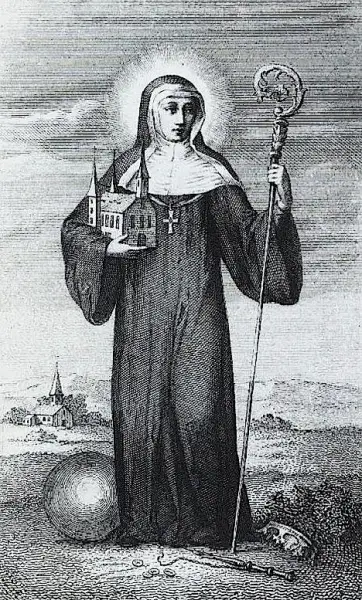
Irmina died in 720 at the monastery of Weissenburg, a house her father had founded, so that her life ended where her family's patronage of monasticism had begun. From her own foundations her memory spread: Oeren bore her name, Echternach grew into one of the great abbeys of the region under the protection her kin had promised, and her feast was fixed on 3 January, though some sources give 24 December. She is honored as patroness of Trevos, and her representations show her in the habit of a religious with the crosier of an abbess, holding the model of a church in her hand to mark her status as a founder, while two angels above her head carry her soul to heaven. Historians approach her story with caution, since the biographies written centuries after her death embroidered her ancestry and legend gathered freely around her name. Yet the essentials stand firm: a noblewoman of the Moselle, mother of Plectrude, widow of Hugobert, founder of Oeren and benefactor of Echternach, who used the greatness of her house to serve the monastic conversion of her world.
§ Introduction
Timeline
- 697
Her husband Hugobert dies, leaving her a widow of the highest Frankish nobility
§ Introduction
- 697
Builds her monastery at Oeren in Trier, where she succeeds her sister Modesta as abbess
§ Introduction
- 697
Donates lands to help Willibrord found the convent of Echternach, in 697 or 698
§ Introduction
- 706
Willibrord pledges fidelity to her family, which promises in turn to protect Echternach and its holdings
§ Introduction
- 720
Dies at the monastery of Weissenburg, which her father had founded
§ Introduction
The Record
- Major works
- Convent of Oeren near Trier (founder and abbess)·Convent of Echternach (co-founder, with Willibrord)
- Patron of
- Trevos (as named in the source)
- Symbols
- Religious habit and abbess's crosier·Model of a church in her hand·Two angels above her head
- Canonization
- Pre-congregation; ancient veneration as a saint in the Catholic Church
Prayer
Bibliography
Show 7 sources
- Dunbar, Agnes B.C. (1901). A Dictionary of Saintly Women. Vol. 1. London: George Bell & Sons. pp. 413–414.
- Kreiner, Jamie (2014). The Social Life of Hagiography in the Merovingian Kingdom. New York: Cambridge University Press. p. 29. ISBN 978-1-107-65839-4.
- Watkins, Basil (2016). The Book of Saints: A Comprehensive Biographical Dictionary (Eighth ed.). London: T&T Clark. p. 332. ISBN 978-0-567-66414-3.
- “St Irmina's Church.” Trier Tourism and Marketing. Retrieved 5 July 2021.
- Fouracre, Paul (2020). “Forgetting and Remembering Dagobert II: The English Connection.” In Frankland: The Franks and the World of the Early Middle Ages. Manchester University Press. p. 83. ISBN 978-1-5261-4825-4.
- Wood, Ian (2004). “Genealogy Defined by Women: The Case of the Pippinids.” In Gender in the Early Medieval World: East and West, 300–900. Cambridge University Press. p. 247. ISBN 0-521-81347-6.
- McKitterick, Rosamond. The Frankish Kingdoms under the Carolingians 751–987. Routledge, 2018, p. 29. ISBN 9781317872481.
Profile text adapted from the Wikipedia article, licensed CC BY-SA 4.0.
Pray with this saint every day
Save St. Irmina of Oeren to your favorites, read the full profile, and get feast-day reminders in the Saints app.
Get the Saints AppFree on the App Store for iPhone and iPad