
1607-1646·Feast October 19
St. Isaac Jogues
Priest, Missionary and Martyr
Overview
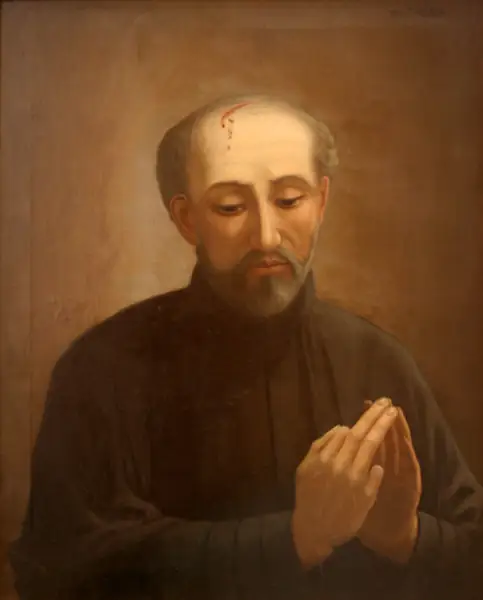
Isaac Jogues was born at Orleans on 10 January 1607, the fifth of nine children of a bourgeois family, and entered the Jesuit novitiate at Rouen at seventeen. Ordained in 1636, he sailed at once for New France, writing to his mother on landing that he knew no greater joy than celebrating his first Mass in the New World. For six years he lived among the Wendat (Huron) at the village of St-Joseph, learning their language and ways, and was entrusted with building Fort Sainte-Marie. In August 1642, returning from Quebec with Guillaume Couture, Rene Goupil and Christian Wendat, the party was taken by a Mohawk war party. Jogues was beaten, his fingernails torn out, his thumb cut off; through a year of captivity he comforted, baptized and absolved fellow prisoners. Freed in 1643 with Dutch help, he became the first Catholic priest to set foot on Manhattan. Pope Urban VIII called him a living martyr and dispensed him to say Mass despite his mangled hand. He returned to France, then to Canada, and in 1646 went again to Mohawk country as a French ambassador. There, at Ossernenon on 18 October 1646, he was killed.
The Complete Life
Early Life
Isaac Jogues was born at Orleans on 10 January 1607, the fifth of nine children of Laurent Jogues and Francoise de Sainte-Mesmin, a bourgeois family. Educated at home until ten, he then passed into Jesuit schools, and at seventeen entered the Jesuit novitiate at Rouen, where his master of novices was Louis Lallemant, whose brothers and nephew served as missionaries in New France. The order's missions to the colony had begun in 1625 with Enemond Masse and Jean de Brebeuf, and the example worked on the young novice. He professed simple vows in 1626, studied philosophy at the royal college of La Fleche, taught humanities to boys at Rouen from 1629, pursued theology at the College de Clermont in Paris from 1633, and was ordained a priest there in 1636.
§ Early life and education
Conversion and Vocation
When Brébeuf, Charles Lallemant, and Masse returned from New France in 1636, they told Jogues plainly of the hardships, treacheries, and tortures that ordinarily awaited missionaries there; the accounts only increased his desire to devote himself to the conversion and welfare of the natives. Not long after his ordination he took up missionary work and set out for New France in the company of other missionaries, Charles Garnier among them. His ship left France on 8 April 1636, dropped anchor eight weeks later in the Baie des Chaleurs, and reached Quebec City on 2 July. Writing to his mother on arrival, he said that while he could not say what entering heaven was like, nothing in this world could surpass, in sheer overflowing joy, what he felt at setting foot in the New World and celebrating his first Mass on the day of the Visitation.
§ Early missions
Mission and Ministry
Jogues joined Brébeuf's mission at the village of St-Joseph on Lake Huron on 11 September 1636, fell feverish on arrival, and watched an epidemic spread through Jesuits and villagers alike, so that the Wendat blamed the Black Coats and threatened to kill them; Brébeuf conciliated them, and within a year the missionaries were being invited from village to village. Jogues spent six years at St-Joseph learning the Wendat language and ways, the missionaries accommodating themselves to native custom and food to show they had come to teach, not to trade. Trips with Garnier to the Petun found the ground hard, since rumor, fed by natives who had been among English and Dutch settlers to the south, credited the Black Coats with calamity. In 1639 the new superior Jerome Lalemant entrusted Jogues with building Fort Sainte-Marie, and in September 1641 he and Charles Raymbault traveled to the Saulteurs, some two thousand of whom welcomed them.
§ Early missions
Trial and Final Years
On 3 August 1642, returning from Quebec City with Guillaume Couture, René Goupil, and Christian Wendat, Jogues was waylaid by a Mohawk war party. He had hidden in the reeds but left hiding to join the prisoners and comfort them; for comforting the tortured Couture he was beaten with sticks, his fingernails torn out, and his fingers gnawed to the bone. The captives ran the gauntlet at village after village; an Algonquin woman cut off Jogues's thumb; he was hung from a plank until a bystander cut him down. Throughout he baptized, heard confessions, and absolved the other prisoners. After about a year, malnourished and half-clothed, he escaped with the help of Arent van Curler of Rensselaerswyck, passed through New Amsterdam as the first Catholic priest on Manhattan, and reached France, where Urban VIII, calling him a living martyr, dispensed him to say Mass with his mutilated hand. He visited his mother at Orleans, then returned to New France in 1644. In spring 1646 he went again to Mohawk country with Jean de Lalande as French ambassador to keep the peace of 1645. When disease and crop failure struck Ossernenon, the Mohawk blamed the Catholic paraphernalia the Jesuits had left, and on 18 October 1646 they killed Jogues with a tomahawk, and Lalande the next day, throwing the bodies into the Mohawk River.
§ Capture by the Haudenosaunee
Spirituality and Witness
Jogues's letters reveal a spirituality of participation in the passion. He wrote that Jesus was making them share his sufferings and admitting them to participate in his crosses, and, quoting the psalm against his torturers, that sinners had built monuments of their rage upon his back. He regarded torture and expected death as imitation of Christ, an acceptance into the company of those whose strength had equaled the persecutions inflicted on the primitive church. In captivity this became practical: he saved a pregnant woman who fell into a winter creek, and he baptized the very man who had delivered him from the wooden instrument of torture.
§ Attitudes towards martyrdom
Canonization
Jogues was beatified by Pius XI at Rome on 21 June 1925 and canonized by the same pope on 29 June 1930, together with seven other martyrs, the Canadian or North American Martyrs, Jesuit priests and their associates killed between 1642 and 1649. His feast day is 19 October in the General Roman Calendar, while Canada keeps it on 26 September. A canonical oddity attaches to his death: French native allies captured his killer in 1647 and condemned him, and the man, baptized before execution with the name Isaac Jogues, was seen as a secondary martyring of the saint.
§ Introduction
Legacy
The National Shrine of the North American Martyrs stands at Auriesville, New York, on the site formerly identified with the Mohawk village of Ossernenon. Jogues was the first European to see and name Lake George, which he called Lac du Saint Sacrement. He is remembered also as the first Catholic priest to set foot on Manhattan Island, during his escape through New Amsterdam in 1643, a detail that has given him a place in the story of Catholic New York. With Brébeuf and their companions he stands at the origin of the church in North America, and their deaths, once told simply as heroic martyrdom, are now read within the fuller history of epidemic, diplomacy, and war in which they occurred.
§ Introduction
Timeline
- 10 Jan 1607
Born at Orléans on 10 January to Laurent Jogues and his wife Françoise.
§ Early life and education
- 1624
Entered the Jesuit novitiate at Rouen at the age of seventeen.
§ Early life and education
- 1626
Professed simple vows and took up philosophical studies at La Flèche.
§ Early life and education
- 1633
Sent to the Collège de Clermont in Paris to pursue theological studies.
§ Early life and education
- 1636
Ordained a priest at Clermont.
§ Early missions
- 8 Apr 1636
Sailed from France for New France on 8 April, reaching Quebec City on 2 July.
§ Early missions
- 11 Sep 1636
Joined Jean de Brébeuf at the Wendat village of St-Joseph (Ihonatiria) on Lake Huron on 11 September.
§ Early missions
- 1639
Entrusted by the mission superior Jérôme Lalemant with building Fort Sainte-Marie.
§ Early missions
- Sep 1641
In September set out with Charles Raymbault into Ojibwe territory, reaching the Sault.
§ Early missions
- 3 Aug 1642
Waylaid on 3 August by a Mohawk war party while returning from Quebec with Couture and Goupil; taken captive and tortured.
§ Capture by the Haudenosaunee
- 1643
Brought by Mohawk traders to Beverwijck in the autumn, escaped with Arent van Curler's help, and reached France by way of New Amsterdam.
§ Capture by the Haudenosaunee
- 1644
Received a papal dispensation to celebrate Mass with his mutilated hands and returned to New France.
§ Return to France
- 1646
In the spring went back to Mohawk country with Jean de Lalande as French ambassador, to keep the peace concluded the year before.
§ Return to New France and death
- 18 Oct 1646
Killed with a tomahawk at Ossernenon on 18 October; Lalande was slain the following day.
§ Return to New France and death
- 21 Jun 1925
Beatified in Rome on 21 June by Pope Pius XI.
§ Veneration and legacy
- 29 Jun 1930
Canonized by Pope Pius XI on 29 June together with seven other North American Martyrs.
§ Veneration and legacy
In Their Own Words
I do not know it is to enter Heaven, but this I know—that it would be difficult to experience in this world a joy more excessive and more overflowing than I felt in setting foot in the New World, and celebrating my first Mass on the day of Visitation.
The Record
- Major works
- The Jesuit Relations letters from the Wendat mission and captivity
- Patron of
- North American Martyrs shrine at Auriesville, New York
- Symbols
- Jesuit cassock·Mutilated hand (fingers and thumb lost in captivity)·Tomahawk, instrument of his martyrdom
- Canonization
- Beatified by Pope Pius XI on 21 June 1925; canonized with the North American Martyrs by Pope Pius XI on 29 June 1930
Prayer
Bibliography
Show 12 sources
- ↑ "Lives of the Canadian Martyrs" . Canadian Martyrs Catholic Church .
- ↑ O’Neill, Sean (2000). "Jogues, Isaac (1607–1646), Jesuit missionary and martyr" . American National Biography . doi : 10.1093/anb/9780198606697.article.0101240 . ISBN 978-0-19-860669-7 .
- ↑ Giguère, Georges-Émile (1979) [1966]. "Jogues, Isaac" . Dictionary of Canadian Biography . Vol. 1. University of Toronto/Université Laval.
- 1 2 Vann 1953 , p. 413.
- 1 2 3 4 "Isaac Jogues 1607–1646" . www.wyandot.org . Archived from the original on 29 March 2024 . Retrieved 21 February 2016 .
- ↑ Scott 1927 , p. 45.
- 1 2 3 Scott 1927 , p. 52.
- ↑ Scott 1927 , p. 61.
- 1 2 3 4 5 6 7 "The Jesuit Relations and Allied Documents Volume 31" . puffin.creighton.edu . 11 August 2014. Archived from the original on 28 February 2015 . Retrieved 21 February 2016 .
- ↑ Scott 1927 , p. 64.
- ↑ Denner, Diana (6 July 2011). "New interpretive sign to adorn Schuyler Flatts Park" . Troy Record .
- 1 2 3 4 Anderson 2013 , p. 25.
Profile text adapted from the Wikipedia article, licensed CC BY-SA 4.0.
Pray with this saint every day
Save St. Isaac Jogues to your favorites, read the full profile, and get feast-day reminders in the Saints app.
Get the Saints AppFree on the App Store for iPhone and iPad