
c. 350 – c. 438·Feast September 8
St. Isaac of Armenia
Catholicos and Father of the Armenian Alphabet
Overview
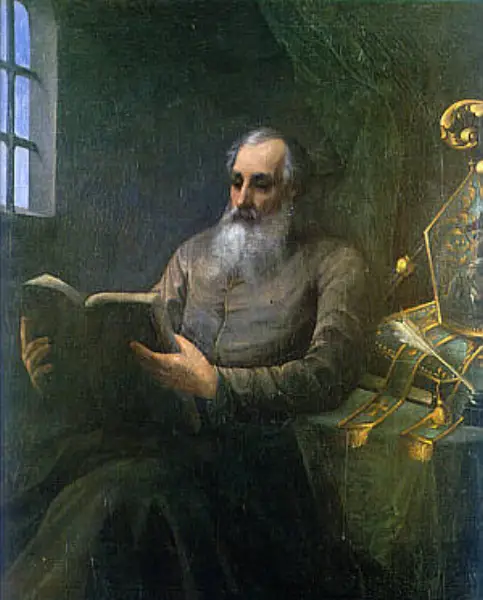
Isaac of Armenia, called Sahak Partev in Armenian and honored as Isaac the Great or Sahak the Parthian, led the Armenian Church as catholicos from about 387 until about 438, through the most consequential half-century in the nation's cultural history. Born around 350 to the future catholicos Nerses I, he was the last patriarch descended in direct line from Gregory the Illuminator, the apostle of Armenia. Educated at Caesarea, Alexandria, and Constantinople, he mastered Greek, Syriac, and Persian before his election to the see in the year the kingdom was partitioned between Rome and Persia. Twice deposed amid the intrigues of the declining Arsacid monarchy, he nevertheless presided over the rebuilding of churches ruined by the Persians, the holding of three councils, and, above all, the creation of the Armenian alphabet by his colleague Mesrop Mashtots, in which he encouraged, advised, and personally participated, translating and revising books of the Bible. Deposed again in 428, imprisoned at Ctesiphon, restored to partial office in 432, he declined the patriarchate in 437 and died about 438 at the village of Blur in Bagrevand, being buried at Ashtishat in Taron. His memory is kept by the Armenian Apostolic and Roman Catholic churches.
The Complete Life
Birth, Lineage, and Studies
Isaac was born about the year 350, the son of the man who would reign as Catholicos Nerses I, and through his father he inherited the blood of Gregory the Illuminator, who had brought the Christian faith to the Armenian kingdom at the beginning of the fourth century and become its first chief bishop. From Gregory's day the office of catholicos had passed by heredity within his line, with occasional interruptions, and Isaac would prove to be the last patriarch of that sacred descent. His mother's name is a matter of sources: the anonymous Life of St. Nerses calls her Sandukht, a princess of the Mamikonian house whom Nerses wed at Caesarea before his consecration, dying after the child's birth, while the Buzandaran chronicler names no wife at all, and Movses Khorenatsi makes Nerses marry the daughter of a noble called Aspion at Constantinople. During his father's patriarchate the boy was sent abroad to study, spending long years at Caesarea in Cappadocia, at Alexandria, and at Constantinople, and acquiring Greek, Syriac, and Persian. The historian Ghazar Parpetsi says he sat among many learned Byzantines and became thoroughly trained in musical notation, persuasive rhetoric, and above all philosophy. In due course he received episcopal consecration and preached at the cathedral of Etchmiadzin, attended by a band of sixty disciples.
§ Early life
Election, Deposition, and Restoration
Around 387, upon the death of his predecessor Aspuraces, Isaac was elected catholicos of the Armenian Church. The same year brought catastrophe to the state, for the kingdom was divided between the Roman and Sasanian empires. Isaac threw his support behind King Khosrov IV in his endeavor to reunite the Armenian realm, and for this, or possibly for being elevated to the catholicosal throne without Persian sanction, Khosrov was seized and imprisoned by the Sasanian king around 389. Isaac was deposed in the aftermath, but Vramshapuh, Khosrov's successor on the throne, managed to have him reinstated. The years of his patriarchate that followed were years of building: under his direction the churches and monasteries the Persians had destroyed were raised again, education was fostered with lavish care, the Zoroastrianism that Shah Yazdegerd I sought to impose was driven out, and three councils were convened to restore ecclesiastical discipline. Contemporaries noted the austerity of his manner of life, a catholicos who governed a national church while living as an ascetic. Through his daughter Sahakanoysh, given in marriage to the Mamikonian prince Hamazasp, his line would continue even after his house's male line ended with him.
§ Patriarchate
The Alphabet and the Book
The work by which Isaac is remembered grew out of a linguistic predicament. Before the alphabet existed, the Armenian Church worshipped in Greek and Syriac, and after the partition of 387 the two halves of the nation were pulled apart linguistically: the Roman sector barred Syriac and slowly Hellenized, while the Persian sector forbade Greek altogether. Armenian culture and unity alike were in danger of dissolution. Isaac encouraged Mesrop Mashtots to devise an Armenian alphabet, and according to Ghazar Parpetsi the inventor and the first translators turned constantly to the catholicos, with his excellent education, for aid in the task. Isaac himself translated and emended portions of the Bible. The rendering begun from the Syriac Peshitta was revised against the Septuagint and apparently the Hebrew original as well, in labor that ran from about 410 to about 430. The liturgy, formerly Syrian, was translated into Armenian in a form shaped by the rite of Basil of Caesarea to give the new worship a national character. Schools of higher learning that Isaac had founded, staffed by disciples sent to Edessa, Melitene, Constantinople, and elsewhere, now produced Armenian versions of Athanasius, Cyril of Jerusalem, Basil, the two Gregories, John Chrysostom, and Ephrem. The new letters hastened the Christianization of the Armenian people.
§ Creation of the Armenian alphabet
Ascetic and Prophet
The sources portray Isaac as an ascetic by temperament, notable even among the austere bishops of his age for the simplicity of his way of life. His interior world comes to us through a vision preserved in the history of Ghazar Parpetsi, at the close of that work's first section. Isaac is said to have told of it when the Armenian lords begged him to take up the patriarchal office again and he would not consent. What he saw was a row of signs belonging to the Church and the faith, and he saw that the Arsacid kings of Armenia and the Gregorid house of his own ancestry were to fall from power and apparently vanish; yet after an interval of upheaval both were destined to be restored each to its own throne, and from his daughter Sahakanoysh would come powerful and pious men. Some scholars judge the vision a later insertion into Ghazar's sixth-century history, though Gohar Muradyan allows that Ghazar himself may have written it from an existing source. Whatever its origin, the prophecy circulated widely: it was repeated across Armenian literature, rendered into Greek and from Greek into Georgian, and readers were still applying it to the events of their own times at the end of the seventeenth century.
§ Vision
Deposition, Exile, and Death
In 428 the Sasanian king, with the backing of most of the Armenian nobles, deposed Artashes, the last Arsacid king of Armenia. Isaac had opposed the collapse of the monarchy, and for this he too was removed from his office. A nobleman named Surmak was installed in his place, soon to be replaced by the Syrian bishop Brkisho. The deposed catholicos was carried to Ctesiphon and imprisoned there until 432, when he was permitted to return to Armenia and to occupy certain offices within the church, though not his former throne. When Catholicos Samuel, Brkisho's Syrian successor, died in 437, the nobility begged Isaac to take up the patriarchate again, and he declined. He died around 438 at the village of Blur in Bagrevand. His body was conveyed to Taron and laid to rest at Ashtishat, an ancient sanctuary of the Armenian Church. With him the male line of the Gregorids ended, and Taron, Bagrevand, and Acilisene, the lands of his line, went to the Mamikonians, for his daughter Sahakanoysh had married their prince Hamazasp, through whom his blood flowed into the next generation of Armenian leadership.
§ Second deposition and death
Veneration
Isaac has been honored as a saint since before the formal processes of canonization existed, and today he is venerated in both the Armenian Apostolic Church and the Roman Catholic Church. The Armenians keep his memorial twice in the year, in a pattern that binds him to the rhythm of their liturgical calendar. The first keeps him on the Saturday before Lent's penultimate Sunday, which lands anywhere from 24 January to 28 February; the second unites him with Saint Mesrop Mashtots, his comrade in giving Armenia its letters, on the Thursday after the fourth Sunday of Pentecost, a window running from 1 June to 16 July. In the Roman Catholic calendar his feast is 8 September, though a second observance, on the Thursday after the third Sunday following the Assumption, is also recorded. The double memory of Isaac and Mashtots is especially telling: the Church that keeps them together honors at once the last hereditary patriarch of Gregory's line and the monk who gave Armenia its letters, joining in a single feast the apostolic succession of the nation and the script in which its Gospel was written.
§ Veneration
Works and Legacy
The writings that survive from Isaac's own hand are few but consequential. Abraham Terian identifies as authentic his canons and two letters: one to Archbishop Proclus of Constantinople, composed jointly with Mashtots in reply to the archbishop's letter to the Armenians on matters of faith, and one to Bishop Acacius of Melitene, likewise an answer to a letter now preserved in Armenian. Doubts raised by some authors about the canons are, in Terian's judgment, unfounded. Movses Khorenatsi's history further quotes letters of Isaac to the emperor Theodosius II, to the consul Anatolius, and to Archbishop Atticus of Constantinople. To him are attributed four sermons preserved in the Armenian book of hours and many of the hymns called sharakans, so that the translator of the Bible is also remembered as a maker of his church's song. His greater legacy lies in what his patronage made possible: a written Armenian literature born within a generation of the alphabet, a biblical text that became the anchor of national identity, and a church whose independence of language helped it survive the fall of the kingdom that had first sheltered it.
§ Works
Timeline
- 350
Born around this year to the future Catholicos Nerses I; his mother Sandukht dies shortly after his birth, according to his Life
§ Early life
- 373
His father Nerses I dies, reportedly poisoned by the Arsacid king Pap
§ Early life
- 387
Elected catholicos on the death of his predecessor Aspuraces, in the year Armenia is partitioned between Rome and Persia
§ Patriarchate
- 389
King Khosrov IV is imprisoned by the Sasanian shah, apparently for elevating Isaac without Persian approval; Isaac is deposed, and later restored under Vramshapuh
§ Patriarchate
- 410
The Armenian Bible translation made with Mesrop Mashtots is revised against the Septuagint and apparently the Hebrew, work that continues to about 430
§ Creation of the Armenian alphabet
- 428
The last Arsacid king Artashes is deposed with the nobles' help; Isaac, who opposed it, is removed from office
§ Second deposition and death
- 432
Released from imprisonment at Ctesiphon and allowed to return to Armenia to exercise certain church offices
§ Second deposition and death
- 437
Declines to resume the patriarchate after the death of Catholicos Samuel, the successor of the Syrian bishop Brkisho
§ Second deposition and death
- 438
Dies at the village of Blur in Bagrevand; his body is carried to Taron and buried at Ashtishat
§ Second deposition and death
The Record
- Major works
- Canons attributed to Isaac·Letter to Archbishop Proclus of Constantinople, co-authored with Mesrop Mashtots·Letter to Bishop Acacius of Melitene·Four sermons in the Armenian book of hours (zhamagirk)·Liturgical hymns (sharakans) attributed to him
- Canonization
- Pre-congregation; venerated from antiquity by the Armenian Apostolic and Roman Catholic churches
Prayer
Bibliography
Show 10 sources
- “Saint Isaac the Great.” CatholicSaints.Info. 7 February 2022. Archived from the original on 8 September 2023. Retrieved 17 June 2024.
- Setian, N. M. (2003). “Isaac the Great, Armenian Catholicos, St.” New Catholic Encyclopedia. Vol. 7 (2nd ed.). Detroit: Gale. pp. 590–591.
- Van Lint, Theo (2022). “Isaac the Great, St”. In Louth, Andrew (ed.). The Oxford Dictionary of the Christian Church (4th online ed.). Oxford University Press. ISBN 9780191744457. Retrieved 16 June 2024.
- Garsoian, Nina (1997). “The Aršakuni Dynasty”. In Hovannisian, Richard G. (ed.). The Armenian People from Ancient to Modern Times. Vol. 1. New York: St. Martin's Press. ISBN 0-312-10169-4.
- Ghazar P'arpec'i (1985). History of the Armenians. Translated by Bedrosian, Robert. New York.
- Katvalyan, Maxim; Arevshatyan, Sen (2002). “Sahak A Part‘ev”. In Ayvazyan, Hovhannes (ed.). Kristonya Hayastan handragitaran [Christian Armenia encyclopedia] (PDF) (in Armenian). Yerevan: Armenian Encyclopedia Publishing House. pp. 876–878.
- Moses Khorenats'i (2006). History of the Armenians. Translation and commentary by Robert W. Thomson. Ann Arbor: Caravan Books. ISBN 978-0-88206-111-5.
- Muradyan, Gohar (2014). “The Vision of St. Sahak in the History of łazar P'arpec'i”. In The Armenian Apocalyptic Tradition: A Comparative Perspective. Leiden: Brill. pp. 313–325. ISBN 978-90-04-27026-8.
- Vailhé, Siméon (1910). “Isaac of Armenia”. In Herbermann, Charles (ed.). Catholic Encyclopedia. Vol. 8. New York: Robert Appleton Company.
- Agathangelos (1976). History of the Armenians. Translation, introduction and commentary by Robert W. Thomson (First ed.). Albany: State University of New York Press. ISBN 0-87395-323-1.
Profile text adapted from the Wikipedia article, licensed CC BY-SA 4.0.
Pray with this saint every day
Save St. Isaac of Armenia to your favorites, read the full profile, and get feast-day reminders in the Saints app.
Get the Saints AppFree on the App Store for iPhone and iPad