
died May 30, 383·Feast May 30
St. Isaac of Dalmatia
Confessor before Valens and founder of Constantinople's Dalmatian Monastery
Overview
Isaac the Confessor, also called Isaacius or Isaakios, was an ascetic honored by both the Eastern Orthodox and Roman Catholic churches as a saint and confessor, best remembered as the founder of Constantinople's Dalmatian Monastery. Some traditions describe him as a Syrian by origin, though this remains uncertain. By the 370s he was leading a solitary life in a humble hut in the wilds beyond the imperial capital. In 378, hearing that Emperor Valens had embraced Arianism and was persecuting Nicene Christians, deposing bishops and transferring sanctuaries into Arian hands, Isaac made his way into the city to challenge him. After repeated attempts to turn the emperor from his course, he warned that Valens would perish in flames. The emperor cast him into prison, promising punishment upon his return from campaign; instead Valens fell at the Battle of Adrianople on August 9, 378, and died in a burning barn. The new emperor, Theodosius I, freed Isaac, outlawed Arianism and reopened the churches. Saturninus, a wealthy aristocrat of the city, erected a monastery for Isaac, and Isaac governed it as first hegumen. He defended orthodoxy at the Second Ecumenical Council in 381 and, near the end of his life, entrusted his community to his disciple Dalmatus, after whom the monastery took its name. He died on May 30, 383, though some sources place his death around 396.
The Complete Life
A Hermit on the Edge of the Capital
Almost nothing secure is recorded of Isaac's origins. Some accounts describe him as a Syrian, but the tradition is uncertain, and the details of his early life have been lost. What history does preserve is the shape of his chosen life: by the 370s he was keeping a hermit's cell, a mere hut, in the wild country beyond Constantinople, then the greatest city of the Christian East. From that solitude he watched the crisis of the church unfold. Emperor Valens had fallen into Arianism, the teaching that denied the full divinity of the Son, and was pressuring the Nicene faithful: bishops were deposed, some churches were closed, and others were handed over to the Arian party. For a solitary formed in prayer, the reports from the capital were not distant news but a wound in the body of Christ. Isaac's decision to leave his hut and walk into the imperial city must be read against those years of hidden discipline. Whatever his origin, his formation was that of a desert ascetic, and it was the authority of that hidden life, not any office he held, that he would soon set against the might of an emperor.
§ Life
From Hut to Hegumen
Isaac's vocation passed through three distinct stages. First came the eremitic years outside the walls of Constantinople, in a hut so humble that later writers remembered it simply as a shelter in the wilderness. Second came the years of public witness, when he set aside his solitude to confront Valens and then, under the emperor's successor, found himself a figure of the restored Nicene church. Third came the government of a community. Isaac wanted to return to the monastic life of the wilderness once the persecution had ended, but this was not to be. Saturninus, one of the city's wealthy aristocrats, erected a monastery for him inside the walls, and Isaac, apparently against his own preference for solitude, accepted leadership over it as its first hegumen, or abbot. The house thus became the seedbed of an enduring monastic tradition in the capital. Near the end of his life he entrusted its leadership to his closest disciple, Dalmatus, who was himself later glorified as a saint. It was from Dalmatus that the house took the name by which both it and Isaac are remembered: the Dalmatian Monastery.
§ Life
Confronting an Emperor
In 378, as Valens prepared a military campaign against the Goths, Isaac came into the imperial city to challenge the persecution of the Nicene Christians. Again and again he sought to dissuade the emperor from his course. When his pleading failed, he passed from petition to prophecy, warning Valens that he would die in flames because of what he had done to the church. The emperor's answer was a prison cell: Valens ordered Isaac thrown into custody, vowing to punish him and put him to death on his return from battle. The reckoning fell on the other side instead. On August 9, 378, the Roman army was destroyed at the Battle of Adrianople, and Valens, taking refuge in a barn, perished when it burned. The outcome sealed Isaac's reputation as a confessor who had faced down imperial power armed only with the truth. Valens' successor, Theodosius I, released the prisoner, outlawed Arianism and restored the churches that had been closed or seized. Isaac's public mission culminated in 381, when he stood among the zealous defenders of orthodoxy at the Second Ecumenical Council, convened in Constantinople itself.
§ Life
The Abbot's Last Charge
The sources are sparing about Isaac's closing years, but they show an old man carefully securing the future of the community he had never quite meant to found. Having accepted the abbacy of the monastery built for him by Saturninus, he governed it long enough to see it established, and then, as death approached, entrusted its leadership to the disciple he loved most, Dalmatus. The choice proved providential. Dalmatus was later glorified as a saint in his own right, and the monastery came to be known by his name, the Dalmatian Monastery, which is why Isaac himself is sometimes styled Isaac the Dalmatian — a name owing nothing to Dalmatian origins and everything to the community he governed. He died there on May 30, 383, though not every tradition agrees on the date: some place his death around 396, and the life of John Chrysostom includes a mention of Isaac living into the fifth century. Whatever the exact year, he died within the walls of the community rather than in the wilderness hut he had once chosen, leaving behind a monastery, a line of holy successors and a memory of boldness before emperors.
§ Life
Confessor and Saint of Two Communions
Isaac was never subject to a formal process of canonization; his glorification belongs to the practice of the undivided church, which recognized as saints those whose witness had been proven in persecution and confirmed in holiness of life. Both the Eastern Orthodox Church and the Catholic Church honor him as a saint, and in both he bears the title of confessor, reserved for those who suffered for the faith without shedding their blood. Among the Orthodox, his chief feast falls on May 30, the day of his death, and he is commemorated a second time on August 3, together with other saints of his monastery, including Dalmatus and Faustus. His cult took on an imperial dimension in Russia: Peter the Great, whose birthday fell on Isaac's feast day of May 30, made him the heavenly patron of the Romanov dynasty. That devotion found its most visible monument in Saint Isaac's Cathedral in Saint Petersburg, one of the city's great churches, consecrated in his honor. Through these memorials a fourth-century confessor of Constantinople remains woven into the devotional and imperial history of the Orthodox East.
§ Life
The House That Bears Another's Name
Isaac's legacy is inseparable from the monastery he founded, yet by a pleasing inversion he is remembered through a name that is not his own. The house built for him by Saturninus passed to his disciple Dalmatus, and the abbey took its title from Dalmatus rather than from Isaac; the label 'the Dalmatian' attaches to Isaac purely through his own foundation. The community endured for centuries as one of Constantinople's monastic houses, and it produced or sheltered other recognized saints, commemorated with Isaac each August 3. Beyond the monastery walls, his chief monument is moral: the image of a hermit who walked out of the wilderness to tell an emperor that persecution would end in fire, and who lived to see the prophecy fulfilled and the churches reopened. That memory traveled far from the Bosphorus. In Russia, Peter the Great's personal devotion, rooted in the coincidence of his birthday with Isaac's feast, made the saint the heavenly patron of the Romanov dynasty, and Saint Isaac's Cathedral in Saint Petersburg still bears his name above one of the world's most famous church buildings. Few founders of a single monastery have left so wide a footprint.
§ Life
Timeline
- 378
Left his hermitage and entered Constantinople to confront Emperor Valens over his persecution of Nicene Christians.
§ Life
- 378
Imprisoned by Valens after repeatedly urging the emperor to end his persecutions and foretelling his death by fire.
§ Life
- 9 Aug 378
The Roman army was destroyed at Adrianople; Valens took shelter in a barn that caught fire and perished, exactly as Isaac had warned.
§ Life
- 381
Championed the Nicene faith before the fathers of the great council of 381 in Constantinople.
§ Life
- 30 May 383
Died in his monastery in Constantinople, having placed its leadership in the hands of his disciple Dalmatus.
§ Life
The Record
- Major works
- Dalmatian Monastery, Constantinople
- Patron of
- Romanov dynasty
- Symbols
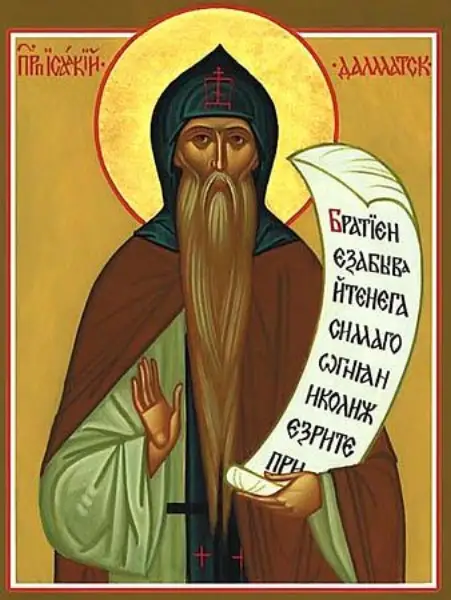
- Clothed as an Eastern monk·Scroll bearing a quotation from his hagiography·Paterissa (abbot's staff)
- Canonization
- Pre-congregation glorification; honored as a venerable confessor by both the Eastern Orthodox and Roman Catholic churches
Prayer
Bibliography
Show 1 sources
- Klein, Wilhelm; Dressler, Fritz (1994). St. Petersburg. Boston: APA Publications. p. 147. ISBN 9780395699720.
Profile text adapted from the Wikipedia article, licensed CC BY-SA 4.0.
Pray with this saint every day
Save St. Isaac of Dalmatia to your favorites, read the full profile, and get feast-day reminders in the Saints app.
Get the Saints AppFree on the App Store for iPhone and iPad