
1225 – 1270·Feast February 26
St. Isabelle of France
Capetian Princess and Foundress of Longchamp Abbey
Overview
Isabelle of France was a daughter of King Louis VIII and Blanche of Castile, born in Paris in March 1225, younger sister to Saint Louis IX and to Alfonso, Count of Poitiers, elder sister to Charles I of Sicily. Her widowed mother raised her her widowed mother, she learned Latin, delighted in devotional reading and the tales of chivalry, and took particular pleasure in embroidering priestly vestments. From childhood she sought spiritual direction and grew devoted to God under Franciscan guidance. Though betrothed by the Treaty of Vendôme to Hugh, heir of Lusignan, and later pressed to accept Conrad IV of Germany even by Pope Innocent IV, she refused every marriage out of a fixed resolve to keep her virginity, while never becoming a nun. In 1256 she brought into being the nunnery of Longchamp, set in the Forest of Rouvray west of Paris, composing for it, with Franciscan masters such as Bonaventure, a special Rule sanctioned by Pope Alexander IV in 1259 and revised under Urban IV in 1263. She retired there after her mother's death, lived in silence and poverty of spirit, supported her abbey and the poor, and died at Longchamp on 23 February 1270.
The Complete Life
A Daughter of the Capetians
Isabelle was born in Paris in March 1225, a daughter of King Louis VIII of France and Blanche of Castile, and thus a grandchild of Philip II through her father and of Alfonso VIII of Castile through her mother. Her father died when she was only two years old, and the task of raising her fell to her formidable mother, the regent Blanche, who personally oversaw her education. The princess proved an apt pupil: she learned to read both Latin and the vernacular, and her tastes ranged from the chivalric romances that entertained the court to books of devotion that fed her soul. Her needle, too, found consecrated uses, for while she practised the embroidery expected of royal women she took special delight in working on vestments for the priests at the altar. As a child she asked for spiritual direction, and under the guidance of the Franciscans her devotion deepened into a lifelong attachment to their order. Contemporary observers would judge her even more devoted to the Friars Minor than her celebrated brother, King Louis IX, and this early formation set the direction her whole life would follow.
§ Early life
The Refused Crowns
Royal daughters of the thirteenth century were instruments of diplomacy, and Isabelle's hand was sought early. Under the Treaty of Vendôme of March 1227 her hand was promised to Hugh, firstborn son and heir of Hugh X of Lusignan; the contract of marriage was drawn up and signed in June 1230. But the princess had other intentions: she refused ever to celebrate the wedding, holding with fixed determination to remain a virgin for the sake of the Kingdom of God, though she equally declined to become a nun, choosing a consecrated life lived in the world. Her resolve was tested by far greater prizes. Conrad IV of Germany, son of the Emperor Frederick II, sought her hand, and everyone pressed her to accept, even Pope Innocent IV himself; she refused him. In 1254 the same pope answered her perseverance with a gift better suited to her heart: by a papal bull of 26 May he allowed her to retain certain Franciscan friars as her special confessors, binding her still more closely to the order she loved. A princess who had declined a king's son and an emperor's crown had, in her own eyes, gained a far greater marriage.
§ Early life
The Founding of Longchamp
Isabelle's great enterprise was the foundation of a religious house for women after her own heart. Desiring a community of Sorores minores, Sisters minor, she inspired her brother King Louis IX to purchase in 1255 the ground needed in the Forest of Rouvray, a short distance from the Seine on the west side of Paris — the tract today called the Bois de Boulogne. On 10 June 1256 the foundation stone of the conventual church was set in place, the king himself taking part in the rite. The house received the name of the Convent of the Humility of the Blessed Virgin Mary; its sisters styled themselves the Humble Order of Servants of the Most Blessed Virgin Mary and lived under the authority of the Friars Minor, their first members drawn in part from the Poor Clare monastery at Reims. Unusually, the community was permitted to hold property. Isabelle did not simply endow the house: she composed its Rule herself, working with a team of Franciscan university masters that included Bonaventure, and Pope Alexander IV gave his sanction to this special Rule on 2 February 1259. A revision approved by Pope Urban IV on 27 July 1263 granted the nuns the preferred name of Sorores minores inclusae, the Enclosed Sisters minor of Longchamp.
§ Longchamp Abbey
Silence, Poverty and Separate Rooms
After the death of her mother, Isabelle withdrew to Longchamp, yet in a manner entirely her own: though she lived beside the community she had founded, she never actually joined it. Illnesses that troubled her throughout life prevented her from following the nuns' rule of life in its fullness, and as patroness and foundress she occupied a room separate from the sisters' cells. Declining the office of abbess, which was open to her, proved a deliberate choice of poverty: as a private woman she kept control of her wealth and resources, and so could continue to support her abbey and to give alms to the poor. Her days at Longchamp were shaped by a discipline of silence that she kept for most of each hour of the day, a queen's daughter living as a quiet neighbour to the Bride of Christ. The king her brother frequently visited her there, and the sisters saw in their living patron a model of humility set in the midst of royal splendour. In her person the cloister and the court met without either absorbing the other.
§ Longchamp Abbey
Death at Longchamp
Isabelle's final years were spent at the abbey whose every stone bore the mark of her will and her brother's generosity. She died at Longchamp on 23 February 1270, aged forty-four, a few months before her saintly brother Louis would set out on his last crusade and die before the walls of Tunis. She was buried in the abbey church she had raised in the forest, among the sisters who called themselves by the humble title her Rule had given them. Nine days after her burial her body was exhumed, and her hagiographies relate that it showed no sign of decay, while many miracles were reported at her grave, signs that the faithful around Paris had already concluded that a saint lay there. Her death closed a life that had refused three of the great vocations open to a Capetian princess, queenship in Lusignan or in Germany and the abbess's throne at her own foundation, and had chosen instead a path of virginity, silence and almsgiving that none of her rank had quite trodden before. She had lived to see her Rule sanctioned by two popes, her sisters settled in the silence of the forest, and the king her brother at the height of his reign, and she left behind a community that would guard her memory for five centuries.
§ Death
From Local Cult to Papal Honours
The Church moved slowly but surely toward Isabelle's official honours. The miracles at her tomb and the incorruption reported at the exhumation of 1270 grounded a lasting local cult at Longchamp, and in 1521 Pope Leo X gave the abbey the right to keep her feast with a special Office — the first papal recognition of her blessedness. Devotion continued to grow within the walls she had founded: on 4 June 1637 her body was exhumed a second time, and on 25 January 1688 the nuns secured the right to surround her feast with an octave, a liturgical embellishment marking the highest liturgical rank. Finally, in 1696, Pope Innocent XII allowed the whole Franciscan Order to keep her feast, assigning it to 31 August for the friars, while the abbey's own calendar kept 26 February, the anniversary of her death. Honoured as a virgin rather than a martyr, she entered the company of the Church's canonized saints more than four centuries after her death, and the Franciscans of France numbered her among the glories of the Second Order they served.
§ Religious veneration
The Abbey Destroyed, the Saint Remaining
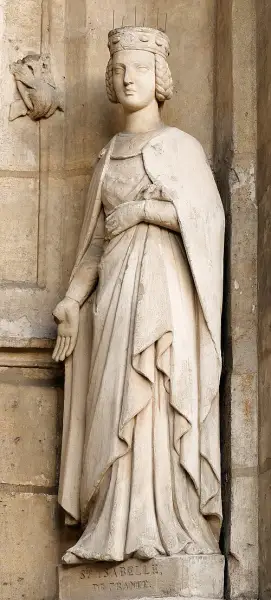
The house Isabelle founded outlived her by more than five centuries before falling to a violent age. Longchamp Abbey was suppressed in the French Revolution, and in 1794 its empty buildings were put up for sale; finding no purchaser, the revolutionaries destroyed them, and in 1857 what still stood was demolished, one tower alone spared, when the grounds were annexed to the Bois de Boulogne. Of the convent of humility only memory and that single tower survived. The saint, however, proved less perishable than her abbey. Her relics were translated to the Basilica of Saint-Denis, the burial church of the kings of France, so that the princess who refused a royal marriage came to rest among the royalty she had declined. Her image endured in the parish churches of Paris, where later copies of her statue, such as the Neo-Gothic figure at Saint-Germain l'Auxerrois, kept her before the faithful. Historians have returned to her as well: Agnes d'Harcourt, third prioress of Longchamp, wrote her Life in the thirteenth century, and modern scholars such as Sean L. Field have recovered the depth of her Franciscan identity and her authorship of the Longchamp Rule.
§ Religious veneration
Timeline
- Mar 1225
Is born in Paris, daughter of Louis VIII of France and Blanche of Castile
§ Early life
- Mar 1227
Is betrothed by the Treaty of Vendôme to Hugh, eldest son of Hugh X of Lusignan
§ Early life
- Jun 1230
The marriage contract with the Lusignan heir is signed
§ Early life
- 26 May 1254
Pope Innocent IV grants her a papal bull allowing certain Franciscan friars as her special confessors
§ Early life
- 1255
Her brother King Louis begins acquiring land in the Forest of Rouvray for her intended nunnery
§ Longchamp Abbey
- 10 Jun 1256
The first stone of the monastic church of Longchamp is laid
§ Longchamp Abbey
- 2 Feb 1259
Pope Alexander IV sanctions the special Rule composed for Longchamp by Isabelle and Franciscan university masters
§ Longchamp Abbey
- 27 Jul 1263
Pope Urban IV approves a revised Rule, granting the nuns the name Sorores minores inclusae
§ Longchamp Abbey
- 23 Feb 1270
Dies at Longchamp and is buried in the abbey church
§ Death
- 1521
Pope Leo X grants the abbey leave to keep her feast with its own special Office
§ Religious veneration
- 4 Jun 1637
Her body is exhumed for a second time at Longchamp
§ Religious veneration
- 25 Jan 1688
The nuns win leave to add an octave to her feast
§ Religious veneration
- 1696
Pope Innocent XII permits the whole Franciscan Order to celebrate her feast on 31 August
§ Religious veneration
The Record
- Major works
- The Rule of the Convent of the Humility of the Blessed Virgin Mary at Longchamp, composed with Franciscan masters including Bonaventure
- Patron of
- Patroness of the Sick·Poor Clares in France
- Canonization
- Beatified in 1521 by Pope Leo X; canonized in 1696 by Pope Innocent XII
Prayer
Bibliography
Show 5 sources
- Field, Sean L. (2006). Isabelle of France: Capetian Sanctity and Franciscan Identity in the Thirteenth Century. University of Notre Dame
- Bihl, Michael. "St. Isabel of France." The Catholic Encyclopedia, Vol. 8. New York: Robert Appleton Company, 1910
- Hallam, Elizabeth M (2014). Capetian France 987-1328. Taylor & Francis, p. 148
- Bouchard, Constance Brittain (1987). Sword, Miter, and Cloister: Nobility and the Church in Burgundy, 980-1198. Cornell University Press, p. 294
- Agnes d'Harcourt (third Prioress of Longchamp, 1263-1270), Vie de Madame Isabelle
Profile text adapted from the Wikipedia article, licensed CC BY-SA 4.0.
Pray with this saint every day
Save St. Isabelle of France to your favorites, read the full profile, and get feast-day reminders in the Saints app.
Get the Saints AppFree on the App Store for iPhone and iPad