
late 16th – early 17th century·Feast May 11
St. Isaiah of Onogošt
Hermit of the Ostrog rocks and pioneer of its holy mountain
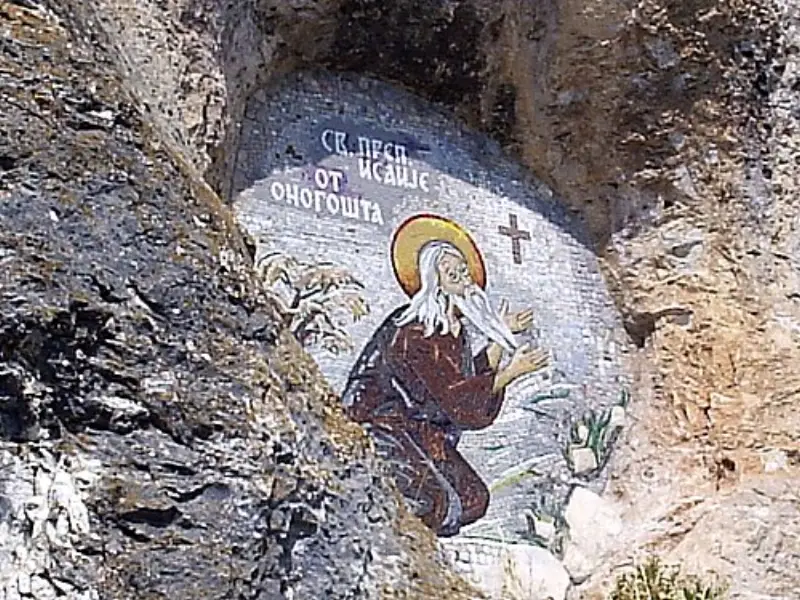
Overview
Isaiah of Onogošt, also remembered as Isaiah of Ostrog, was a monk and ascetic of the Serbian Church whose years fell between the close of the sixteenth century and the opening of the seventeenth, in the generation before the great monastery of Ostrog rose on the same rocks. His birthplace was Popi, a village beside Nikšić, in territory then ruled by the Ottomans, and as a monk he withdrew into the rocky highlands of Ostrog, most likely to escape the Ottoman occupation that pressed upon the lowland villages. There he took up dwelling in a cave where the Ostrog monastery would one day stand, the cliffs themselves serving as his cell. He raised a little church upon the rocks, giving it the patronage of the feast of the Theotokos's Entry into the Temple, and he kept there in prayer until his death. Turks later burned his relics at Planinica, on the road running between Ostrog and Nikšić, hoping to smother the veneration gathering around his memory. The attempt failed. Basil of Ostrog later chose the site of Isaiah's hermitage for his own monastery, while an inscription in the church of the Holy Cross there styles him our holy and venerable father, Isaiah from the village of Popi; and every year since 2015 a service has been celebrated in a chapel dedicated to him at Upper Ostrog.
The Complete Life
Fleeing to the Rocks
The record of Isaiah's life is meager, but its outline is clear enough to follow. His native place was Popi, a village in the district of Nikšić, in the lands the Serbs call Onogošt of old, at a time when the Ottoman Empire ruled the region. At some point he embraced the monastic life, and with it a decision that defined everything that followed: he withdrew into the rocky highlands of Ostrog, most likely to escape the Ottoman occupation that weighed on the villages below. The choice made him one of the first, and perhaps the first, to consecrate that cliff-face by monastic dwelling. On the site of what would later become the Ostrog monastery he found or made a cave, and there he lived as a hermit, his monastery being the rock itself. Yet he was not content with a dwelling alone. He put up a little church among the rocks and gave it for its patron the feast of the Theotokos's Entry into the Temple, a mystery that speaks of consecration, of a young life given wholly to God's house. In that chapel the hermit worshiped through his remaining years, a solitary priest of the high places above the Zeta plain.
§ Biography
Death in the Cave and Ashes at Planinica
Isaiah remained at his hermitage until his death, which came in the early seventeenth century among the rocks he had made his home; later tradition remembers him as having died at the site of the Ostrog monastery itself. He left no writings and founded no institution, and his end would have been invisible to history had it not been followed by something the Ottoman authorities could not ignore: the people began to venerate him as a saint. Pilgrimage to a holy monk's grave was a thing the occupation understood as a threat, and the response was characteristically brutal. Turks burned his relics at Planinica, a place between Ostrog and Nikšić, intending by fire to suppress the veneration that was growing around his name. It is a strange and terrible sequel to a hidden life, that a man who had fled into the cliffs to escape the Turks was pursued even into his relics by their fury. Yet the gesture, read from the other side, is testimony: no one burns the bones of a forgotten man. The fire at Planinica is the Ottoman Empire's own, unwilling attestation that the hermit of Ostrog was already numbered among the saints.
§ Biography
The Site He Hallowed
Isaiah's chief legacy is the ground itself. When Basil of Ostrog, the great seventeenth-century saint of Montenegro, sought a place for his monastery, he chose the very site of Isaiah's hermitage, and the Ostrog monastery, now among the most visited shrines in the Orthodox Balkans, stands on ground first hallowed by the earlier hermit's cave and church. The connection between the two men runs deeper still: Isaiah's grandson became a hieromonk at the new monastery, taking his grandfather's name in religion, so that the family of the saint furnished Ostrog with priesthood in the next generation. His memory was inscribed in stone at the church of the Holy Cross at Ostrog, where an inscription styles him our holy and venerable father, Isaiah of the village of Popi. In our own day his cult received formal liturgical expression: on May 11, 2015, a first liturgy in Saint Isaiah's honor was sung when a little chapel in his name was consecrated at the Upper Ostrog monastery; every year since, services in his memory have been kept there. The man whose relics were burned to end his veneration is now commemorated annually on the cliffs where he prayed.
§ Legacy
The Record
- Major works
- Church of the Entry of the Most Holy Theotokos into the Temple, Ostrog
- Patron of
- Monastics of Ostrog·Christians of the Nikšić region
- Symbols
- Vested as a monk·Shown praying in a kneeling position
- Canonization
- Pre-congregation veneration in the Eastern Orthodox Church; first liturgical service in his honor held on May 11, 2015
Prayer
Bibliography
Show 3 sources
- "Žitije svetog Isaije | Manastir Ostrog - Zvanični portal Manastira Ostrog". manastirostrog.com. Retrieved 2023-12-06.
- "Предавање у Духовном центру Светог Исаије од Оногошта у Никшићу | Српскa Православнa Црквa [Званични сајт]". 2018-11-16. Archived from the original on 2018-11-16. Retrieved 2023-12-06.
- "Prepodobni Isaija Ostroški molitveno proslavljen u Gornjem Ostrogu u paraklisu njemu posvećenom (video) | Manastir Ostrog". manastirostrog.com. Retrieved 2023-12-06.
Profile text adapted from the Wikipedia article, licensed CC BY-SA 4.0.
Pray with this saint every day
Save St. Isaiah of Onogošt to your favorites, read the full profile, and get feast-day reminders in the Saints app.
Get the Saints AppFree on the App Store for iPhone and iPad