
1062 – 1089/90·Feast May 15
St. Isaiah of Rostov
Missionary bishop who carried the gospel to pagan Rostov
Overview
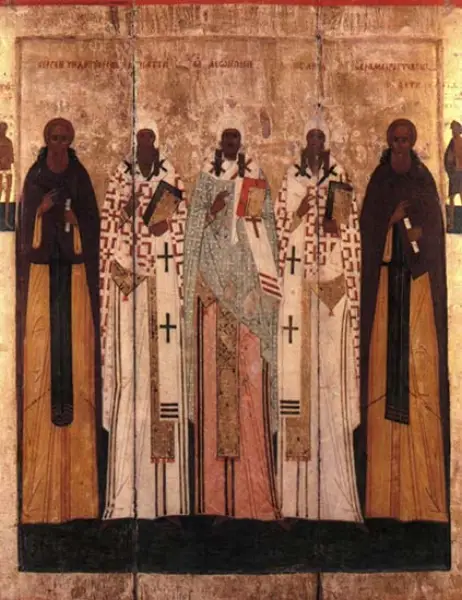
Isaiah of Rostov was a Russian Christian missionary and bishop whose episcopate fell in the generation when the faith was still taking root in the lands north-east of Kiev. Born near Kiev around 1062, he was tonsured at the Kiev Pechersk Lavra, the cradle of Russian monasticism, and was chosen by Prince Iziaslav I in 1062 for the newly instituted Demetrios (Saint Dmitry's) Monastery in the capital, where he became abbot. In 1077 the prince secured his appointment as the second bishop of Rostov, succeeding the martyr Leonty. Christianity was not yet firmly established in his vast and restive diocese, and Isaiah spent his tenure converting pagans, uprooting idolatry and encouraging the spread of the gospel. The Primary Chronicle mentions him twice: in 1088 he consecrated Saint Michael's church at Vydubitsy, and in 1089 he joined Metropolitan John in consecrating the Church of the Theotokos at Pechersk Lavra, an occasion medieval hagiographers embellished with a tale of miraculous flight from Rostov. The year and circumstances of his death are unknown. For more than a hundred years afterward no successor filled the see of Rostov. His relics, unearthed in 1162 or 1164, were re-interred in Rostov's new cathedral in 1474, the year of his canonization.
The Complete Life
From Kiev's Hills to the Caves
Isaiah's life begins, as do so many of the great Russian saints', in the neighborhood of Kiev, the mother city of Kievan Rus'. He was born near the capital in the middle of the eleventh century, in the years when the Christianity freshly received from Byzantium was spreading from the princely court into the monasteries and the countryside. As a young man he sought the strictest school of the new faith available: the Kiev Pechersk Lavra, the Monastery of the Caves, where Anthony and Theodosius had established the model of Russian monastic life. There Isaiah was tonsured, taking on the discipline of prayer, obedience and poverty that the Lavra's rule demanded. His abilities marked him out quickly. In 1062 Prince Iziaslav I of Kiev selected the young monk, along with Barlaam, for service at the newly instituted Demetrios Monastery, a princely foundation dedicated to Saint Dmitry and built to bring the prestige of the Caves into the capital itself. There Isaiah rose to be abbot, governing a community that stood at the intersection of princely patronage and monastic rigor. The first Life of Theodosius preserves this early chapter, and it remains the oldest witness to Isaiah's very existence.
§ Isaiah of Rostov
Called to Rostov
Isaiah's vocation as a bishop was forged at the meeting of two forces: the administrative needs of the young Russian church and the willingness of Pechersk monks to serve it. His abbacy at the Demetrios Monastery made him known to the prince's circle, and in 1077 Iziaslav I secured his appointment as bishop of Rostov, the second occupant of that see, succeeding Leonty of Rostov, the missionary bishop revered as a martyr. The succession was symbolic as much as administrative: Leonty had died preaching to the peoples of the Rostov land, and Isaiah inherited both his unfinished task and his unfinished field. Christianity in the north-east of Rus' was still an outpost faith, thin on the ground among a population that continued to honor its ancestral gods. Accepting Rostov meant leaving the capital's comfort and the abbacy he had earned for a hard frontier diocese. The medieval sources do not record his inner deliberations, but his subsequent record shows a bishop who took the missionary character of his office seriously. Isaiah's path from the caves of Kiev to the cathedral of Rostov traces the typical route by which the early Russian church staffed its frontier sees with the Lavra's best men.
§ Isaiah of Rostov
Converting the Rostov Land
Isaiah's episcopate was defined by the missionary struggle his predecessor had begun. The sources summarize it plainly: because the faith of Christ had not yet taken firm hold of the district, his years in office went to winning pagans for the gospel, tearing down idols and furthering its advance. Behind that compressed record lies a generation of patient, unglamorous work, preaching to villages whose loyalty to the old gods ran deep, dismantling the shrines and idols that anchored the old cult, and building up the faint infrastructure of a new church in a hostile country. The measure of how hard that field was comes a century later: after Isaiah's death the seat of the bishop of Rostov remained vacant for more than a hundred years, a fact that speaks both to the difficulty of the post and to the shortage of men willing to take it. Isaiah's own tenure, by contrast, endured, and the church he planted outlasted him. The chronicle's notices of his presence at consecrations in Kiev in 1088 and 1089 show a bishop still connected to the capital's church life even while serving the frontier. The hagiographic Life turned one such visit into a legend of miraculous flight from Rostov to Kiev and back, a marvel invented precisely because his historical presence there was well attested.
§ Isaiah of Rostov
Two Consecrations and an Unknown End
The last firmly dated events of Isaiah's life come not from Rostov but from Kiev, recorded in the Primary Chronicle. In 1088 he consecrated the church of Saint Michael at Vydubitsy, the monastery patronized by his old master Prince Iziaslav's family. In 1089 he stood with Metropolitan John himself to consecrate the great Church of the Theotokos at the Kiev Pechersk Lavra, the mother church of Russian monasticism, in which he had been tonsured a generation before. The medieval biographer who wrote the Life of Isaiah had almost nothing else to work with: those two chronicle notices, reproduced in his text, were effectively all the facts available to him, and he adorned the second with a tale of Isaiah traveling instantly by prayer from Rostov to Kiev and back. What the sources conspicuously do not give is the end of the story. The year and circumstances of Isaiah's death remain unknown; the date can be given only as a range, 1089 or 1090, which suggests he died not long after his last recorded appearance in the capital. He was buried at Rostov, where his memory endured alongside that of Leonty until the discovery of both bishops' relics in the twelfth century.
§ Isaiah of Rostov
Relics Found, Relics Raised
Isaiah's canonization belongs to the slow, consensus-based pattern of early Russian sanctity, confirmed centuries after his death. The turning point came in 1162, or by some accounts 1164, when the relics of Leonty and Isaiah were discovered at Rostov, an event that placed the second bishop of the see formally beside its martyred first bishop in the memory of the church. His cult, however, awaited a later institutional moment. In 1474 his relics were re-interred in the new cathedral of Rostov, and around this same year, which the sources identify as the year of his canonization, the first brief Life of Isaiah was compiled. The dating matters to historians: nineteenth-century scholars attributed that brief Life to thirteenth-century Rostov chroniclers, but contemporary researchers conclude it was actually put together around 1474, in connection with the canonization itself. A second and larger version of the Life exists as well, one that incorporates long quotations from earlier chronicles and scriptures but adds nothing to the bare biographical record. Thus the saint's official commemoration was built, characteristically for medieval Rus', not on new information but on the disciplined arrangement of old witnesses, with his relics raised into the cathedral that still housed them.
§ Isaiah of Rostov
A Bishop Remembered by His Vacant See
The strangest feature of Isaiah's legacy is an absence. After his death the seat of the bishop of Rostov stood empty for more than a century, a silence that testifies both to the harshness of the frontier he had served and to the difficulty of finding men of his stamina for it. His labor, however, had made the see worth refilling; the Christianization of the Rostov land, which he pursued by converting pagans and destroying idolatry, continued after him until the diocese flourished as one of the great churches of northern Rus'. His literary legacy is correspondingly spare but instructive. The first historical reference to him appears not in his own Life but in the Life of Theodosius of Kiev, and his two mentions in the Primary Chronicle provided the medieval biographer with nearly everything he knew. The two versions of the Life of Isaiah, brief and expanded, became a textbook case for Russian hagiographic scholarship, used to show how a saint's dossier grows by accretion of borrowed texts rather than new facts. In the church's memory the details matter less than the pattern: a monk of the Kiev caves who carried the gospel to the pagans of Rostov and, in 1474, was raised to the altars.
§ Isaiah of Rostov
Timeline
- 1062
Selected by Prince Iziaslav I of Kiev from the monks of Pechersk Lavra for the newly instituted Demetrios Monastery.
§ Isaiah of Rostov
- 1077
Succeeded Leonty of Rostov, taking office as the second bishop of the see of Rostov.
§ Isaiah of Rostov
- 1088
Consecrated Saint Michael's church in Vydubitsy, according to the Primary Chronicle.
§ Isaiah of Rostov
- 1089
Joined Metropolitan John in consecrating the Church of the Theotokos at Kiev Pechersk Lavra.
§ Isaiah of Rostov
- 1162
Relics of Bishops Leonty and Isaiah of Rostov discovered.
§ Isaiah of Rostov
- 1474
Relics re-interred in the new cathedral of Rostov; the brief Life of Isaiah was compiled around this year of canonization.
§ Isaiah of Rostov
The Record
- Major works
- Demetrios (Saint Dmitry's) Monastery, Kiev (as abbot)
- Patron of
- Missionaries to pagan peoples·Diocese of Rostov
- Canonization
- Canonized around 1474, when his relics were re-interred in the new cathedral of Rostov and his first Life was compiled
Prayer
Bibliography
Show 4 sources
- Gordon, Karen L. (1999). "Isaiah of Rostov". In Gerald H. Anderson (ed.). Biographical Dictionary of Christian Missions. Eerdmans Publishing. p. 321. ISBN 0-8028-4680-7.
- "Житие Феодосия Печерского" [Life of Theodosius]. Библиотека литературы Древней Руси / РАН. ИРЛИ (Library of old Russian literature, vol. 1, XI–XII века). СПб.: Наука, 1997. (in Russian)
- Kagan, M. D. "Житие Исайи, епископа Ростовского" [Life of Isaiah of Rostov]. Словарь книжников и книжности Древней Руси. Вып. 2 (вторая половина XIV – XVI в.). Ч. 1: А–К. Л.: Наука, 1988. (in Russian)
- "Исаия (епископ ростовский)". Русский биографический словарь. Т. 8: Ибак — Ключарев. 1897. p. 141. (in Russian)
Profile text adapted from the Wikipedia article, licensed CC BY-SA 4.0.
Pray with this saint every day
Save St. Isaiah of Rostov to your favorites, read the full profile, and get feast-day reminders in the Saints app.
Get the Saints AppFree on the App Store for iPhone and iPad