
died c. 456·Feast Not recorded in the source article
St. Iserninus
Early missionary bishop of Leinster with Patrick and Auxilius
Overview
Iserninus, also written Isernius, was an early Christian missionary of Ireland, remembered as a companion in the conversion of the island's south alongside Saint Patrick and Saint Auxilius. He died around the year 456 at Aghade, in Ireland, and is venerated in the Roman Catholic Church. Tradition holds that he was originally named Fith, that he was a Briton or an Irishman by origin, and that his ordination to the diaconate may have taken place at Auxerre, in company with Patrick and Auxilius, before the crossing to Ireland. The Annals of Ulster refer to him as a bishop and record that he began his mission in the year 439. According to Cardinal Patrick Francis Moran, Patrick assigned the valley of the Liffey jointly to Auxilius and Iserninus. Old Kilcullen's church is credited to Iserninus as founder, and tradition adds that Patrick consecrated him bishop there, possibly together with Saint Mactail; Kilcullen began as a monastic settlement around 448, sited near the royal ceremonial site of Dun Ailinne. A tradition at Aghade in County Carlow holds that he founded a church there as well and was later buried in it. Modern scholarship, following Charles Thomas, now tends to associate Iserninus, Secundinus and Auxilius not with Patrick but with Palladius, the first bishop of the Irish.
The Complete Life
Fith, the Man of Two Names
The earliest facts about Iserninus are already couched in the language of uncertainty. He is thought to have been either a Briton or an Irishman, a reminder of how fluid identity was in the missionary generation that carried Christianity from Roman Britain into Ireland. Tradition preserves that he bore a different name at first, Fith, and that his ordination as deacon may have taken place at Auxerre in Gaul, in the company of Patrick and Auxilius. If that tradition is right, his formation belonged to the great Gallican church that trained so many of Ireland's first bishops, and his later career in Ireland was the second act of a consecration made on the continent. The association with Auxerre is precisely the kind of detail modern historians scrutinize, since it ties Iserninus to the Patrick legend; more recent research, following Charles Thomas, prefers to link him with Palladius, the bishop sent to the Irish by Pope Celestine. Either way, the traditional picture presents him as a man ordained for mission before he ever reached his field, a deacon of Auxerre who became a bishop of the Irish, carrying his original name Fith into an island that would remember him instead as Iserninus.
§ Traditional view
A Bishop in the Annals
Whatever the uncertainties of his origins, Iserninus emerges in the written record with unusual clarity for a fifth-century figure. The Annals of Ulster refer to him as a bishop and record that he began his mission in the year 439, one of the earliest securely dated moments in the Christianization of Ireland. According to Cardinal Patrick Francis Moran's account in the Catholic Encyclopedia, Saint Patrick assigned the valley of the Liffey jointly to Auxilius and Iserninus, making the pair the first shepherds of the region around which much of Leinster Christianity would organize. The territorial language of the tradition matters: these were not itinerant preachers but bishops with assigned ground, planting the episcopal structure of the church in the island's southeast. Tradition further holds that at Old Kilcullen Iserninus was appointed bishop by Patrick himself, possibly together with Saint Mactail, giving him what would have been a formal share in the Irish episcopate. Whether the hand behind that appointment was Patrick's or Palladius's, as modern scholarship tends to argue, the outline remains: a bishop of the Liffey valley, at work in Leinster within a decade of his mission's beginning in 439.
§ Traditional view
Churches of the Liffey and the Barrow
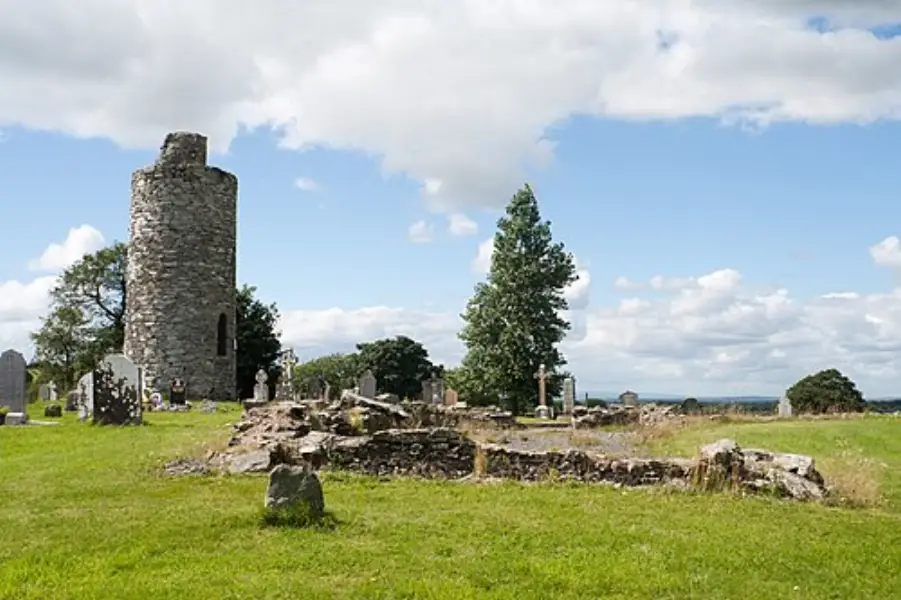
Iserninus's mission left concrete footprints in the church geography of Leinster. Old Kilcullen counts him as founder of its church, a foundation whose monastic settlement took shape in the period around 448. Picking that ground was likely no accident of chance: it lay near Dun Ailinne, the great ceremonial center associated with the kings of Leinster, and planting a church within sight of a royal sanctuary was a characteristically strategic act of early Irish evangelization, setting the new faith beside the old order of power. Kilcullen would grow into one of the notable ecclesiastical sites of the region, its memory preserved today in the remains of its church and round tower. A second tradition, kept at Aghade in County Carlow, holds that Iserninus founded a church there too and that he was later buried in it, which would make the village his last and most personal foundation. Together the two traditions sketch a missionary working the corridor between the Liffey valley assigned to him by the tradition of Patrick and the barrow country of Carlow, founding churches, gathering monastic communities and dying, around 456, in the parish he had planted for himself.
§ Modern studies
Patrick's Man or Palladius's?
Iserninus's afterlife in scholarship is a small lesson in how the study of early Ireland is written and rewritten. For centuries he stood securely in the orbit of Saint Patrick: Moran's nineteenth-century Catholic Encyclopedia article assigns him his mission ground from Patrick's own hand, and the tradition of his diaconate at Auxerre beside Patrick and Auxilius belongs to the same narrative. The historian Charles Thomas voiced the shift that has since gathered weight: by his account, scholarly opinion today leans toward linking Secundinus, Auxilius and Iserninus to Palladius instead of Patrick. On that reading, Iserninus belongs to the mission of the first bishop whom Rome itself sent to the Irish, and the church of Leinster looks back not to Armagh's famous apostle but to a lesser-known continental enterprise. His cult, meanwhile, has remained modest but continuous: he is venerated in the Roman Catholic Church, and his foundations at Old Kilcullen and Aghade kept his name alive in local tradition. David Dumville's studies of Auxilius, Iserninus, Secundinus and Benignus keep the question open, and the missionary bishop of the Liffey remains one of early Irish Christianity's productive mysteries.
§ Modern studies
Timeline
- 439
Began his Irish mission, according to the Annals of Ulster, which record him as a bishop.
§ Traditional view
- 448
Old Kilcullen began as a monastic settlement associated with his founding, near the royal site of Dun Ailinne.
§ Modern studies
- 456
Died at Aghade, County Carlow, where tradition says a church he founded became his burial place.
§ Modern studies
The Record
- Major works
- Church at Aghade, County Carlow·Church and monastic settlement at Old Kilcullen
- Patron of
- Early church of Leinster
- Canonization
- Pre-congregation veneration in the Roman Catholic Church as an early missionary bishop of Ireland
Prayer
Bibliography
Show 5 sources
- Moran, Patrick Francis Cardinal. "St. Patrick." The Catholic Encyclopedia. Vol. 11. New York: Robert Appleton Company, 1911.
- Thomas, Charles. Christianity in Roman Britain to AD 500. University of California Press, 1981. ISBN 9780520043923, p. 306.
- O'Leary, Edward. "Kildare and Leighlin." The Catholic Encyclopedia. Vol. 8. New York: Robert Appleton Company, 1910.
- Johnston, Susan; Wailes, Bernard (2007). Dún Ailinne: Excavations at an Irish Royal Site 1968–1975. Philadelphia: University Museum Publications. ISBN 978-1-931707-99-2.
- Dumville, David N. "Auxilius, Iserninus, Secundinus and Benignus." In Saint Patrick, AD 493-1993, ed. by David N. Dumville and Lesley Abrams. Studies in Celtic history 13. Woodbridge: Boydell, 1993. pp. 89–105. ISBN 0-85115-332-1.
Profile text adapted from the Wikipedia article, licensed CC BY-SA 4.0.
Pray with this saint every day
Save St. Iserninus to your favorites, read the full profile, and get feast-day reminders in the Saints app.
Get the Saints AppFree on the App Store for iPhone and iPad