
c. 1115 – 1204·Feast June 15
St. Isfrid of Ratzeburg
Premonstratensian provost and prince-bishop of Ratzeburg
Overview
Isfrid of Ratzeburg was a Premonstratensian canon regular who rose from provost of Jerichow to become the third bishop of Ratzeburg and its first prince-bishop, governing the frontier diocese on the Wends' borders in the last decades of the twelfth century. Born around 1115, he made his profession as a canon at the Cappenberg monastery in Westphalia; in 1159 he was named provost of Jerichow, where he completed the Romanesque collegiate church of Saint Mary and Saint Nicholas. In 1179 he succeeded Evermode of Ratzeburg as the diocese's third bishop, and from 1180 the episcopate was joined with secular rule over part of the diocese, making him prince-bishop. He was celebrated as an organizer who created many parishes, and his gifts served the wider order as well: he restored the monastery of Floreffe near Namur after it had been destroyed by fire, gathering back the canons who had scattered, and consecrated the collegiate church of Postel in Belgium. In the pages of the old Stederburg annals he shines with Christian wisdom, humility and fortitude; marvels, too, were credited to his life. He died on June 15, 1204, at Ratzeburg, and his memory is kept on that day, with an ancient cult at Osnabrück confirmed in 1725.
The Complete Life
A Canon of Cappenberg
Isfrid's formation began in Westphalia, at the monastery of Cappenberg, where he was a professed canon of the Premonstratensians. Cappenberg was one of the order's most storied houses in the German lands, a community of canons regular living the mixed life of contemplation and pastoral work that Norbert of Xanten had given the church, and it was within that discipline that the young Isfrid learned the combination of prayer, learning and administration that would mark his whole career. Born around 1115, he belonged to the generation that carried the young order through its second age, decades after its founding but long before its mature expansion across northern Europe. His gifts evidentlycommended him early, for his next appointment carried him east: in 1159 he was made provost of Jerichow, a Premonstratensian house in the lands east of the Elbe where German settlement and missionary work among the Wends went hand in hand. The move from Westphalia to the Elbe frontier placed Isfrid where the church's future in northern Germany was being decided, and it gave the provostship of Jerichow, with its unfinished great church, the man who would bring it to completion.
§ Religious life
Provost of Jerichow
As provost of Jerichow from 1159, Isfrid governed a community whose principal monument was still rising stone by stone. There he brought to completion the great Romanesque collegiate church honoring Saint Mary together with Saint Nicholas, a double-dedicated church that remains the landmark of Jerichow and one of the notable Romanesque buildings of northern Germany. The completion of so substantial a church was a work of years and of organization, the assembling of materials, craftsmen and funds on a frontier where all were scarce, and it displayed at scale the practical ability his contemporaries would later praise. The provostship also rooted him in the missionary geography of the east-Elbian church, where the Premonstratensians stood in the front rank of the work among the Slavic peoples. It was from this house, known to the order and to the hierarchy as a house well governed and now well built, that Isfrid was called in 1179 to the highest office of his life: the bishopric of Ratzeburg, where he would succeed the saintly Evermode, the second bishop of the see and a fellow Premonstratensian, as third bishop of a diocese still young and still contested.
§ Religious life
Organizer of a Frontier Diocese
Isfrid governed Ratzeburg for a quarter of a century, and the sources compress his achievement into a single telling phrase: his administrative gifts were famous, and across the diocese he established parish after parish. In a missionary diocese on the Wendish frontier, the creation of parishes was the structural work of evangelization itself, planting the parish network by which the faith moved from princely courts into villages, and Isfrid pursued it on a scale that earned him enduring recognition as the organizer of his church. His talents were called upon beyond his own diocese. When the Premonstratensian monastery of Floreffe, near Namur in the Low Countries, was destroyed by fire, Isfrid took responsibility for its restoration, and Arnold of Lübeck records that he succeeded in recalling all the canons who had been scattered in every direction over the previous year and a half, reassembling a broken community. His journey of service continued to the consecration of the collegiate church of Postel in Belgium, then under Floreffe's jurisdiction, binding the German and Netherlandish houses of the order together. The ancient annals of Stederburg summarize the man beneath the offices: exalted for Christian wisdom, humility and fortitude, with many miracles attributed to his life.
§ Religious life
Death on the Feast He Keeps
Isfrid's long episcopate closed at Ratzeburg, where he died on June 15, 1204, the very day on which his memory has been celebrated ever since. He had held the see since 1179, and from 1180 had held it in a new form: the see had been raised to princely rank, its bishop ruling over part of the territory in his own right; Isfrid was the first to hold it so, of the combined office, prince-bishop of Ratzeburg, a dignity he exercised until his death and handed on to his successor Philip of Ratzeburg. He left behind a diocese thickened with parishes, a completed church at Jerichow, a restored house at Floreffe and a consecrated church at Postel, a record of building and rebuilding rare among bishops of his generation. The miracles associated with his life continued to gather after his death, and his cult took hold most strongly in the diocese of Osnabrück, where he enjoyed an ancient and local veneration. He was depicted in art as a bishop with the two signs of his wonder-working charity, water that had turned into wine and a blind man restored to sight, images of a holiness that served the table and opened the eyes.
§ Religious life
An Ancient Cult Confirmed
Isfrid never received the formal canonization process of the later church; he belongs to the long company of bishops whose sanctity was acknowledged by the ancient practice of local cult. His veneration was strongest in the diocese of Osnabrück, where it was kept from early times, and it belonged likewise to the memory of his own Premonstratensian order, which numbered him among its saints alongside his predecessor Evermode. The decisive act came in 1725, when Pope Benedict XIII confirmed the ancient cult of Isfrid for the Order of Premonstratensians, giving papal recognition to a devotion that centuries of observance had already settled. Benedict XIII, himself a canonist with a special care for the recognition of historic cults, thus fixed Isfrid's feast in the calendar of the order for June 15, the day of the bishop's death at Ratzeburg in 1204. In the arrangement of his memory the medieval pattern is plainly visible: first the local veneration of a pastor beloved for wisdom, humility and fortitude, then the order's claim upon its own saint, and at last the Roman confirmation that transformed an old German devotion into a permanent liturgical commemoration for Premonstratensians everywhere.
§ Religious life
The Builder Bishop of the North
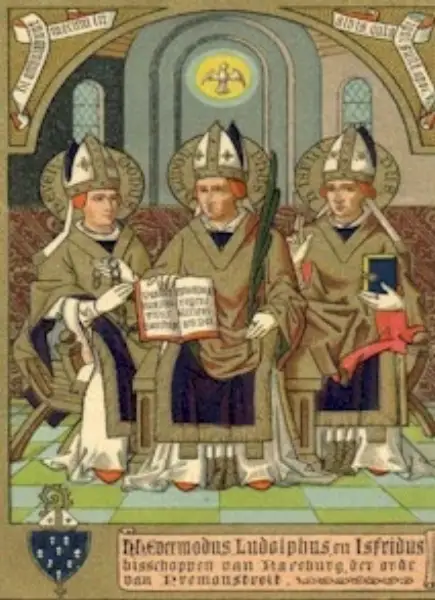
Isfrid's legacy is written most durably in stone and in parish boundaries. The Romanesque collegiate church of Saint Mary and Saint Nicholas at Jerichow, completed under his provostship, still stands as one of the masterpieces of brick Romanesque in northern Germany, the artistic fruit of the years he spent governing that house. The parishes he created across the diocese of Ratzeburg gave the frontier church the structure that let it survive the turbulent centuries after him, and his restoration of Floreffe preserved a house of the order that might otherwise have dissolved in the aftermath of its fire. Within the Premonstratensians he is remembered in the company of his predecessors and contemporaries, with his image set beside Saints Ludolph and Evermode in the order's iconography, a bishop marked out by the miracle of the water changed to wine and the healing of a blind man. The judgment of the Stederburg annalists, written close to his own time, has never needed revision: wisdom, humility and fortitude were the virtues of his government as well as of his soul. His cult at Osnabrück, confirmed by Pope Benedict XIII in 1725, keeps him in the calendar of the order each June 15, the feast of the builder bishop of the north.
§ Religious life
Timeline
- 1159
Appointed Provost of Jerichow, where he would bring the great Romanesque church honoring Mary and Saint Nicholas to completion.
§ Religious life
- 1179
Succeeded Evermode of Ratzeburg as the third bishop of Ratzeburg.
§ Religious life
- 1180
The see of Ratzeburg gained princely rank, joining his episcopate with secular rule over part of the diocese.
§ Religious life
- 15 Jun 1204
Died at Ratzeburg on the day his memory is now celebrated each year.
§ Religious life
- 1725
Pope Benedict XIII confirmed the ancient cult of Isfrid at Osnabrück for the Order of Premonstratensians.
§ Religious life
The Record
- Major works
- Collegiate church of St. Mary and St. Nicholas, Jerichow (completion)·Restoration of the monastery of Floreffe·Consecration of the collegiate church of Postel
- Patron of
- Order of Premonstratensians (cult confirmed to the order)
- Symbols
- Depicted as a bishop·Water turned into wine·A blind man he healed
- Canonization
- Ancient cult in the diocese of Osnabrück confirmed in 1725 by Pope Benedict XIII for the Order of Premonstratensians
Prayer
Bibliography
Show 4 sources
- "St. Isfrid (June 15) on Premontre". 6 February 2020.
- Odden, Per Einar. "Den hellige Isfrid av Ratzeburg (~1115-1204)". Den katolske kirke, March 22, 2009.
- "Saints and Beati of the Order". St. Philip's Priory, Order of Canons Regular of Prémontré.
- "Sant' Isfrido di Ratzeburg Vescovo". Santi e Beati, May 26, 2008.
Profile text adapted from the Wikipedia article, licensed CC BY-SA 4.0.
Pray with this saint every day
Save St. Isfrid of Ratzeburg to your favorites, read the full profile, and get feast-day reminders in the Saints app.
Get the Saints AppFree on the App Store for iPhone and iPad