
fl. 4th century, died before 365·Feast May 10
St. Isidora
Fool for Christ of the Tabenna monastery
Overview
Isidora of Tabenna was a fourth-century Egyptian nun counted among the earliest of the fools for Christ. Almost nothing is known of her origins, and nearly everything that survives comes from the Lausiac History, written in 419-420 by Palladius of Galatia. She entered the women's monastery at Tabenna in Egypt, the community founded near Pachomius's great house, where some four hundred sisters lived the common life. There Isidora made herself the least of the community: she wandered the kitchen doing the menial work, accepted the dirtiest jobs, wore a mere rag on her head in place of the veil, and was mocked by the other sisters as insane or possessed, so that they would not eat with her and sometimes beat her. She lived on crumbs and dishwater, never sat at table, and never answered insult with insult. The hermit Pitirim, told by an angel that a woman wearing a crown surpassed him in holiness, found her in the convent, saw the rag like a crown upon her forehead, and fell at her feet asking her blessing. Unable to bear the honor that followed, Isidora left the monastery and disappeared from history, dying, most scholars judge, no later than 365.
The Complete Life
An Unknown Woman of Egypt
Of Isidora's origins the record says almost nothing: her birthdate, her family, and even her birthplace are unknown, and the little that can be told of her belongs to the house she entered rather than the life she came from. She joined the monastery at Tabenna, or Tabennesi, in Egypt, the original house established by St. Pachomius sometime after 325. Before Pachomius, Egyptian monastics had lived alone as hermits and anchorites, each following a rule received individually from God; Pachomius, believing that monastics would support one another better in community, founded the first coenobitic house, with the guidance of the Holy Spirit and of his elder Palaemon. His sister Maria, aided by him, founded a companion house for women beside her brother's — Egypt's first full community for women — and it was in this tradition that Isidora took her place. The year of her arrival and her age at the time are alike unknown. Whatever brought her there, she came to a house of several hundred women, and it was within that great company that she chose the way of self-emptying that made her name endure.
§ Early life
The Monastery Sponge
Within the community at Tabenna, where some four hundred women lived and worked at the monastic life, Isidora remained a deliberate outsider. She was known to wander about the kitchen, absorbed in menial tasks, and the sisters called her the monastery's sponge, a name that honored nothing except her willingness to take the dirtiest work in the house. Though she was tonsured on entering, she refused even the outward dignity of her state: she covered her head with a rag — probably a dish towel from the kitchen — instead of the tonsure and cowl the other sisters wore. The costume was a sermon. In a monastery founded on the discipline of the common life, she made herself the servant of the pots and the crumbs, seeking the tasks no one else would claim and the appearance no one else would want, taking on herself the lowliness the Gospel blesses. Her vocation, as it came to be understood, was not the sought holiness of the Desert Fathers but the hidden kind, in which every mark of honor is renounced so completely that the world sees only folly.
§ The monastery at Tabenna
The Hermit and the Crown
The turning of Isidora's story came through a holy man who did not know her. St. Pitirim, a hermit of repute living in the desert during her years at the monastery, was at prayer one day when an angel appeared and rebuked his self-regard, asking whether he wished to see a woman more religious than himself, and sending him to the monastery of the Tabennesi women to find one wearing a crown on her head — a woman better than he, who though she contended with a great crowd had never let her heart depart from God. Pitirim came to the convent in search of the crowned woman, and when Isidora was brought before him, he perceived the rag on her forehead — some accounts say he saw an actual crown appear above her — and fell at her feet, asking her blessing. She fell before him in the same manner and asked whether he would bless her, Master. He declared her a spiritual leader, and the sisters, confronted with what they had done, confessed their abuses of her. The despised kitchen sponge stood revealed as the holiest soul in the house.
§ Meeting St. Pitirim
Feigned Madness, True Wisdom
To the community, Isidora's conduct seemed sheer madness, and by all accounts she maintained a pattern of behavior so erratic that the sisters judged her insane or possessed by a demon. Palladius writes that she feigned madness and possession, though he gives no examples of the pretense; what the record does give is her treatment and her answer to it. She was held in such contempt that the sisters would not eat with her — which, it was noted, she preferred — and she was sometimes beaten, cursed, and execrated. None of the four hundred ever saw her take a formal meal. Palladius records that she never sat at table, contenting herself with the crumbs she wiped from the boards and the dishwater of the pots she scrubbed, and that although cuffed and insulted, she never insulted anyone in return, never grumbled, and never spoke either little or much. Her model, consciously chosen, was the word of St. Paul, that whoever seems wise by the world's measure should become a fool to become truly wise. Inwardly, her suffering for the sake of that folly became an act of worship, seen by God alone.
§ Behavior
Flight and Silence
After Pitirim's departure, everything at Tabenna changed. The sisters who had beaten and shunned Isidora now begged her forgiveness and reverenced her as blessed, and the honor they pressed upon her was the one thing her vocation could not carry. Unable to bear the glory, and burdened beneath the weight of their apologies, she left the monastery. Then the record fails entirely. No story, no text, no tradition tells where she went, how she lived, or how she died; the woman who had hidden herself among the pots vanished a second time into an obscurity she had chosen and heaven confirmed, as though to seal the lesson beyond recall. Modern scholarship sets her death no later than the year 365. The silence of her ending is the last act of her sanctity: a life spent refusing to be seen ended by refusing to be found. The Desert Mothers and Fathers who treasured her story saw in that disappearance the completion of the lesson, that glory from men is nothing beside conduct seen by God, even when the self remains unknown to everyone but him.
§ Later life and death
A Saint of the Pre-congregation Age
The date and manner of Isidora's canonization are unknown. She lived long before the Sacred Congregation of Rites was founded by Pope Sixtus V in 1588, the body now known as the Congregation for the Causes of Saints, and whatever records were once made of her recognition have been lost, if they ever existed. Her sainthood belongs to the pre-congregation age, when those designated for veneration could be raised to the altars by a local bishop or primate on the ground of popular devotion, and it is almost certainly by that path — the devotion of the Egyptian church and of all who read Palladius — that she came to be honored as a saint. Her feast is kept on May 10 in the Eastern Orthodox Church and on May 1 in the Roman Catholic Church, and she is venerated in both communions, together with the Anglican tradition that remembers the desert saints. The title by which she is best known is drawn from her own manner of life: fool for Christ, the crown-wearer of Tabenna, whose foolishness confounded the wise of her monastery and of every age since.
§ Canonization
The First of the Fools
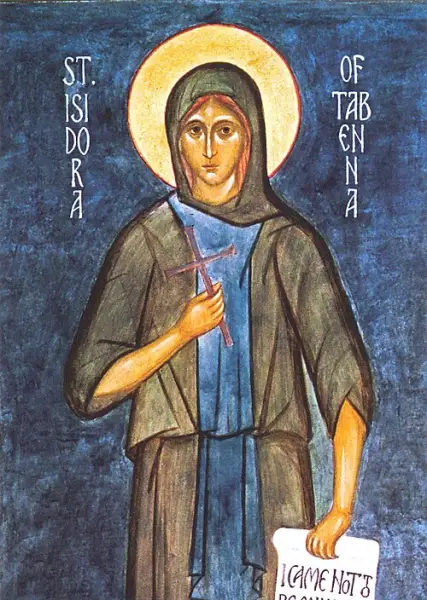
Isidora is considered among the earliest of the fools for Christ, the company of holy men and women who made themselves despised in imitation of the apostle's word, and her story holds a founding place in that tradition. Posterity owes her story to the Lausiac History, which Palladius of Galatia composed in 419-420 at the urging of Lausus, the chamberlain who served the emperor Theodosius II; other texts of the age also tell of her, but Palladius's account remains the one most often cited. For the Desert Fathers and Desert Mothers who recorded her, Isidora's life carried the ideal that mattered most in their world: that the praise of men weighs little beside conduct observed by God, even when the deeds, and the doer, remain unknown or misunderstood. Every later fool for Christ, from the streets of the Byzantine cities to the Russian hagiographies, walks in the way she first cleared in an Egyptian kitchen. Her icon shows her crowned, the rag of Tabenna transfigured into glory, a standing reminder that the judgment of a community is not the judgment of heaven.
§ Introduction
Timeline
- 325
St. Pachomius establishes the original monastery at Tabennesi sometime after this year, the community to which Isidora's convent was joined
§ Early life
- 365
By most modern estimates Isidora has died no later than this year, her end unrecorded after she left the monastery
§ Later life and death
- 419
Palladius of Galatia records Isidora's life in the Lausiac History, written in 419-420 for the chamberlain Lausus
§ Early life
In Their Own Words
She never sat at table, nor partook of a piece of bread, but wiping up the crumbs from the tables and washing the kitchen pots she was content with what she got in this way
Go to the monastery of the Tabennesi women and there you will find a woman wearing a crown on her head. She is better than you.
Whosoever of you believes that he is wise by the measure of this world, may he become a fool, so as to become truly wise.
The Record
- Symbols
- Fool for Christ
- Canonization
- Pre-congregation; canonization records lost, likely by local episcopal devotion
Prayer
Bibliography
Show 6 sources
- The Orthodox Church in America, Lives of the Saints.
- "1 Corinthians 3:18 Commentaries: Let no man deceive himself. If any man among you thinks that he is wise in this age, he must become foolish, so that he may become wise". biblehub.com. Retrieved 2024-09-23.
- Tertullian, Text of the Lausiac History, Chapter 34.
- Catholic Online, "St. Isidora".
- New Advent, Catholic Encyclopedia, "Canonization and Beatification".
- "www.synaxaristis - ΜΕΓΑΣ ΣΥΝΑΞΑΡΙΣΤΗΣ". www.synaxarion.gr. Retrieved 2024-09-23.
Profile text adapted from the Wikipedia article, licensed CC BY-SA 4.0.
Pray with this saint every day
Save St. Isidora to your favorites, read the full profile, and get feast-day reminders in the Saints app.
Get the Saints AppFree on the App Store for iPhone and iPad