
died 251·Feast May 14
St. Isidore of Chios
Egyptian soldier-martyr of the island of Chios
Overview
Isidore of Chios was an Egyptian Christian soldier serving as an officer in the Roman navy who laid down his life for the faith on Chios in 251, a victim of the persecution Emperor Decius had ordered. Stationed with the fleet in the Aegean, he declared his Christian faith without reserve before the fleet's commander as the ships lay anchored off Chios. Refusing the demanded repentance and sacrifice to the gods of the state, he was subjected to torment and finally beheaded, his body being thrown into a cistern. Tradition holds that his friends Ammonius and Myrope, themselves destined for martyrdom, recovered the body and buried it with honour; Myrope was afterwards laid beside him, and their grave became a place of reported healing. A chapel was raised there, and in the fifth century a church, which may survive in ruins within the town of Chios. His cult spread across the whole Mediterranean, and sailors adopted him as their protector. In 1125 his remains were translated from Chios to the Basilica of St Mark in Venice, where a side chapel still guards his sarcophagus.
The Complete Life
An Egyptian Officer of the Roman Fleet
Isidore came from Egypt, and tradition points to Alexandria as his native city, though the earliest accounts preserve his origins only in outline. What is certain in the memory of the Church is that he served as an officer in the Roman navy, a career that carried him across the eastern Mediterranean in the service of an empire still ruled by pagan law. He was a Christian at a time when the faith, though spreading through every province, had no protection from the state, and when the loyalty of a soldier to the emperor could be tested at any moment by a demand for sacrifice to the Roman gods. The year 251 brought such a test to every Christian in imperial service: Decius, newly emperor, ordered a general persecution intended to compel all subjects to perform public acts of worship to the traditional gods. For a serving officer of the fleet this demand could not be avoided or deferred; refusal meant disgrace, torture, and death. Isidore's posting brought him to the Aegean island of Chios, and it was there, among the ships, that his profession of faith would be put to the proof.
§ Life and martyrdom
Confession Before the Commander
The accounts of Isidore's passion exist in several versions, written chiefly with hagiographic intent, yet all agree on the decisive scene: while the fleet lay at Chios, the Egyptian officer did not conceal his religion but confessed himself a Christian directly to the commander of the fleet. In the atmosphere of the Decian persecution this was a sentence of death spoken by the accused against himself. The commander required repentance — that is, a public renunciation of Christ and compliance with the state cults — and Isidore refused. Worship of the gods of the state was the price of pardon, and he would not pay it. His refusal was answered first with torment: the accounts record that he was tortured in the effort to break him, and that the tortures failed to move him. The penalty for his constancy was finally beheading, and his executioners, following the customary contempt for the bodies of the condemned, cast his corpse into a cistern. One beloved legend attaches itself to this moment: the trees covering the island's southern shore were said to weep for the murdered soldier, and from this grief came the mastic still gathered on Chios to the present day.
§ Life and martyrdom
Friends Who Buried the Martyr
The body of Isidore did not remain dishonoured in the cistern. According to the tradition, two friends of the martyr, Ammonius and Myrope, risked their own lives to retrieve the remains and give them burial in due form. Both of these friends were themselves destined for martyrdom, and the story of the little community that gathered around Isidore's grave is one of shared witness. Myrope, after her own death, was laid to rest beside the martyr she had honoured, and at their shared grave the faithful began to report miraculous recoveries from sickness. The reports drew pilgrims, and a chapel was built upon the spot. In the fifth century the chapel was replaced by a church, an act associated with Saint Marcian; a few ruins still visible in the town of Chios may belong to this very structure. From that island shrine the veneration of the martyr travelled with the ships of the Mediterranean world, until Isidore was honoured in ports and cities across the whole sea, and sailors above all claimed him as their guardian and protector in danger.
§ Life and martyrdom
From Chios to the Basilica of St Mark
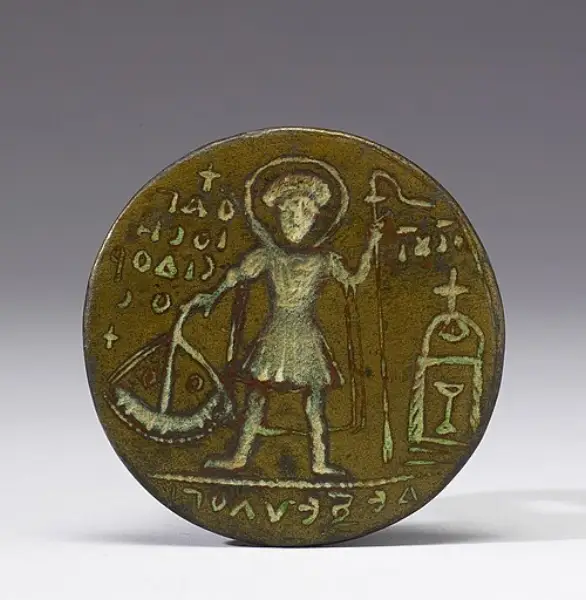
The cult of Isidore of Chios endured across the centuries and across the whole Mediterranean basin, carried especially by those who earned their living upon the sea. His feast is kept on May 14, and at Mollerussa, in Catalonia, he is honoured as patron. The most notable event in the later history of his relics came in 1125, when his remains were brought from Chios to Venice and installed in the Basilica of St Mark, the great ducal church of the Venetian republic whose own life was bound to the sea. There a small chapel within the basilica received the martyr's sarcophagus, where it remains to this day, linking the Venetian church to an Egyptian officer who died under Decius. Byzantine pilgrims of the sixth century carried tokens bearing his image, evidence of the devotion he commanded in the East. The memory of his passion, preserved in several hagiographic versions, keeps alive the figure of a soldier who chose the losing side of an imperial persecution and thereby won the quiet and lasting victory that outlasted the empire that had condemned him to die.
§ Life and martyrdom
Timeline
- 251
Beheaded on Chios for confessing Christ before the fleet's commander during the Decian persecution; his body was cast into a cistern.
§ Life and martyrdom
- 1125
His relics were conveyed from Chios to Venice's Basilica of St Mark, where a modest chapel shelters the sarcophagus.
§ Life and martyrdom
The Record
- Patron of
- patron of sailors·patron of Mollerussa
- Canonization
- Pre-congregation martyr, venerated since antiquity in East and West
Prayer
Bibliography
Show 3 sources
- Ὁ Ἅγιος Ἰσίδωρος ὁ Μάρτυρας ἐν Χίῳ, ΜΕΓΑΣ ΣΥΝΑΞΑΡΙΣΤΗΣ (in Greek).
- Victoria Finlay, Color.
- The Basilica of St. Mark in Venice, edited by Ettore Vio (1999).
Profile text adapted from the Wikipedia article, licensed CC BY-SA 4.0.
Pray with this saint every day
Save St. Isidore of Chios to your favorites, read the full profile, and get feast-day reminders in the Saints app.
Get the Saints AppFree on the App Store for iPhone and iPad