
c. 370 – c. 450·Feast February 4
St. Isidore of Pelusium
Ascetic abbot and master of the spiritual letter
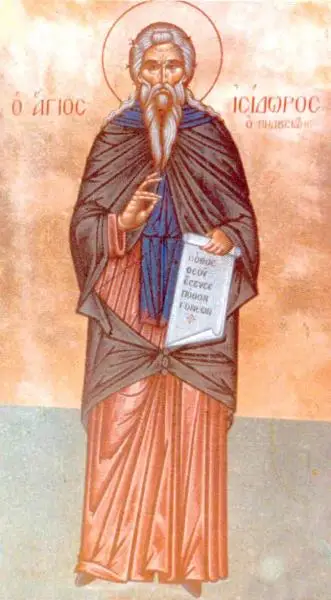
Overview
Isidore of Pelusium, born around 370 in Alexandria to a prominent family related to Archbishop Theophilus, became one of the most prolific correspondents of the ancient Church. Though trained in Scripture and outstanding in Greek, he fled Alexandria by night when he learned that its people and bishops intended to make him Patriarch of Alexandria, and became a monk near Pelusium, in the tradition of the Desert Fathers. His exactitude in observance and his austerities soon drew notice, and his correspondence suggests that he served as abbot. After seeing and hearing John Chrysostom at Constantinople, he took the great preacher as his model and devoted himself to Christian preaching, though he judged good works more important than eloquence. He supported Chrysostom in his persecution by Empress Eudoxia and Theophilus, and mentored Cyril of Alexandria, whom he rebuked for refusing to restore Chrysostom's name to the diptychs. Through his initiative the Third Ecumenical Council was convened at Ephesus in 431, where Nestorianism was condemned. He died around 450, leaving more than two thousand letters, a treasury of dogma, discipline, and moral guidance.
The Complete Life
A Son of Alexandria
Isidore was born around the year 370 at Alexandria, the great intellectual capital of Egyptian Christianity, into a prominent family of the city. He was an only child, and his relatives included Theophilus, who held the archbishopric of Alexandria — a connection that placed the boy close to the summit of ecclesiastical power in Egypt from his earliest years. His parents gave him a careful formation in the books of the church and in the Greek language, and in both he excelled, acquiring the learning that would later flow through his immense correspondence. Alongside his education, his biographers record the qualities of temperament that shaped his course: he was from youth both ascetic and humble, disposed to self-denial rather than advancement. The Egypt of his childhood was the land of the Desert Fathers, where monasticism had transformed the religious landscape, and its ideal of withdrawal from the world for the sake of prayer was the natural horizon for a young man of his disposition. Alexandria offered him every worldly and ecclesiastical prospect; the desert and the mountain offered him God, and his heart inclined to the latter.
§ Life
Flight by Night to Pelusium
The decisive turn of Isidore's life came with news that Alexandria's populace and clergy intended to place him upon the patriarchal throne — the highest office in the Egyptian Church, and one for which his family connection to Theophilus marked him out. Rather than accept, he took flight by night and made his way to Pelusium, a city on the eastern edge of the Nile delta, and became a monk in a monastery on a mountain near it, following the tradition of the Desert Fathers. In the monastic life his gifts found their true theatre: Word spread quickly through the desert of the strictness of his observance and the harshness of the penances he undertook upon himself. His abilities could not remain wholly hidden, however. A passage in his voluminous correspondence gives reason to believe that in time he held the office of abbot, governing the very kind of community he had entered as a fugitive from honour. The man whom Alexandria had wanted for its archbishop became instead a spiritual master of the desert edge, ruling monks rather than dioceses.
§ Life
Chrysostom, Cyril, and the Council of Ephesus
Isidore's horizons were never limited to his monastery. On a journey to Constantinople he managed to see and hear John Chrysostom, whose preaching had made him the most celebrated voice of the Eastern Church, and he took the golden-mouthed patriarch as his model, devoting himself thereafter primarily to Christian preaching. When Chrysostom was persecuted by the empress Eudoxia and by Pope Theophilus of Alexandria — Isidore's own relative — his friendship proved steadfast, and he supported him in his affliction. The same fidelity later required harder words closer to home: after Chrysostom's deposition at the Synod of Oak in 403, his name had been struck from the diptychs of the Alexandrian Church, and Cyril, Isidore's former pupil among the bishops, refused to restore it. Isidore wrote rebuking him, urging that the living Church not be made the instrument of private vengeance owed to the dead, and Cyril in the end consented to the restoration. Isidore also stood among the mentors of Cyril and other bishops during the years before the Nestorian controversy, and through his initiative the Third Ecumenical Council was convened at Ephesus in 431, where Nestorianism was condemned.
§ Life
A Discipline Measured to the Soul
Isidore's advice on the formation of those embracing the monastic state reveals a spiritual teacher of remarkable balance. Newcomers to the cloister, he counselled, must not be confronted at once with the full severity of the rule, which would only drive them away; yet idleness and exemption from daily work would breed sloth; the wise guide advances souls gradually toward perfection. Fasting of extraordinary rigor profits nothing, he warned, where the senses themselves are not subdued. His counsel took concrete form: where possible the monk should wear garments of skin and eat herbs, unless frailty of body demanded richer fare. His correspondence reached beyond the cloister into the life of the laity: in a letter to Tuba he argued that a soldier has no business walking the streets of a peaceful city with a sword or to appear in public bearing arms and military uniform. In all of this he joined the desert's rigour with a pastor's discrimination, weighing every discipline and every denial against the real capacity of the individual soul that stood before him, so that neither indulgence nor despair should have the last word.
§ Letters
Eighty Years and a Vast Correspondence
Isidore lived through the greater part of two centuries, dying in Egypt around the year 450 at about eighty years of age. His last decades spanned the fall of Chrysostom, the episcopate of Cyril, and the council that condemned Nestorius, in all of which he had played his part from the mountain above Pelusium. According to the historian Nicephorus his pen produced upwards of ten thousand letters — now rebuking one correspondent, now counselling another, now comforting a third, now schooling a fourth — a ministry conducted entirely through the post, reaching emperors such as Theodosius II, patriarchs, monks, and laymen of every class and condition. Of these, the monks of Constantinople's so-called Sleepless monastery gathered two thousand into one collection in antiquity, which has reached us in several manuscripts, each item numbered and set in order; other letters, never yet published, survive in Syriac dress. He died, as he had lived, a monk of the Egyptian desert edge — honoured locally and then universally, and remembered chiefly not for offices held but for words written: short, sharp, and salutary extracts, often no more than a sentence or two in length.
§ Letters
A Saint of the Undivided Church
Isidore was never subjected to any process of canonization, for he belonged to the generation of the fathers whose sanctity the Church recognised by universal and immemorial observance. He is revered as a saint, with his feast kept on February 4, in the Catholic Church, the Eastern Orthodox Church, the Eastern Catholic Churches, and the Oriental Orthodox Churches alike — a full communion of East and West in his honour. The Coptic Church of his native Egypt keeps his memory in its own calendar of monks and ascetics. Serbian Orthodox tradition likewise celebrates him as our holy father Isidore of Pelusium. No relics, shrine, or canonizing decree are recorded in the sources that transmit his life; the veneration that gathered around him attached instead to his writings, which were copied, collected, and read in monasteries long after his death. In this he represents a class of saints the modern Church rarely produces: those canonized not by a congregation of causes but by the continuous judgement of centuries, who are counted holy because their words proved, in the experience of generations of readers, to lead souls to God.
§ Life
The Letters That Survived
Isidore's only extant work is the great collection of extracts from his correspondence, more than two thousand letters, sorted by theme into three groups: dogma and Scripture on one side; ecclesiastical and monastic discipline on another; and practical moral counsel addressed to laypeople of every rank and walk of life. Among them are passages of real value for interpreting the Greek Scriptures. Volume 78 of the Patrologia Graeca carries the printed collection, Greek with a Latin version on facing pages — though the sequence of the letters there is unfortunately wrong. In 1995 Pierre Evieux published a monograph on Isidore and his writings, and he then prepared the second half of the corpus, whose disorder was gravest, for the Sources Chrétiennes, appearing in 1997 and 2000, supplying a concordance that links the original numbering with the Patrologia Graeca's; the rest of the letters still await both a critical edition and rendering into any modern tongue. The Syriac world preserved a collection of 126 letters in translation, and Severus of Antioch cited several letters in his Contra Grammaticum with high praise — evidence of the reach of this desert correspondent.
§ Letters
Timeline
- 370
Born in Alexandria to a prominent family; a relative of Theophilus, Archbishop of Alexandria.
§ Life
- 403
John Chrysostom was deposed at the Synod of Oak, and his name was removed from the diptychs of the Alexandrian Church.
§ Letters
- 431
Through Isidore's initiative, the Third Ecumenical Council was convened at Ephesus, at which Nestorianism was condemned.
§ Life
- 450
Died in Egypt at about eighty years of age, leaving a vast correspondence of letters.
§ Life
- 1997
Pierre Evieux published a critical edition of the second half of the letter collection, where the ancient disarrangement was most serious, in the Sources Chrétiennes series.
§ Letters
In Their Own Words
It is more important to be proficient in good works than in golden-tongued preaching
Stop these contentious arguments. Refrain from involving the living Church in your own private vengeance that is prosecuted out of a sense of duty to the dead.
The Record
- Major works
- Collection of more than 2,000 letters (Patrologia Graeca vol. 78), treating dogma, Scripture, ecclesiastical and monastic discipline, and practical morality
- Canonization
- Pre-congregation saint, venerated in the Eastern Orthodox, Oriental Orthodox, Eastern Catholic, and Catholic Churches
Prayer
Bibliography
Show 6 sources
- Pierre Evieux, Isidore de Peluse, 1995.
- C. H. Turner, "The Letters of Isidore of Pelusium", Journal of Theological Studies 6 (1905).
- "Venerable Isidore of Pelusium", oca.org. Retrieved 2018-03-17.
- Butler, Alban. Lives of the Saints, Vol. II, 1886.
- R. L. Wilken, Judaism and the Early Christian Mind, p. 50.
- Brock, Sebastian P.; Butts, Aaron M.; Kiraz, George A.; Van Rompay, Lucas (2011). Gorgias Encyclopedic Dictionary of the Syriac Heritage. Beth Mardutho: 219. ISBN 9781593337148.
Profile text adapted from the Wikipedia article, licensed CC BY-SA 4.0.
Pray with this saint every day
Save St. Isidore of Pelusium to your favorites, read the full profile, and get feast-day reminders in the Saints app.
Get the Saints AppFree on the App Store for iPhone and iPad