
c. 560 – 4 April 636·Feast April 4
St. Isidore of Seville
Last scholar of the ancient world, Archbishop of Seville
Overview
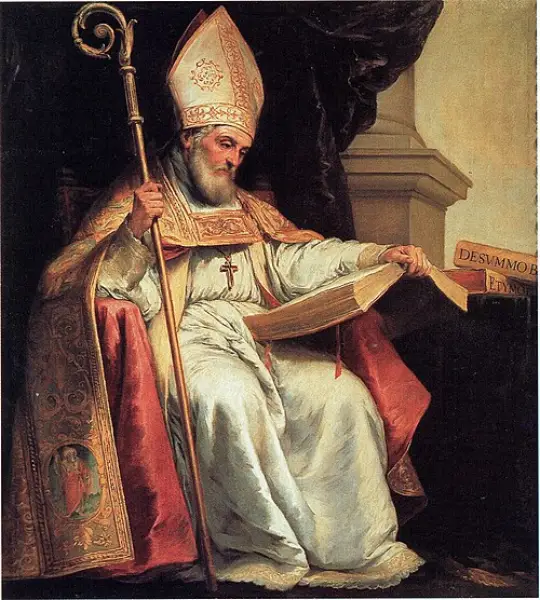
Isidore of Seville (c. 560 – 4 April 636) combined the offices of scholar, theologian, and archbishop of Seville; the historian Montalembert judged him the last scholar of the ancient world. Born at Cartago Spartaria into a notable Roman Hispanian family, he belonged to a household of saints: his brother Leander preceded him as archbishop of Seville, his brother Fulgentius was Bishop of Astigi, and his sister Florentina was a nun. Educated at the cathedral school of Seville, he mastered classical Latin and acquired Greek and Hebrew. Succeeding Leander around 600 or 601, he made himself the protector of monks, worked to weld Roman and Gothic peoples into a united Catholic nation, helped convert the Arian Visigothic kings, and presided over the Second Council of Seville in 619 and the Fourth Council of Toledo in 633, which ordered seminaries in every cathedral city. His fame rests chiefly on the Etymologiae, an encyclopedia of 448 chapters in twenty books that preserved much of classical learning from extinction. After upwards of thirty-two years governing the see he passed away in 636; in 1722 the Church ranked him among her Doctors.
The Complete Life
A Family of Saints in a Falling World
Isidore was born around 560 at Cartago Spartaria, modern Cartagena in Spain, a former Carthaginian colony, to Severianus and Theodora, members of a notable Hispano-Roman family of high social rank. His house stood at the centre of the political-religious manoeuvring that would eventually convert the Visigothic kings from Arianism to Catholicism, and the Church now honours all his siblings as saints. His elder brother Leander, who immediately preceded him as Archbishop of Seville, opposed King Liuvigild during his episcopate; his younger brother Fulgentius served as Bishop of Astigi under the Christian king Reccared; and his sister Florentina was a nun said to have ruled over forty convents and a thousand consecrated religious — a claim later writers have doubted, given how few functioning monasteries existed in Spania of that day. Isidore received his elementary education at the cathedral school of Seville, the first institution of its kind in Spania, where a body of learned men including Archbishop Leander taught the trivium and quadrivium. He applied himself so diligently that he quickly mastered classical Latin and acquired some Greek and Hebrew, the linguistic foundation of all his later writing.
§ Childhood and education
Successor of Leander at Seville
Whether Isidore ever personally embraced monastic life or joined a religious order scholars may debate, but he esteemed monks highly, and the episcopate to which he was called became a life of discipline administered to others. When his brother Leander passed away on 13 March 600 or 601, the See of Seville passed to Isidore; no sooner was he consecrated than he took the monks under his protection, a stance he would enforce with a formal anathema in 619 against any ecclesiastic who in any way molested the monasteries. He recognised that the spiritual and material welfare of his people depended on the assimilation of the remnant Roman culture and the ruling barbarian one, and his aim was to fuse the several peoples and cultures of the Visigothic realm into one nation, and toward that end he marshalled every religious instrument available. In this he succeeded. He practically eradicated the lingering heresy of Arianism among the Goths and completely stifled the new heresy of the Acephali at its outset, while strengthening religious discipline throughout his see. The schooling movement that radiated from Seville drew its life from his own zealous mind, and Aristotle was made known to his countrymen through him generations before Arab scholars took up Greek philosophy in earnest.
§ Bishop of Seville
Councils of Seville and Toledo
Isidore's influence as a churchman was exercised above all in council. In the reign of King Sisebut, whose inner circle he frequented, he took the chair at the Second Council of Seville, which opened on 13 November 619, a provincial assembly joined by eight bishops of Baetica whose Acts expound the full doctrine of Christ in answer to the notions of Gregory, a Syrian voice of the Acephali. Around 624 he presided over a further provincial council, known from canons preserved in the Pseudo-Isidorian Decretals, which dealt with the conflict over the See of Écija — where bishop Martianus was wrongfully stripped of his see, a wrong later rectified by the Fourth Council of Toledo — and weighed the grievances of Jews compelled into Christian baptism. His crowning labour in this field came at the Fourth National Council of Toledo, begun on 5 December 633 and attended by all the bishops of Hispania. The aged archbishop presided over its deliberations and originated most of its enactments. Through his influence the council commanded every bishop to establish seminaries in his cathedral city on the model of Seville's own school, prescribing Greek, Hebrew, and the liberal arts, and encouraging the study of law and medicine — a policy made obligatory throughout the Visigothic kingdom.
§ Fourth National Council of Toledo
The Closing Years of a Long Episcopate
Isidore governed the see of Seville for more than thirty-two years, dying on 4 April 636. By the time of the great council of 633 he was already described as aged, and his final years belong to the gathering shadow of the world he had laboured to preserve: under two hundred years of Gothic dominion the old institutions, the classical inheritance, and Roman manners had been fading away across Iberia, and even his lucid, unadorned Latin bears the imprint of Visigothic usage. Yet his energies did not slacken. To the Fourth Council of Toledo he contributed two decisions concerning the Jews of the kingdom: one canon ordered children taken from Crypto-Jewish parents to be brought up by Christians, on the presumption that their baptism had been granted under false pretences; the other, Canon 65, is understood to bar Jews, and Christians of Jewish descent, from public office — decisions that modern readers weigh against the generosity of his encyclopedic mind. He died at Hispalis, in the Visigothic kingdom, in 636, and was buried at Seville, where for Mozarab Christians in the centuries following the Arab conquest his grave stood as a chief object of devotion.
§ Death
Ornament of the Church and Doctor of the Church
Isidore's sanctity and learning were honoured by the Church within a generation of his death. The Eighth Council of Toledo, held in 653, recorded its admiration in glowing terms, hailing him as an extraordinary doctor, the crowning ornament of the Catholic Church, the man whom learning had most enriched among the age's closing generations, one whose name should always be uttered with reverence; the Fifteenth Council of Toledo, meeting in 688, gave its approval to these words. His friend and contemporary Braulio of Zaragoza credited him with a providential mission: amid so much ruin and calamity, God had raised up this one man to rebuild the monuments of the ancients and keep his people from plunging wholly into barbarism. His canonization belongs to the pre-congregational age of the Church, the recognition of his cult preceding any formal process. In 1722 Pope Innocent XIII proclaimed him a Doctor of the Church, ranking his teaching with that of the great doctors of East and West. His liturgical commemoration is kept on 4 April in both the older and the Byzantine uses of the Roman Rite, on 22 December in the Mozarabic Rite of his native land, and on 15 December at León, which keeps the feast of the translation of his relics.
§ Veneration
From the Etymologiae to the Relics of León
The Etymologiae, Isidore's masterpiece, was the first summa of universal knowledge attempted by a Christian writer: an epitome of 448 chapters in twenty volumes in which he digested the handbooks, miscellanies, and compendia of Roman learning. In the process he preserved countless fragments of antiquity that would otherwise have been hopelessly lost, though, as his translator Katherine Nell MacFarlane remarks, he contributed little more than the mortar connecting excerpts from other authors. its reputation was immense — Braulio pronounced it to hold practically all knowledge worth having — and its very success displaced individual classics from the copying shops, so that they perished. No compendium was more at home in the libraries of the Middle Ages; at least ten printings appeared between 1470 and 1530; and its practice did much to settle how the full stop, comma, and colon were used. In the middle of the eleventh century, Ferdinand I of León and Castile received the saint's remains from Abbad II al-Mu'tadid of Seville as part of a tribute arrangement, and reinterred them in the then-recently constructed Basilica of San Isidoro in León; today many of his bones rest in the cathedral of Murcia. His name has been given to St. Isidore Island in Antarctica.
§ Etymologiae
Timeline
- 560
Born at Cartago Spartaria (now Cartagena) in Roman Hispania, to Severianus and Theodora, a family of high social rank.
§ Childhood and education
- 600
His brother Leander died on 13 March 600 or 601, and Isidore succeeded to the See of Seville, at once constituting himself protector of monks.
§ Bishop of Seville
- 13 Nov 619
Presided over the Second Council of Seville, a provincial council of nine bishops that countered the Acephali heresy; that year he pronounced anathema against any ecclesiastic who molested monasteries.
§ Second Synod of Seville (November 619)
- 624
Presided over another provincial council at Seville, which dealt with the conflict over the See of Écija and the concern over Jews forced to convert to Christianity; his longer edition of the history of the Gothic kings, with the Laus Spaniae and Laus Gothorum, was issued the same year.
§ Third Synod of Seville (624)
- 5 Dec 633
The Fourth National Council of Toledo opened, attended by all the bishops of Hispania, with the aged Isidore presiding and originating most of its enactments.
§ Fourth National Council of Toledo
- 4 Apr 636
Died at Hispalis (Seville) after serving more than thirty-two years as archbishop.
§ Death
- 653
The Eighth Council of Toledo recorded its admiration of his character, styling him the Church's newest ornament and the most learned of the age's final generations.
§ Veneration
- 688
The Fifteenth Council of Toledo endorsed the earlier council's tribute to Isidore.
§ Veneration
- 1722
Proclaimed a Doctor of the Church by Pope Innocent XIII.
§ Veneration
In Their Own Words
the last scholar of the ancient world
After so much destruction and so many disasters, God has raised him in recent times to restore the monuments of the ancients, so that we would not fall completely into barbarism
The extraordinary doctor, the latest ornament of the Catholic Church, the most learned man of the latter ages, always to be named with reverence, Isidore
The Record
- Major works
- Etymologiae (Origines), an encyclopedia of 448 chapters in 20 volumes·Historia de regibus Gothorum, Vandalorum et Suevorum·Chronica Majora, a universal history·De differentiis verborum, a theological treatise on the Trinity and the nature of Christ·De natura rerum, on astronomy and natural history, dedicated to King Sisebut·De fide catholica contra Iudaeos·Liber numerorum qui in sanctis Scripturis occurrunt·De viris illustribus·De ecclesiasticis officiis·De summo bono (Sententiae libri tres)·De ortu et obitu patrum·Regula Monachorum·Questions on the Old Testament
- Patron of
- patron of students·patron of computer programmers·patron of computer users
- Symbols
- bees and apiaries·an old bishop with a prince at his feet·pens·books·depicted with Saints Leander, Fulgentius of Cartagena, and Florentina·the Etymologiae
- Canonization
- Pre-congregation; proclaimed a Doctor of the Church by Pope Innocent XIII in 1722
Prayer
Bibliography
Show 3 sources
- Montalembert, Charles Forbes René de. Les Moines d'Occident depuis Saint Benoît jusqu'à Saint Bernard. Paris: J. Lecoffre, 1860.
- Fontaine, Jacques. Isidore de Séville et la culture classique dans l'Espagne wisigothique. Paris, 1959.
- Houston, Keith (2 September 2015). "The mysterious origins of punctuation". www.bbc.com. Retrieved 13 September 2015.
Profile text adapted from the Wikipedia article, licensed CC BY-SA 4.0.
Pray with this saint every day
Save St. Isidore of Seville to your favorites, read the full profile, and get feast-day reminders in the Saints app.
Get the Saints AppFree on the App Store for iPhone and iPad