
c. 1070 – 15 May 1130·Feast May 15
St. Isidore the Laborer
Humble farmworker and patron saint of farmers
Overview
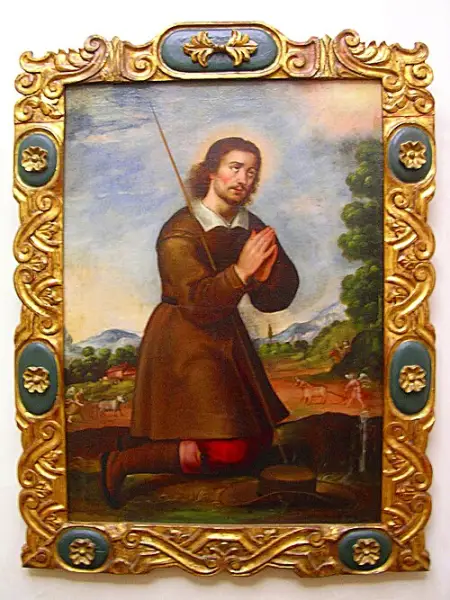
Isidore the Laborer, born Isidro de Merlo y Quintana around 1070, was a Mozarab farmworker who spent his whole life in and around medieval Madrid, first under Muslim rule and then, after 1085, under the crown of Castile. Christened in honour of St. Isidore of Seville, he worked as a hired hand for the wealthy landowner Juan de Vargas, who in time entrusted him with the bailiwick of the whole Lower Caramanca estate. He was famous for piety that blended seamlessly with his labour: he attended Mass before work each morning, shared his meals and goods with the poor, and showed mercy to animals. A rich cycle of miracles grew around his fields — angels seen ploughing beside him, a fountain springing from dry ground, wheat multiplied for wood-pigeons, and a pot of stew that never ran out. He married Maria Torribia, honoured in Spain as Santa María de la Cabeza. He died on 15 May 1130, though one official source gives 1172. Beatified in 1619, he was canonized on 12 March 1622 alongside Ignatius of Loyola, Francis Xavier, Teresa of Ávila, and Philip Neri, and is venerated as patron of Madrid, of farmers, and of agriculture.
The Complete Life
A Poor Child of Madrid
Isidore was born in Madrid around 1070, though some sources give 1082, to parents who were poor but devout. They gave their son the name of their patron, St. Isidore of Seville — the great scholar-bishop whose learning stood at the farthest imaginable distance from the life this child would lead, and whose name he would render illustrious in an entirely different way. He was a Mozarab, a Christian living under Muslim rule: Madrid then belonged to the taifa of Toledo. In 1083 or 1085 the armies of King Alfonso VI of León and Castile took the city, and Isidore grew up as the old order gave way to the new. His family's poverty meant no schooling and no prospects; his inheritance was the spade and the plough. Yet his parents' faith took root in him and became the whole architecture of his life. He never left his native region: Madrid and its surrounding countryside, its wheat fields, wells, and mills, formed the entire stage on which his sanctity would be worked out — a sanctity of hired labour, daily prayer, and quiet charity rather than of journeys, offices, or renown.
§ Biography
Servant of Juan de Vargas
Isidore spent his life as a hired farmhand in the service of Juan de Vargas, a wealthy Madrilenian landowner, on a farm in the city's vicinity. His competence and reliability were such that his master eventually promoted him to bailiff of the entire estate of Lower Caramanca, a position of trust over lands he had once laboured on as a mere day worker. He married Maria Torribia, a woman of like piety whom Spain honours as Santa María de la Cabeza, though she has never been formally canonized. The couple had one son, and one family story became famous: when the boy fell into a deep well, the parents' prayers were answered as the water rose miraculously to ground level, bringing the child up with it. In thanksgiving the two vowed sexual abstinence and lived thereafter in separate houses, a common form of marital devotion in the medieval world. Their son died in his youth. Isidore's domestic life thus carried both tenderness and sorrow, and his marriage became — like his labour — a field in which holiness was cultivated alongside ordinary duty.
§ Biography
Mass Before Work, Angels in the Furrows
Isidore's piety had a fixed daily shape: every morning, before going to the fields, he attended Mass in one of the churches of Madrid. This habit made him late for work, and his fellow labourers complained to their master — who, investigating, found Isidore at prayer while an angel did his ploughing for him. On another occasion on another day the master, looking out, beheld angels guiding ploughs at his labourer's side, with the result that Isidore accomplished as much as three of his fellow field hands. The miracle stories that gathered around him are homely and agricultural. He is said to have raised his master's deceased daughter to life and to have drawn a fountain of fresh water from dry earth to quench the man's thirst. On a snowy day, walking to the mill with wheat, he poured half his precious sack on the frozen ground for a flock of starving wood-pigeons, mocked by the witnesses — and found the bag full when he arrived, its flour doubled when ground. At home, Maria kept a pot of stew always on the fire because Isidore kept bringing the hungry home; when it ran dry before the guests were served, he made her look again, and there was enough for all.
§ Miracle stories
Death, Incorruption, and the Body Examined
His death came on 15 May 1130 in the place of his birth near Madrid; the sole official record, however, defers it to 1172 — a contradiction never settled. Forty years after his death, according to the medieval codex that preserves his cult, his body was found incorrupt. When torrential rains on 2 April 1212 washed the buried dead out of Madrid's cemeteries, his remains came to light in that same seemingly incorrupt condition. In 2022 forensic specialists of the Complutense University examined the relics. A lion-stamped coin had lodged in the throat, guessed to belong to the era of Henry IV of Castile; the sole active disease detected was dental abscess, put forward by the investigators as what killed him. His age at death was reckoned anywhere from 48 to 102 years, his stature at 167 to 186 centimetres. Most strikingly, the skull displayed chiefly North African characteristics — a scientific footnote to the story of the Mozarab farmworker that has complicated the popular image of the saint, unsettled long-cherished assumptions about his appearance, and deepened scholarly interest in his true origins.
§ Biography
From a Country Codex to Canonization
For his life, scholarship leans on a solitary early witness: the Códice de Juan Diácono, a codex of the fourteenth century that narrates five wonders — grain left for pigeons, angels at the plough, a donkey rescued by prayer from a wolf, the pot belonging to his wife, and a kindred tale of food multiplied for a brotherhood — and records that his body, lifted from the earth forty years after burial, showed no corruption. Royal devotion then carried the cause forward. A mortal illness of King Philip III was believed to yield when he touched the relics; Philip answered with a lavish silver reliquary in place of the old one and pressed the Apostolic See to act. On 2 May 1619 Paul V beatified him in Rome, the corresponding bull following on 12 March 1621; and on 12 March 1622 Gregory XV enrolled him among the saints side by side with Ignatius of Loyola, Francis Xavier, Teresa of Ávila, and Philip Neri, the most brilliant company the modern era has raised to the altars at once. Benedict XIII later issued the bull of canonization, on 4 June 1725. The miracles credited to him have been tallied at 438.
§ Veneration
Patron of Farmers and of Madrid
No saint of the countryside is more widely honoured than Isidore. Farmers, peasants, and day labourers claim him as patron, as do agriculture at large and the brick layers, together with his native Madrid — along with León, Zaragoza, Seville, and countless places across the former Spanish Empire, from San Ysidro in California to towns throughout the Philippines, where festivals in his honour crowd the middle of May. In 1947 the National Catholic Rural Life Conference petitioned successfully for his proclamation as patron of farmers throughout the United States. His relics, repeatedly carried to royal sickbeds — to the Alcazar for Charles II in 1696, to the Royal Palace for Maria Amalia of Saxony in 1760 — were settled in 1769 by Charles III in the San Isidro Church in Madrid, in a sepulchre of nine locks whose master key belongs to the king alone. The house of his master Juan de Vargas is now the Casa de San Isidro museum, built over the chapel where he lived and died and the well where his son was saved. His life has inspired canvases, a poem from Lope de Vega, musical works, and a 1964 film; it remains a standing admonition that human labour has dignity and that holiness can ripen in the commonest routine.
§ Patronage
Timeline
- 1070
Born in Madrid to poor, devout parents and christened after their patron, St. Isidore of Seville.
§ Biography
- 1083
Forces of Alfonso VI of León and Castile wrested Madrid from Muslim hands, ending the taifa of Toledo's dominion over the city of his birth.
§ Biography
- 15 May 1130
Died near Madrid in the district where he was born; the sole official record defers his death to 1172.
§ Biography
- 2 Apr 1212
Torrential rains washed cadavers out of Madrid's cemeteries on 2 April 1212, and his body emerged seemingly untouched by decay.
§ Miracle stories
- 1212
Said to have appeared to Alfonso VIII of Castile, showing him the hidden path that brought victory over the Moors at Las Navas de Tolosa.
§ Miracle stories
- 2 May 1619
Beatified in Rome by Pope Paul V, after King Philip III's cure by his relics set the cause in motion.
§ Veneration
- 12 Mar 1621
The Bull of Beatification was published.
§ Veneration
- 12 Mar 1622
Canonized in Rome by Gregory XV together with Ignatius of Loyola, Francis Xavier, Teresa of Ávila, and Philip Neri.
§ Veneration
- 1696
For the sake of Charles II's health his remains were carried to Madrid's Royal Alcazar, where the royal locksmith drew a tooth from the body for the ailing monarch.
§ Veneration
- 1760
Madrid's Royal Palace received his body while Maria Amalia of Saxony lay ill.
§ Veneration
- 1769
Charles III relocated the remains of Isidore and his wife Maria to the San Isidro Church in Madrid, in a sepulchre with nine locks held by the king.
§ Veneration
- 1947
He was formally proclaimed patron of farmers across the United States at the petition of the National Catholic Rural Life Conference.
§ Patronage
- 2022
A forensic team from the Complutense University examined his remains, finding dental abscesses, probable North African cranial features, and a coin with a lion in the throat.
§ Biography
In Their Own Words
If you have your spiritual self in order, your earthly commitments will fall into order also.
The Record
- Major works
- Lifelong service as farmworker and bailiff on the estate of Juan de Vargas near Madrid
- Patron of
- patron of farmers, peasants, and day labourers·patron of agriculture·patron of Madrid·patron of brick layers·patron of the National Catholic Rural Life Conference
- Symbols
- a peasant holding a sickle and a sheaf of corn·a sickle and staff·an angel ploughing for him·an angel and white oxen beside him·a spade or plough in Spanish art
- Canonization
- Beatified 2 May 1619 by Pope Paul V; canonized 12 March 1622 by Pope Gregory XV
Prayer
Bibliography
Show 4 sources
- Moya Rueda, Patricia; de Benito Sánchez, María; Rascón Risco, Mónica; Angulo Bujanda, Isabel (2022-11-28). "Informe de reconocimiento forense del cuerpo de san Isidro Labrador. Avance" (PDF). Escuela de Medicina Legal y Forense, Universidad Complutense de Madrid (in European Spanish).
- Butler, Alban. The Lives or the Fathers, Martyrs and Other Principal Saints, Vol. V, D. & J. Sadlier, & Company, 1864.
- Knight, Kevin (2020). "St. Isidore the Labourer". New Advent. Retrieved 26 October 2021.
- Roman Martyrology (Libreria Editrice Vaticana, 2001). ISBN 978-88-209-7210-3.
Profile text adapted from the Wikipedia article, licensed CC BY-SA 4.0.
Pray with this saint every day
Save St. Isidore the Laborer to your favorites, read the full profile, and get feast-day reminders in the Saints app.
Get the Saints AppFree on the App Store for iPhone and iPad