
fl. 6th century
St. Issel
Sixth-century Welsh saint, father of St Teilo
Overview
Issel, whose name appears in surviving texts in the forms Eussyllt and Usyllt, was a Welsh saint of the sixth century who lived in the kingdom of Dyfed, in the southwest of Wales. His fame rests less on his own recorded deeds than on the family he raised: he was the father of St Teilo, one of the great saints of Wales, whose cult at Llandaff made him among the most honored figures of the Welsh church. The Book of Llandaff preserves the name of Issel's wife, Guenhaf, daughter of Liuonui. Through his daughter Anauved, who married King Budig of Armorica in Brittany and bore three saints, Issel became the ancestor of sanctity on both sides of the Channel, and the oldest genealogies present him as the father also of St Cynllo. His name appears to derive from the Latin Auxilius, a sign of the Roman Christian inheritance beneath the Welsh forms. He is the patron of the parish church at Saundersfoot, known in Old Welsh as Llanussyllt, though the neighboring dedication at Haroldston St Issells probably belongs instead to his grandson, St Ismael.
The Complete Life
A Household of Saints in Dyfed
Issel belonged to the sixth-century church of Dyfed, the ancient kingdom in southwest Wales that had taken its Christianity directly from the age of Roman Britain. His very name carries that inheritance: the forms Eussyllt and Usyllt in the surviving texts appear to derive from the Latin Auxilius, a Roman name transformed into Welsh speech, and it marks him as a man of a Christian lineage older than the Saxon conquests far to the east. The Book of Llandaff, the great cartulary of the church of Teilo, names his wife Guenhaf, a daughter of Liuonui, and records the saintly issue of the marriage. Of these the greatest was Teilo, patron of Llandaff and one of the three saints of Wales, whose cult dominated the religious life of southeast Wales for a thousand years. A daughter, Anauved, crossed the sea to Armorica and married King Budig of Brittany, bearing three saints of her own, so that the children of Issel's house sanctified two nations. The oldest genealogies add yet another son, St Cynllo, though this further descent belongs to the earliest stratum of the Welsh pedagogies of the saints.
§ Introduction
Llanussyllt and the Dedications of Pembrokeshire
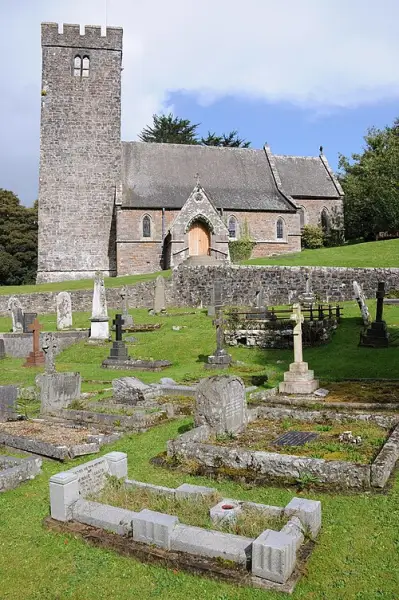
The memory of Issel survives chiefly in the dedications of Pembrokeshire. The parish church of Saundersfoot honors him as its patron — the little harbor town on the Dyfed coast bears the ancient Welsh name Llanussyllt, simply the enclosure of Issel. That dedication claims him for the coastal country where his family held its lands, and it has stood through the centuries as the standing witness to his local cult. A second dedication is less certain: the church of Haroldston St Issells bears a form of his name, but the evidence suggests the dedication was probably corrupted from an original invocation of his grandson, St Ismael, whose own cult flourished in the same region. The distinction between the two is a small lesson in how Welsh hagiology was transmitted, by parishes remembering their founders and occasionally confusing one saintly kinsman with another. What is not in doubt is the place Issel holds at the head of one of the most fruitful families in the calendar of Wales: father of Teilo, grandfather of saints, and ancestor through Armorica of a sanctity that crossed the sea.
§ Introduction
The Record
- Patron of
- Saundersfoot parish church
- Canonization
- Pre-congregation; venerated in Celtic Christianity and in the Orthodox Church
Prayer
Bibliography
Show 2 sources
- Baring-Gould, Sabine et al. (2005). The Lives of the British Saints. Vol. 4. Kessinger Publishing. p. 348 f.
- Alonso, Justo Fernandez (2008). "San Cynllo: Santi e Beati".
Profile text adapted from the Wikipedia article, licensed CC BY-SA 4.0.
Pray with this saint every day
Save St. Issel to your favorites, read the full profile, and get feast-day reminders in the Saints app.
Get the Saints AppFree on the App Store for iPhone and iPad