
1864 – 1918·Feast August 23
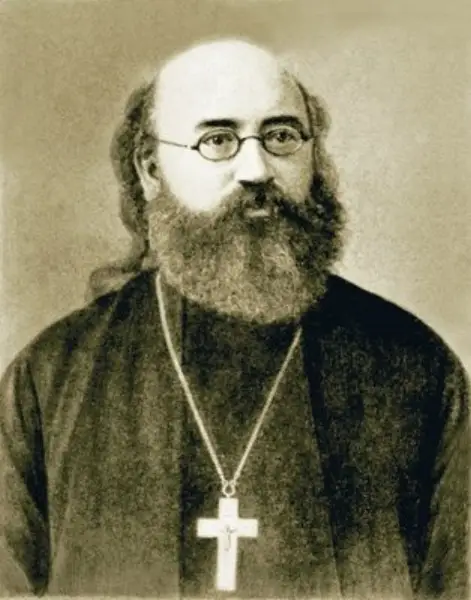
St. Ivan Vostorgov
Hieromartyr and Archpriest of Moscow
Overview
Ivan Ivanovich Vostorgov was an archpriest of the Russian Orthodox Church whose ministry ranged from village schools in the Kuban to the pulpits of Moscow. Orphaned young and raised in a clerical family, he taught in church schools, served parishes in the Kuban and the Caucasus, and rose to prominence as a missionary organizer, founding parochial schools, brotherhoods, and pastoral courses across Siberia and Central Asia. In 1913 he took charge of St. Basil's Cathedral, the Intercession Cathedral on the Moat, and was regarded as one of the most celebrated Orthodox preachers of his era. A leading figure in the monarchist movement and chairman of the Russian Monarchist Party, he withdrew from party leadership when the Synod barred clergy from politics. After the Bolshevik seizure of power he denounced the new regime from the pulpit and urged believers to defend the church. Arrested in May 1918, he was shot in Petrovsky Park that September as one of the first hostages of the Red Terror. The Russian Orthodox Church glorified him among the New Martyrs in 2000.
The Complete Life
A Kuban Childhood and Seminary Years
Vostorgov was born on 1 February 1864 in the village of Kavkazskaya, in the Kuban region of the Russian Empire, into the household of the priest Ioann Aleksandrovich Vostorgov and his wife Tatiana Ksenofontovna. Learning ran deep in the family: his grandfather Aleksandr had been a master of theology and a professor at the Vladimir Theological Seminary. The boy lost his parents early, and the church that had sheltered his family became his path forward. He proved a capable student and in 1887, at the age of twenty-three, completed the course of the Stavropol Theological Seminary. The institution did not part with him at graduation; he remained on its staff as a teacher. In these same years he married Elena Evplovna Makovkina, who would stand beside him through three decades of restless ministry and die in 1915, three years before her husband faced the execution ground in Moscow.
§ Early life
Schools and Parishes of the South
Ordination came quickly. In August 1887 Vostorgov was named supervisor of the Stavropol Theological School and teacher of Russian and Church Slavonic, and two years later he was made deacon of the Church of the Archangel Michael at Kirpilskoye in the Kuban, rising almost at once to the priesthood. He proved a pastor who spent his own money as freely as his energy: at personal expense he founded a parochial school in the village, organized a temperance society, and preached so effectively that many local Old Believers were reconciled to the Russian Orthodox Church. Advancement followed through educational administration — observer of parish schools in the Kuban, religious teacher and rector at the Stavropol boys' gymnasium, member of the diocesan women's school council and of the seminary board. In 1894 he moved across the Caucasus to Elisavetpol, now Ganja, as gymnasium religious teacher, and by 1897 and 1898 he held similar posts at the first girls' and boys' gymnasiums of Tiflis, where his organizing gifts soon found a far larger field.
§ Service in the Stavropol Diocese
Missionary of the Empire's Edges
Raised to archpriest on 6 January 1901 and made editor of the Spiritual Herald of the Georgian Exarchate, Vostorgov inspected the Russian mission at Urmia in Persia and witnessed the conversion of Persian Assyrians to Orthodoxy. In Tiflis he helped open parochial schools for dissident communities, and as diocesan observer of parochial schools from December 1900 he saw the number of schools in the diocese double. In 1906 he transferred to Moscow as a missionary preacher with anti-sectarian authority, becoming one of Metropolitan Vladimir's closest collaborators. He organized the 4th Missionary Congress at Kiev in 1908, journeyed to the Far East to preach among settler farmers, and from January 1909 served as deputy chairman of the Brotherhood of Christ's Resurrection, which in its first year created twenty-five preaching and three missionary circles. He inspected the Beijing Spiritual Mission, the churches of northern Manchuria, and the missions of Japan and Korea, traveled through Turkestan and Semirechye in 1910, and built pastoral courses in Moscow, Khabarovsk, Tobolsk, Irkutsk, and Tashkent to staff the settler parishes.
§ Moscow priest and missionary
Preacher of the Cross of St. Basil
Vostorgov's spirituality was apostolic and public: he believed the faith must be preached, organized, and defended in the open square of Russian life. From 1910 he led the Higher Theological Women's Courses in Moscow, transformed in 1913 into a Women's Missionary Institute, and from 1911 headed psalm-reading courses preparing readers for the vast dioceses of Siberia and the Far East. In 1913 he took charge of St. Basil's — the Intercession Cathedral on the Moat on Red Square — and chaired the Moscow council of deans. Contemporaries ranked him among the great pulpit orators of his generation; John of Kronstadt himself compared his eloquence to that of Chrysostom and foresaw great benefit to Russia from his voice. He carried that zeal into controversy as well, writing extensively against socialist and atheist thought and leading monarchist organizations until the Synod forbade clerical politics in 1913, when he relinquished his party posts. His credo was a church unenslaved: after the February Revolution he wrote that under the old order both bishops and Synod had been in bondage.
§ Moscow priest and missionary
Arrest and Martyrdom
After the Bolsheviks seized power, Vostorgov condemned their rule from the pulpit and called the faithful to unite in defense of the church, which he regarded as facing an existential threat. On 30 May 1918 he was arrested in his apartment alongside Bishop Efrem of Selenginsk, an old friend stranded from his Irkutsk diocese, ostensibly over the sale of the by-then nationalized diocesan house; the press of the new regime smeared the prisoners, and Izvestia published an inflammatory article under the title of a commercial deal of Patriarch Tikhon and Vostorgov. Held in the Cheka's internal prison and then in Butyrka, he was accused of ties to the Romanov house. When the murder of Uritsky and the attempt on Lenin unleashed the Red Terror, the Revolutionary Tribunal's commission liquidated his case extrajudicially on 4 September. The next day he was shot in Petrovsky Park with Bishop Ephraim, former ministers, and other hostages. An eyewitness recorded that the condemned were allowed to pray and embrace, that Vostorgov urged them all to offer a last atoning sacrifice in trust of God's mercy, said 'I am ready,' and knelt first to receive his death.
§ Arrest and execution
Glory Among the New Martyrs
Veneration of the priest shot in Petrovsky Park matured as the Russian Orthodox Church emerged from decades of Soviet persecution. On 16 August 2000 the Jubilee Bishops' Council of the Russian Orthodox Church, meeting in Moscow, glorified Ivan Vostorgov among the Holy New Martyrs and Confessors of Russia for church-wide veneration, enrolling the archpriest who had died in the first wave of the Red Terror in the great choir of twentieth-century witnesses. His commemoration falls on 23 August according to the Julian calendar, and he is also honored within the Council of New Martyrs and Confessors of Russia. In the calendar of a church that had counted tens of thousands of martyrs, his name stands with Bishop Ephraim, his companion in prison and death, and with the hierarchs and pastors whose blood the Council recognized as the seed of a new springtime for Russian Orthodoxy.
§ Introduction
Memory in Church and Culture
Beyond his place in the calendar of the new martyrs, Vostorgov has re-entered Russian cultural memory as a figure of the church's collision with Bolshevism. Natalia Irtenina's historical novel Crimson Robes, published in Moscow in 2021, makes the hieromartyr one of its principal characters in its portrait of the new martyrs and confessors of the twentieth-century Russian Church; he also appears in Valentin Pikul's novel Evil Force. On the screen, the character of Ioann Vostorgov was played by Vyacheslav Vasiliev in the Soviet feature film Agony of 1974 and by Stepan Krylov in Black Triangle of 1981. His decorated career — Orders of St. Anne and St. Vladimir of the first and second degrees, earned between 1905 and 1916 — marks the esteem of the pre-revolutionary state, but his durable legacy lies in his schools, brotherhoods, and missionary courses, and above all in the witness of a preacher who used his last words not to plead but to bless.
§ In culture
Timeline
- 1 Feb 1864
Born in the village of Kavkazskaya in Kuban to the priest Ioann Aleksandrovich Vostorgov and his wife Tatiana
§ Early life
- 1887
Graduates from the Stavropol Theological Seminary and stays on to teach there
§ Early life
- 1889
Ordained deacon of the Church of the Archangel Michael at Kirpilskoye in the Kuban, soon elevated to priest
§ Service in the Stavropol Diocese
- 6 Jan 1901
Elevated to archpriest and becomes editor of the Spiritual Herald of the Georgian Exarchate
§ Acension to Archpriesthood
- 1906
Appointed missionary preacher with anti-sectarian rights and transfers to Moscow, becoming a close associate of Metropolitan Vladimir
§ Moscow priest and missionary
- 9 Sep 1909
Becomes rector of the Prince Vladimir Church at Moscow's diocesan house and deputy chairman of the Brotherhood of Christ's Resurrection
§ Moscow priest and missionary
- 1913
Appointed rector of St. Basil's, the Intercession Cathedral on the Moat, and steps down from monarchist party leadership
§ Moscow priest and missionary
- 1917
Named secretary of the Holy Synod's Missionary Council and serves as a member of the All-Russian Local Council
§ Activities after the February Revolution
- 30 May 1918
Arrested in his Moscow apartment together with Bishop Efrem of Selenginsk on charges tied to the sale of the diocesan house
§ Arrest and execution
- 5 Sep 1918
Publicly executed by shooting in Petrovsky Park, Moscow, among the first victims of the Red Terror
§ Arrest and execution
- 2000
Glorified among the Holy New Martyrs and Confessors of Russia by the Jubilee Bishops' Council of the Russian Orthodox Church
§ Introduction
In Their Own Words
Since socialism denies God, the soul, immortality, spiritual freedom in man, constant rules of morality, then it must turn to the only means of influencing man — violence.
He is a wonderful man, possessing extraordinary eloquence, that he is Chrysostom, that he can bring great benefit to Russia.
I am ready.
The Record
- Major works
- Spiritual Herald of the Georgian Exarchate (editor)·Newspapers Tserkovnost, Russkaya Zemlya, and the magazine Vernost·Numerous writings criticizing socialist and communist teachings
- Patron of
- New Martyrs and Confessors of Russia·Persecuted Christians
- Symbols
- Archpriest's vestments·Cross and Gospel book·Palm of martyrdom
- Canonization
- Glorified 16 August 2000 by the Jubilee Bishops' Council of the Russian Orthodox Church among the Holy New Martyrs and Confessors of Russia
Prayer
Bibliography
Show 9 sources
- "Vostorgov, I. I. (Ioann Ioannovich), 1867-1918 — LC Linked Data Service: Authorities and Vocabularies", id.loc.gov, Library of Congress
- "Biografii. Ioann (Vostorgov), pravoslavnyi svyatoi", Zamos.Ru
- Project Muse open-access monograph chapter, muse.jhu.edu
- DukeSpace bitstream, dukespace.lib.duke.edu
- Bogdanovich, Peter (2019-05-21). "Foreword", Preston Sturges, Intellect Books, pp. xi–xii, doi:10.2307/j.ctv36xvxvw.4, ISBN 978-1-78938-026-2
- Milcomete, Ionut (2023-06-24). "Orthodox Gnoseology Reflected in the Holy Gospel of Saint John the Apostle and Evangelist", Icoana Credintei 9 (18): 76–82, doi:10.26520/icoana.2023.18.9.76-82, ISSN 2501-3386
- Archpriest I. Vostorgov. Church Affairs // Pravoslavny Evangelistnik. Moscow, 1917, May–December, p. 6
- Latyshev, A. G. Declassified Lenin. Moscow: March, 1996, p. 84, ISBN 5-88505-011-2
- "Zhertvy 'krasnogo terrora', spasateli i razoriteli Rusi v romane Natalii Irteninoi. 'Bagryanye rizy' novomuchenikov", Pravoslavie.Ru
Profile text adapted from the Wikipedia article, licensed CC BY-SA 4.0.
Pray with this saint every day
Save St. Ivan Vostorgov to your favorites, read the full profile, and get feast-day reminders in the Saints app.
Get the Saints AppFree on the App Store for iPhone and iPad