
1253 – 1303·Feast May 19
St. Ivo of Kermartin
Patron Saint of Lawyers and Advocate of the Poor
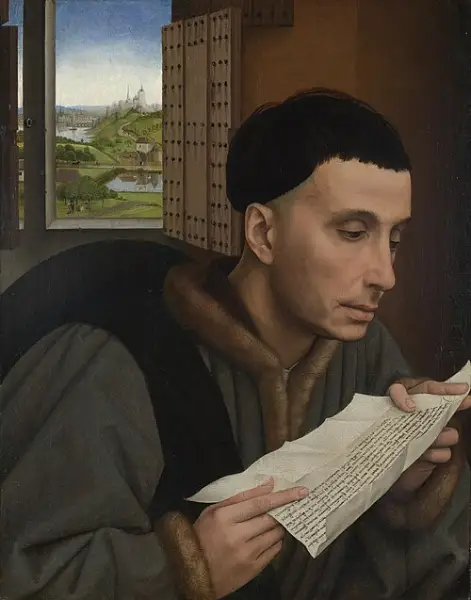
Overview
Ivo of Kermartin, called Yves, Yves Hélory, or in Breton Erwan, was a Breton parish priest and judge who became the only man of his rank canonized in the Middle Ages and remains the patron of lawyers, Brittany, and abandoned children. Born to a noble family near Tréguier in 1253, he studied civil law in Paris and canon law in Orléans before serving as an ecclesiastical judge, first at Rennes and then for the bishop of Tréguier. He protected orphans and widows, refused the bribes customary to his office, paid the costs of the helpless who came to court, and reconciled quarreling parties out of court to spare them expense. Ordained a priest in 1284, he held the parish of Tredrez and then Louannec, where he built a hospital and nursed the sick with his own hands. A member of the Third Order of St. Francis, he joined ascetic discipline to professional rigor until his death in 1303. His tomb at Minihy-Tréguier draws pilgrims to this day, and his cult as 'advocate of the poor' was confirmed by Clement VI in 1347.
The Complete Life
A Breton Son of Nobility
Ivo was born on 17 October 1253 at Kermartin, a manor near Tréguier in the Duchy of Brittany, his father being Helori, lord of Kermartin, and his mother Azo du Kenquis. Though destined for the church rather than inheritance, he received the education appropriate to his rank. In 1267, at fourteen, he was sent to the Faculty of Law of the University of Paris, where he took his degree in civil law. His Paris years set the pattern of his life: while fellow students caroused, he studied, prayed, and visited the sick, and he declined to eat meat or drink wine. Among the scholars of the university in those years were Duns Scotus and Roger Bacon. In 1277 he moved to Orléans to read canon law as a pupil of Peter de la Chapelle, a renowned legist who would later become bishop of Toulouse and a cardinal. Thus equipped in both branches of the law, he returned to Brittany already marked by the austere habits of a discipline that never left him.
§ Life
Judge and Priest
Having received minor orders, Ivo was named an 'official' — the title of an ecclesiastical judge — of the archdeaconry of Rennes in 1280. There his court became famous for fairness: he shielded orphans and widows, defended those who could not defend themselves, and delivered verdicts so impartial that even the losing parties respected them. He went further than the bench required, representing the helpless in other courts at his own expense and visiting them in prison. Though gifts to judges were customary, he refused them all, and he labored to settle disputes out of court so that litigants might keep what little they had. In 1284 he was ordained to the priesthood, and in the same year the bishop of Tréguier called him to be his official, an office he accepted and exercised with such zeal that he did not hesitate to resist royal taxation he judged an infringement of the church's rights. In 1285 he was given the parish of Tredrez, joining pastoral care to his judicial charge.
§ Life
Advocate of the Poor
The fame of Ivo's advocacy gathered stories that spread across France. The most celebrated concerns the widow of Tours, retold by John Wigmore in the Fordham Law Review in 1936: lodging with a widow while attending the bishop's court, Ivo found her weeping over a suit brought by a traveling merchant. Two men had left a casket of valuables in her keeping on condition it be returned only to both together; one had returned alone and carried it off, and now his partner demanded she pay its alleged value. 'Have no fear,' the young advocate told her, and in court he argued that the plaintiff, demanding jointly-returned property singly, had proved nothing. The merchant turned pale and trembled; the judge ordered him detained, his accomplice was traced, and the casket — opened to reveal nothing but old junk — exposed a plot to extort the widow. Thus the lawyer-saint saved her from ruin, and the story fixed his title: advocate and patron of the poor.
§ The Widow of Tours
The Friar's Discipline
Behind Ivo's professional life stood a rigorous spiritual regimen. While still a student he had denied himself meat and wine, and in Brittany he gave himself to the study of Scripture. Franciscan tradition, supported by strong evidence, holds that he joined the Third Order of St. Francis, probably at Guingamp, binding himself to a lay rule of penance and charity while continuing his work as judge and pastor. One incident betrayed the integration of his prayer and his profession: when a mother and son could not be reconciled, he offered Mass for them, and they at once came to a settlement. As a parish priest he preached regularly in chapel and field, and witnesses at the inquest into his sanctity would stress how he joined the call to religion with the demand for good conduct in daily life. Repeated fasting wore on his body for years, and the austerities he practiced alongside hours of legal work marked him as much a penitent as a jurist.
§ Life
Louannec and a Holy Death
Eight years after taking charge of Tredrez, in 1293, Ivo was sent to Louannec, the parish in which he would end his days. There his charity took visible form: he built a hospital and served in it himself, caring for the sick with his own hands and emptying his purse for all the money he could give to the destitute — the purse artists would later place in his right hand. He continued to preach, judge, and intercede for the poor of his flock until his strength failed. Worn by hard work and repeated fasting, he died at Louannec on 19 May 1303, at forty-nine, of natural causes. He was buried at Minihy-Tréguier in the church he had founded, which became the center of his cult; the relic of his skull is still carried in procession at the cathedral gate of Tréguier, as it was in the great procession of 2005.
§ Life
The Inquest and Canonization
The process that made Ivo a saint began while memory of him was fresh. At the inquest into his sanctity held in 1330, parishioners testified to his goodness, recounting that he preached regularly in chapel and in the open field, and that under his care the goodness of the people of the countryside had been doubled — a witness to the bond he taught between religion and honest living. At the urging of Philip I, Duke of Burgundy, Pope Clement VI canonized him in June 1347, barely two generations after his death and in the same century that had known him. His feast was fixed on the day of his death, 19 May. He stands alone in medieval hagiography as a parish priest of his humble station raised to the altars, and his canonization gave official standing to the popular title the courts and streets of Brittany had already given him: advocate of the poor.
§ Veneration
Patron of Lawyers
No saint is more closely bound to a profession. As patron of lawyers, Ivo has given his name to law schools and to associations of Catholic jurists across the world: the Society of St. Yves in Jerusalem, a Catholic center for human rights and legal aid; the Conférence Saint-Yves, the Catholic lawyers' association of Luxembourg; and the Association de la Saint-Yves Lyonnais. In Rome the churches of Sant'Ivo at the Sapienza and Sant'Ivo of the Bretons are dedicated to him, and his statue stands on the Charles Bridge in Prague. Artists from Rogier van der Weyden to Josse van der Baren painted him with his purse and scroll, or standing between rich man and poor. On the 700th anniversary of his death in 2003, Pope John Paul II declared that his pursuit of impartial justice and defense of the poorest still summon Europe's builders to see that every right, above all those of the weakest, is recognized and protected — a timeliness, the pope said, that remains astonishing.
§ Legacy
Timeline
- 17 Oct 1253
Born at the manor of Kermartin near Tréguier to Helori, lord of Kermartin, and Azo du Kenquis
§ Life
- 1267
Sent to the Faculty of Law of the University of Paris, where he earns a degree in civil law while shunning student excess
§ Life
- 1277
Goes to Orléans to read canon law as a pupil of Peter de la Chapelle, who would later become bishop of Toulouse
§ Life
- 1280
Appointed an official, or ecclesiastical judge, of the archdeaconry of Rennes, where he defends the poor and refuses judicial gifts
§ Life
- 1284
Ordained to the priesthood and accepts the bishop of Tréguier's invitation to serve as his official
§ Life
- 1285
Appointed to the parish of Tredrez while continuing to hear cases
§ Life
- 1293
Transferred to Louannec, where he erects a hospital and personally tends the sick
§ Life
- 19 May 1303
Dies at Louannec of natural causes after a life of labor and repeated fasting
§ Life
- 1331
Diocesan inquest into his sanctity hears parishioners testify that under his preaching the people of the land grew twice as good
§ Veneration
- Jun 1347
Canonized by Pope Clement VI at the urging of Philip I, Duke of Burgundy
§ Veneration
The Record
- Major works
- Church at Minihy-Tréguier, which he founded·Hospital at Louannec
- Patron of
- Lawyers·Brittany·Abandoned children
- Symbols
- Purse in his right hand·Rolled paper or scroll in his left·Shown between a rich man and a poor man
- Canonization
- Canonized June 1347 by Pope Clement VI, at the urging of Philip I, Duke of Burgundy
Prayer
Bibliography
Show 14 sources
- Alberge, Dalya (2 February 2019). "'It's a Beatle haircut': historian claims 15th-century portrait is from the 1960s", The Guardian
- "History: Saint Ives — Marywood University", Marywood University, 20 January 2017
- Staley, Tony. "Good as lawyer, judge and priest", The Compass News, Catholic Diocese of Green Bay, Wisconsin, 13 May 2013
- Wigmore, John H. (1936). "St. Ives, Patron Saint of Lawyers", Fordham Law Review 5: 401
- MacErlean, Andrew. "St. Ives", The Catholic Encyclopedia, Vol. 8, New York: Robert Appleton Company, 1910
- "St. Ivo", FaithND
- "Message of John Paul II to Bishop Lucien Fruchaud of Saint-Brieuc and Tréguier for the 700th Anniversary of the Birth of St. Ivo Hélory of Brittany", the Vatican, 13 May 2003
- "About Us", The Society of St. Yves
- "Eglise Saint-Yves à Minihy-Tréguier", Monumentum
- Caughwell, Thomas J., "Patron Saints", Our Sunday Visitor, 2011, ISBN 9781612782058
- Giorgi, Rosa. "Ivo of Kermartin", Saints in Art, Getty Publications, 2003, p. 170, ISBN 9780892367177
- "Saint-Yves des Bretons", L'église française de Rome
- His vita is in the Acta Sanctorum, col. 735
- Vauchez, André (1993). Daniel E. Bornstein (ed.). The Laity in the Middle Ages: Religious Beliefs and Devotional Practices, translated by Margery J. Schneider, Notre Dame: University of Notre Dame Press
Profile text adapted from the Wikipedia article, licensed CC BY-SA 4.0.
Pray with this saint every day
Save St. Ivo of Kermartin to your favorites, read the full profile, and get feast-day reminders in the Saints app.
Get the Saints AppFree on the App Store for iPhone and iPad