
1214 – 1294·Feast December 5
St. Iyasus Mo'a
Abbot and Founder of Istifanos Monastery on Lake Hayq
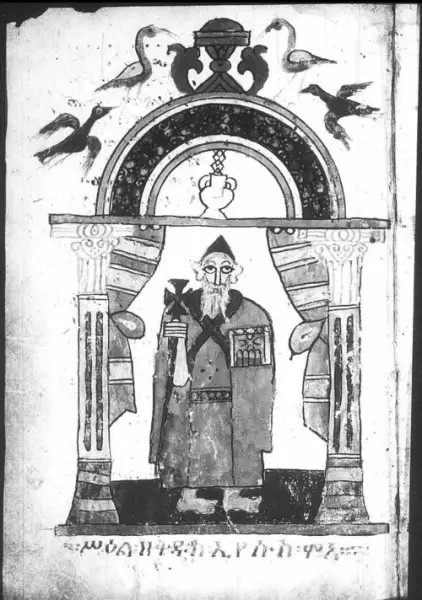
Overview
Iyasus Mo'a (1214–1294) was an Ethiopian monk and abbot whose organizing genius turned a loose eremitic community into one of the great monasteries of medieval Ethiopia. Born in Dehana in the region between the Zagwe kingdom and Alodia, he journeyed at the age of thirty to the ancient monastery of Debre Damo, where under Abba Yohannis he received the monastic habit and the sternest of disciplines. After seven years he left that plateau refuge for the shores of Lake Hayq in Amba Sel, where an eremitic community had grown up around the eighth-century church of Istanafanos. Iyasus Mo'a gathered these solitaries into a monastery with a rule and a school, and the Zagwe king Na'akueto La'ab confirmed the foundation by making him abbot around 1248. Among the students formed in his school was the future national saint Tekle Haymanot, who remained ten years at Hayq. His hagiography, the Gadla Iyasus Mo'a, records that he sheltered and educated the fugitive boy who would reign as Emperor Yekuno Amlak, founder of the Solomonic dynasty. His feast is kept on 5 December.
The Complete Life
A Son of Dehana
Iyasus Mo'a was born in 1214 at Dehana, in the frontier country that lay between the Zagwe dynasty and the kingdom of Alodia. The geographer G.W.B. Huntingford identified Dehana with a village some fifteen miles east of the Tekeze River, though the name may correspond to the later woreda in the Wag Hemra Zone of what is now the Amhara Region. Of his family and childhood the sources are silent; what the tradition preserves is a young man who at thirty was drawn north and east to the most venerable school of Ethiopian monasticism. His birthplace on the marchlands of two Christian kingdoms gave him, perhaps, both the restlessness and the breadth of a founder: he belonged to the border country where the faith of the highlands met the wider world of the Nile valley. All that his biographers record of these first three decades is the summons that carried him from Dehana to the cliffs of Debre Damo, and the readiness with which he answered it.
§ Life
Formation at Debre Damo
The monastery of Debre Damo, accessible only by rope, was Ethiopia's oldest house of monks, and there Iyasus Mo'a presented himself during the abbacy of Abba Yohannis. He was made a monk, and the abbot set him arduous tasks — the tradition's way of saying that his vocation was tested and proved before it was trusted. Seven years he spent under that discipline, mastering the ascetic practices, the liturgical round, and the scriptural learning that a monastery of Debre Damo's antiquity preserved. The formation shaped everything that followed: when at last he left the plateau, he carried with him the conviction that a Christian community is not a crowd of hermits but a body with order. The Gadla Iyasus Mo'a, the Acts written of him by his tradition, passes over these years in few words, but the fruit of them appeared on the shores of Lake Hayq, where the monk formed at Debre Damo became the abbot able to give a rule and a school to others.
§ Life
Founder at Lake Hayq
Leaving Debre Damo after seven years, Iyasus Mo'a came to Lake Hayq in Amba Sel, where a community of hermits had long lived around the church of Istanafanos, a shrine reaching back to the eighth century. He did not simply join them; he organized them, gathering the scattered solitaries into a monastery with a written rule and a school, the twin instruments of durable monastic life. The Zagwe king Na'akueto La'ab recognized the foundation and around 1248 made him its abbot. Under his governance Istifanos Monastery became a center of learning as well as prayer, and its most famous student was Tekle Haymanot, the great saint of Ethiopia, who spent ten years at Hayq before founding his own house at Debre Libanos. The monastery Iyasus built endured: his tomb and memory are honored there still, and the island shrine of Istifanos on Lake Hayq remains his major shrine in the Amhara Region. The founder's name — 'Jesus our refuge' — proved prophetic of the house he raised.
§ Life
Veneration and Feast
Iyasus Mo'a was never formally canonized by a process, for he belongs to the ancient choir of Ethiopian saints honored from the first generations after their deaths. He is venerated in the Ethiopian Orthodox Tewahedo Church and in the Eritrean Orthodox Tewahedo Church, which keep his memory on 5 December, the twenty-sixth day of Hedar in the Ethiopian calendar. His major shrine is the monastery of Istifanos on Lake Hayq in the Amhara Region, the community he founded and governed, where his own story is read as part of the house's identity. In the synaxaria of the Ethiopian church his name stands among the confessors and abbots of the medieval golden age, beside his pupil Tekle Haymanot, whose own feasts fall in the same calendar of saints. The longevity of his cult — eight centuries of unbroken remembrance — is itself the canonization of the monk whom the kings of Zagwe trusted and the founders of the Solomonic dynasty never forgot.
§ Introduction
The Abbot and the Future King
The Gadla Iyasus Mo'a preserves the story that entwined the abbot with the destiny of Ethiopia. Yekuno Amlak, hunted by the authorities of Amba Sel, had taken refuge in the church because of a prophecy — a tinbit — that he would be king. His mother, hearing the prediction and fearing for his life, brought the boy to Istifanos Monastery on Lake Hayq and begged the priests to hide him. Iyasus Mo'a protected and educated the fugitive, and when the prophecy was fulfilled and Yekuno Amlak rose to found the Solomonic dynasty in 1270, the emperor repaid his protector by building the structure to house the abbot's community. Later hagiographies assigned the emperor's rescue to Tekle Haymanot, but the critical studies of Carlo Conti Rossini concluded that the Gadla Iyasus Mo'a stands closer to the true course of events — a verdict that makes the abbot of Hayq, rather than his more celebrated pupil, the saint tied to the restoration of the Solomonic line.
§ Life
Timeline
- 1214
Born at Dehana, a district identified by Huntingford with a village east of the Tekeze River
§ Life
- 1248
Made abbot of the Lake Hayq monastery by the Zagwe king Na'akueto La'ab
§ Life
- 1294
Dies at the age of seventy-nine or eighty, leaving Istifanos Monastery as his memorial
§ Life
The Record
- Major works
- Istifanos Monastery on Lake Hayq, organized with a rule and a school
- Symbols
- Monastic habit of the Ethiopian Orthodox Tewahedo Church
- Canonization
- Pre-congregation; venerated since antiquity by the Ethiopian Orthodox Tewahedo Church and the Eritrean Orthodox Tewahedo Church
Prayer
Bibliography
Show 5 sources
- Huntingford, G.W.B. The Historical Geography of Ethiopia. London: The British Academy, 1989, p. 74
- Taddesse Tamrat. Church and State in Ethiopia. Oxford: Clarendon Press, 1972, pp. 158–160
- Kaplan, Steven (2025). The Ethiopians: Lost Civilizations. Reaktion Books, p. 109, ISBN 978-1-83639-102-9
- Taddesse Tamrat. Church and State in Ethiopia. Oxford: Clarendon Press, 1972, p. 67
- "Biography of Iyasus Mo'a", The Dictionary of Ethiopian Biography
Profile text adapted from the Wikipedia article, licensed CC BY-SA 4.0.
Pray with this saint every day
Save St. Iyasus Mo'a to your favorites, read the full profile, and get feast-day reminders in the Saints app.
Get the Saints AppFree on the App Store for iPhone and iPad