
1802 – 1864·Feast July 26
St. Jacob Netsvetov
Enlightener of Alaska and First Native Alaskan Priest
Overview
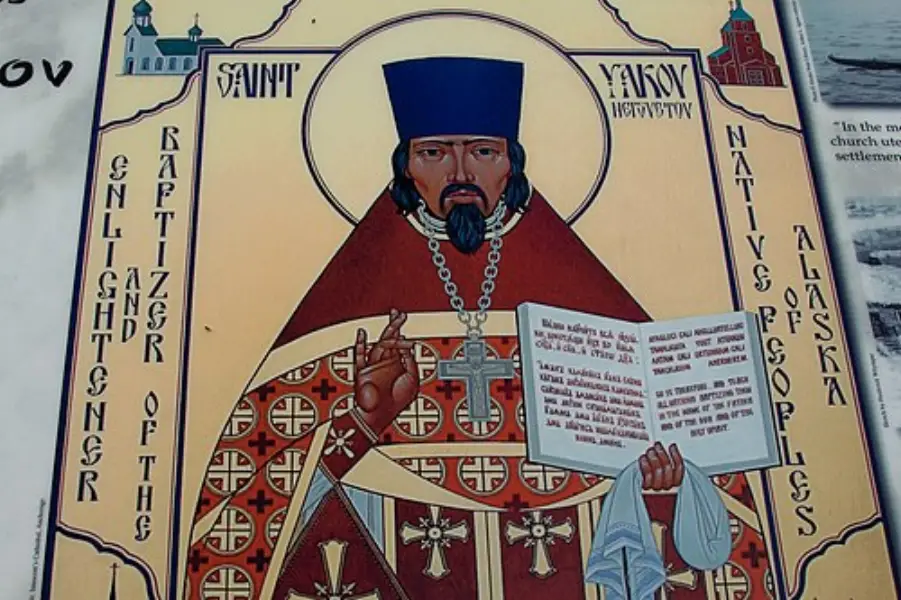
Jacob Netsvetov (1802–1864), called the Enlightener of Alaska, was a Creole of the Aleutian Islands who became the first native Alaskan ordained to the Orthodox priesthood and spent four decades evangelizing the peoples of the Bering Sea coast and the Yukon. Born on Atka to a Russian father from Tobolsk and an Aleut mother, he was educated at the Irkutsk Theological Seminary and ordained priest in 1828 by Archbishop Michael, returning to Alaska with antimensia for a new church at Atka. His parish spanned the islands of the Bering Sea; in his first six months he recorded hundreds of chrismations, and he built a school where Aleut children learned Russian and Unangan alongside Scripture. Widowed and burned out of his home in 1836, he pressed on, corresponding with St. Innocent of Alaska on linguistics, devising an Unangan-Aleut alphabet, and translating the Scriptures. In 1844 he took charge of the Kvikhpak Mission on the Yukon, where for twenty years he preached among the Yup'ik and Athabascan peoples. Cleared of false charges in 1863, he died at Sitka on July 26, 1864, and was glorified by the Orthodox Church in America in 1994.
The Complete Life
A Creole of Atka
Jacob Netsvetov was born in 1802 on Atka Island in the Aleutian chain, the eldest of four children who survived infancy. His father, Yegor Vasil'evich Netsvetov, was a Russian from Tobolsk who managed affairs for the Russian-American Company; his mother, Maria Alekseevna, was an Aleut woman of Atka. The household was thus Creole in the precise sense of Russian America — a family joining the languages, the customs, and the blood of two worlds. His surviving siblings followed distinct paths: Osip and Antony were sent to the Naval Academy at St. Petersburg, becoming a naval officer and a shipbuilder respectively, while their sister Elena married a clerk of the Russian-American Company. Jacob alone was drawn toward the church, and at an early age he was sent to the Irkutsk Theological Seminary, thousands of miles from his island home, to be formed in the learning his future ministry would require.
§ Early life
Ordination and the Journey Home
On October 1, 1825, Netsvetov was tonsured a subdeacon, and in 1826 he finished the seminary course, holding certificates in history and theology. He had married Anna Simeonovna, a Russian woman who shared, perhaps, his own Creole background; clerical marriage was the normal state of a parish priest, and the young couple prepared for ministry together. He was ordained deacon on October 31, 1826, and posted to the Holy Trinity and St. Peter Church at Irkutsk. There, on March 4, 1828, Archbishop Michael made him a priest — the first native Alaskan ever raised to that office. The archbishop gave him two antimensia for the altar, one for the church Jacob planned to build on Atka and one for use in his missionary travels. After a molieben, the party set out on May 1, 1828: the new priest, his wife Anna, and his father Yegor, tonsured a reader for the Atka church. The journey took more than a year, and they reached Atka on June 15, 1829.
§ Education and ordination
The Wide Parish of the Bering Sea
The Atka parish entrusted to Netsvetov reached across most of the islands and lands surrounding the Bering Sea, from Amchitka and Attu to the Copper, Commander, and Near Islands. Bilingual and bicultural, he moved easily among a diverse people. While St. Nicholas Church rose, he celebrated the services in a great tent, and he kept using the tent afterward so that he could preach in the remotest places. Within six months of his arrival he had recorded sixteen baptisms, four hundred and forty-two chrismations, fifty-three marriages, and eight burials — a people gathered into the church at a stroke. Then he turned to their children, teaching them to read and write in both Russian and Unangan Aleut; the Russian-American Company at first supported the school, which was reorganized as a parish school in 1841, and many of his pupils grew into the Aleut leaders of the next generation. In 1844 Innocent named him to lead the new Kvikhpak Mission on the Yukon, where with his nephew and two Creole assistants he based himself at Ikogmiute and traveled hundreds of miles by river, learning new languages, devising yet another alphabet, and building churches among the Yup'ik and Athabascan peoples at the invitation of their own leaders.
§ Missionary work in Atka
Scholar, Translator, Servant of the Word
Netsvetov's sanctity expressed itself in scholarship in the service of evangelization. He collected and prepared specimens of fish and marine animals for the museums of Moscow and St. Petersburg, corresponded with St. Innocent of Alaska on questions of linguistics and translation, worked out an Unangan-Aleut alphabet, and labored on translations of the Scriptures and other church publications into the language of his people. His industry drew recognition: praise from Innocent, elevation in time to the dignity of archpriest, and the imperial Order of St. Anna. Yet the same years took everything worldly from him. His wife Anna died in March 1836; in July fire destroyed his home; the following year his father Yegor died. Broken by these blows, he petitioned to return to Irkutsk and become a monk, and his bishop approved the request — contingent on a replacement arriving. No replacement ever came, and so the widowed missionary stayed at his post, offering his solitude as part of the sacrifice the troparion of his church would remember: a living sacrifice offered to bring light to a searching people.
§ Missionary work in Atka
Slander, Vindication, and Repose
The last chapter of Netsvetov's life brought both dishonor and vindication. In 1863 an assistant lodged charges against him, and Bishop Peter summoned him to Sitka to answer; the hearing cleared him of every accusation. His health now failing, he remained in the capital and served in the Tlingit chapel, ending his ministry among a people different from those he had first evangelized but equally his charge. Across his last missionary journeys in the Kuskokwim and Yukon delta he is remembered for baptizing more than a thousand persons — thirteen hundred and twenty — and for standing as the apostle of the Yup'ik and Athabascan peoples. He died of natural causes on July 26, 1864, at the age of sixty, while serving as a priest at St. Michael's Cathedral in New Archangel, and was buried at Holy Trinity Church in Sitka. The charges of 1863 have long since vanished from his memory; the church remembers him only as the righteous Father Jacob.
§ Death
Glorification in 1994
The Orthodox Church in America glorified Jacob Netsvetov as a saint in October 1994, at St. Innocent Cathedral in Anchorage, Alaska, enrolling the Enlightener of Alaska among its canon of saints. His feast falls on July 26, the day of his repose. The service books of his church give him the tones of a missionary confessor: his troparion hails him as the ornament of Atka and the Yukon delta, an offspring of Russian America and bond of brotherly peoples, healer of the sick and terror of demons; his kontakion names him a teacher of the knowledge of God who bore hardships like the Apostle Paul. Pilgrims and clergy of the OCA remember him as the first of Alaska's own children to stand at the altar, and his glorification in the cathedral named for his own mentor's successor joined his memory to the whole line of Alaskan evangelization, from Herman and Juvenaly to Innocent himself.
§ Hymns
An Enlightener's Long Shadow
Netsvetov's work endures in the Orthodox life of Alaska and in the very names of its people. Many descendants of Russian America living in Alaska bear family names that took root in his century, and follow his teachings in their daily life. The schools he founded trained the Aleut leadership of a generation; the alphabets and translations he produced preserved the Unangan and Yup'ik languages as vehicles for the Gospel; the parishes and communities he planted along the Yukon and Kuskokwim remain at the heart of Orthodoxy in western Alaska. He stands in the calendars beside the great missionaries of Russian America — Herman of Alaska, Juvenaly, and above all Innocent, his correspondent and commander — as the native son who fulfilled their work among his own people. The Orthodox Church in America keeps his life in print and pilgrimage, and Alaskan Orthodox texts in Aleut and Yup'ik still circulate from his hand, nearly two centuries after the young subdeacon of Irkutsk set out for home.
§ Sources
Timeline
- 1802
Born on Atka Island to Yegor Vasil'evich Netsvetov of Tobolsk and Maria Alekseevna, an Aleut of Atka
§ Early life
- 1 Oct 1825
Tonsured a subdeacon while a student at the Irkutsk Theological Seminary
§ Education and ordination
- 31 Oct 1826
Ordained a deacon after graduating with certificates in history and theology, and assigned to the Holy Trinity-St. Peter Church in Irkutsk
§ Education and ordination
- 4 Mar 1828
Ordained to the priesthood by Archbishop Michael, becoming the first native Alaskan priest
§ Education and ordination
- 1 May 1828
Departs Irkutsk for Alaska with his wife Anna and his father Yegor, tonsured a reader for the planned Atka church
§ Education and ordination
- 15 Jun 1829
Arrives at Atka after a journey of more than a year and begins serving under a tent while St. Nicholas Church is built
§ Missionary work in Atka
- Mar 1836
His wife Anna dies, and in July of the same year his home is destroyed by fire
§ Missionary work in Atka
- 1841
The school he founded at Atka is reorganized as a parish school after the Russian-American Company withdraws its support
§ Missionary work in Atka
- 30 Dec 1844
Appointed by Innocent to head the new Kvikhpak Mission on the Yukon River, with headquarters at the Yup'ik village of Ikogmiute
§ Missionary work in Atka
- 1863
An assistant brings charges against him; Bishop Peter summons him to Sitka, where he is cleared of all accusations
§ Missionary work in Atka
- 26 Jul 1864
Dies of natural causes while serving at St. Michael's Cathedral in New Archangel (Sitka), and is buried at Holy Trinity Church, Sitka
§ Death
- Oct 1994
Glorified as a saint at St. Innocent Cathedral in Anchorage by the Orthodox Church in America
§ Introduction
The Record
- Major works
- St. Nicholas Church and parish school at Atka·Unangan-Aleut alphabet and translations of the Scriptures·Kvikhpak Mission along the Yukon River·Churches and communities built across the Kuskokwim and Yukon delta
- Patron of
- Orthodox Church in America·Native Alaskan Orthodox Christians·Yup'ik and Athabascan peoples
- Symbols
- Priest's cross and Gospel book·Missionary's traveling icon case
- Canonization
- Glorified October 1994 at St. Innocent Cathedral, Anchorage, Alaska, by the Orthodox Church in America
Prayer
Bibliography
Show 6 sources
- Archimandrite Serafim (1973). The Quest for Orthodox Church Unity in America: A History of the Orthodox Church in North America in the Twentieth Century. Saints Boris and Gleb Press, p. 16
- "Saint Jacob Netsvetov", Canadian Orthodox History Project
- "Repose of St Jacob Netsvetov the Enlightener of the Peoples of Alaska", Orthodox Church in America
- "Saint Jacob Netsvetov", Orthodox Christian Network
- "St. Jacob (Netsvetov) — The Enlightener of peoples of Alaska", New York City Deanery, July 1, 2015
- Holy Synod of Bishops OCA, The Life of Saint Jacob Netsvetov, Oyster Bay Cove, New York, March 1994
Profile text adapted from the Wikipedia article, licensed CC BY-SA 4.0.
Pray with this saint every day
Save St. Jacob Netsvetov to your favorites, read the full profile, and get feast-day reminders in the Saints app.
Get the Saints AppFree on the App Store for iPhone and iPad