
died 62 (or 69)·Feast May 3
St. James the Just, Brother of the Lord
First bishop of Jerusalem and martyr
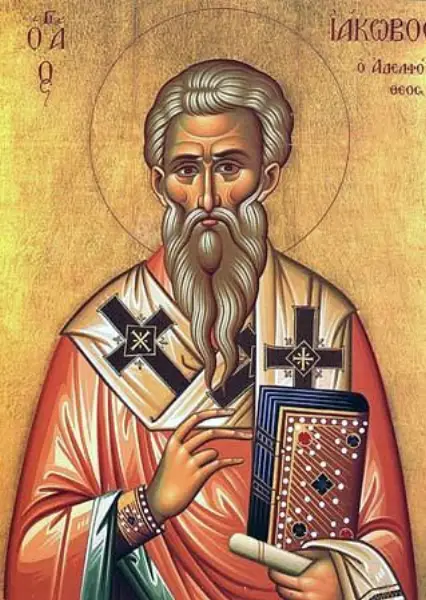
Overview
James the Just, called in the New Testament the brother of Jesus, was the first leader of the church of Jerusalem and one of the most commanding figures of early Christianity. Named first among the brothers of Jesus in the Gospels, he was a personal acquaintance of Paul, who visited him in Jerusalem, and one of the witnesses to whom the risen Christ was said to have appeared. Paul names him with Peter and John as a pillar of the church, and after Peter's departure from Jerusalem he presided over the Council of Jerusalem, shaping the ruling that freed Gentile converts from circumcision. Catholic tradition identifies him with James the son of Alphaeus and James the Less, while distinguishing him from James the son of Zebedee. Ancient writers describe an ascetic of extraordinary severity, a man of prayer whose intercession for the people was ceaseless. His death is disputed: Josephus records that the high priest Ananus had him stoned in 62, while Hegesippus tells of his being cast from the temple pinnacle and clubbed in 69. Honored by every ancient church, he left his name to the Epistle of James and to the oldest surviving Christian liturgy.
The Complete Life
Brother of the Lord
The Gospels name James first among the brothers of Jesus, alongside Joses, Simon, and Judas, and mention unnamed sisters as well, a placement that suggests he was the eldest of the group. What that kinship meant became one of the oldest questions of Christian interpretation, for the Greek word adelphos and the Semitic idiom behind it can denote a full brother, a half brother, a stepbrother, or a cousin. Three main solutions emerged. Some interpreters, from Tertullian to Helvidius and modern historians such as Charles Freeman, held that James and his siblings were the natural children of Mary and Joseph, born after Jesus. The second-century Protoevangelium of James, followed by Epiphanius of Salamis in his Panarion, taught that James was Joseph's son by his first wife, making him Jesus's stepbrother; on this view Joseph was a widower of eighty when he took Mary. A third line, argued by Eusebius and elaborated by Jerome, made James the son of Mary of Clopas, the Lord's cousin. The only defined Catholic doctrine on the question is negative: the brothers were not the biological children of Mary. Disagreement about the exact relationship to Jesus remains a marked feature of his record.
§ Relationship to Jesus, Mary and Joseph
Pillar of the Church
However his kinship is understood, James's standing in the earliest church was singular. Paul reckoned him among those to whom the risen Christ appeared, and after a visit to Jerusalem three years after his conversion reported that he saw no apostle except James, the Lord's brother. In time Paul ranked him with Cephas and John as pillars of the church, entrusted with the mission to the circumcised as Paul was with the mission to the Gentiles. Clement of Alexandria, as Eusebius preserves his words, relates that Peter, James, and John, though honored by the Lord above all, declined to quarrel for glory and instead seated James the Just on the episcopal throne of Jerusalem; Jerome says the apostles ordained him and that he governed the church of the holy city for thirty years. From an early date he stood with Peter at the head of the Jerusalem community, and once Herod Agrippa's persecution drove Peter from the city, James appears as the presiding authority. He is sometimes styled Adelphotheos, Brother of God, an epithet borne by the oldest surviving Christian liturgy, and in the lists of the Seventy he frequently stands first, though the Catholic Encyclopedia judges those lists worthless.
§ Leader
The Council of Jerusalem
James's decisive hour came at the council that had to decide whether Gentile converts must be circumcised to be saved. When the church of Antioch sent Paul and Barnabas to Jerusalem to confer on the question, James played a prominent part in shaping the outcome. He spoke last, after Peter, Paul, and Barnabas, and delivered what Acts records as his decision, a word whose original sense lies closer to opinion. He sided with those who rejected the requirement of circumcision, Peter having recalled his revelation concerning the Gentiles, and proposed instead prohibitions against food offered to idols, blood, the meat of strangled animals, and fornication. That compromise became the ruling of the council, agreed to by the apostles and elders and circulated to the churches by letter, and Acts presents James as a principal author of this Apostolic Decree. Years later, when Paul came to Jerusalem bearing the collection he had gathered for the poor, it was to James that he reported, and James who urged him to purify himself in the temple to disprove the rumor that he taught rebellion against the law of Moses. Modern historians place him at the head of the conservative, Jewish-Christian wing of the early church.
§ Leader
The Ascetic of the Temple
The portrait drawn by Hegesippus, which Eusebius copied into his Ecclesiastical History, made James a wonder of ascetic holiness from the womb. He drank no wine or strong drink, he ate no meat, no razor touched his head, and he refused both anointing with oil and the use of the bath, wearing linen rather than wool; Epiphanius accordingly classes him a Nazirite. He alone, the account says, was permitted to enter the holy place, and he was constantly found kneeling in intercession for the people, so that his knees grew hard like a camel's from his ceaseless prayer. The title all antiquity gave him, the Just, or the Righteous, expressed this reputation: Clement of Alexandria records that people of old called him so on account of his outstanding virtue. Apocryphal texts amplify the same reverence. The Gospel of the Hebrews describes the risen Lord appearing first to James, who had sworn not to eat until he saw him risen, and sharing bread with him; the Gospel of Thomas makes the disciples ask who should lead them after Jesus departs, and the answer is James the Just, for whose sake heaven and earth came into being. Epiphanius adds that he died in virginity at ninety-six.
§ Church Fathers
Martyrdom in Jerusalem
Two ancient accounts of his death survive, and they disagree. Josephus, in the twentieth book of the Antiquities, reports that the high priest Ananus ben Ananus, a Sadducee of bold temper, seized the interval after the death of the procurator Festus and before the arrival of Albinus to convene the Sanhedrin, bring before it James, the brother of the one called Christ, together with several companions, and have them stoned for breaking the law. Fair-minded citizens of Jerusalem, strict observers of the law among them, protested the proceeding as little better than judicial murder, and King Agrippa II deposed Ananus in consequence. Modern scholarship almost universally accepts the passage as authentic, and most historians prefer it to the rival tradition. That tradition, told by Hegesippus, places the martyrdom at the Passover: scribes and Pharisees set James on the temple pinnacle and asked him to restrain the people from Jesus; instead he confessed Christ seated at the right hand of power, was thrown down, stoned when the fall did not kill him, and finally struck on the head with a fuller's club, praying as he died for his executioners. Origen even linked his death to the coming siege of Jerusalem.
§ Death
Feasts of East and West
Veneration of James spread through every ancient church without any formal process, and his feasts multiplied. In the Catholic Church his commemoration, joined to that of the apostle Philip, was kept on May 1, the anniversary of the Roman church now called the Church of the Twelve Apostles, before the combined feast moved to May 3 in the present calendar; the Church of England keeps the festival with Philip on May 1. The Eastern Orthodox Church honors him repeatedly in the year: on October 23, a date recently adopted also by the Episcopal Church and several Lutheran bodies; on the Sunday after the Nativity, together with David the king and Joseph the Betrothed; on December 26 in the Synaxis of the Mother of God; and on January 4 among the Seventy Apostles. The translation of his relics, together with those of Simeon and Zacharias, is commemorated on December 1, and their discovery, which occurred in the year 351, on May 25. In the Eastern tradition he bears the title Apostle, Martyr, and Adelphotheos, Brother of God, the last enshrined in the Liturgy of Saint James, the oldest surviving Christian liturgical rite.
§ Feast day
The Epistle and the Ossuary
Two modern disputes keep James conspicuously before scholars. The first concerns the Epistle of James, traditionally assigned to him since at least the year 253, though many contemporary scholars now contest the attribution. The second is archaeological. In November 2002 the Hebrew scholar André Lemaire reported in Biblical Archaeology Review that an ossuary in the possession of collector Oded Golan bore the Aramaic inscription "James, son of Joseph, brother of Jesus"; the bone box was exhibited that year at the Royal Ontario Museum in Toronto. In June 2003 the Israeli Antiquities Authority concluded from analysis of the patina that the inscription was a recent forgery, aged artificially with a chalk solution, and the museum withdrew the piece. Golan and three associates were indicted in 2004 as members of a forgery ring said to have operated for more than two decades, but in March 2012 an Israeli court acquitted Golan of all forgery charges, while the judge cautioned that acquittal did not establish the inscription's authenticity. The Israeli Antiquities Authority and several scholars still maintain the artifact is a modern fake, and students of the historical Jesus rarely cite it. Josephus's brief notice remains the chief non-Christian evidence for James's life.
§ Ossuary inscription
Timeline
- 44
Following the martyrdom of James the son of Zebedee around this year, he emerged as the principal authority of the Jerusalem church, according to Philip Schaff's chronology.
§ Leader
- 62
Condemned by the high priest Ananus ben Ananus and stoned to death at Jerusalem, in the interval between the deaths of Festus and Albinus.
§ Death
- 69
Alternative dating of his martyrdom by Hegesippus, who places his death at the temple pinnacle at the hands of scribes and Pharisees.
§ Death
- 70
As Eusebius tells it, the believers of Jerusalem fled to Pella while Titus besieged the city, and afterward came back.
§ Leader
- 130
The series of Jewish bishops of Jerusalem that followed him continued until the Bar Kokhba revolt, after which Greek bishops led the rebuilt city.
§ Leader
- 253
By this date the Epistle of James had come to be traditionally attributed to James the Just.
§ Epistle of James
- 351
The relics of James, Simeon, and Zacharias were discovered, an event commemorated on May 25.
§ Feast day
- 1 Dec 351
The translation of his relics, with those of Simeon and Zacharias, is commemorated on December 1.
§ Feast day
- Nov 2002
André Lemaire announced in Biblical Archaeology Review the identification of an ossuary inscribed "James, son of Joseph, brother of Jesus".
§ Ossuary inscription
- 18 Jun 2003
The Israeli Antiquities Authority published a report judging the ossuary inscription a modern forgery, and the Royal Ontario Museum removed it from display.
§ Ossuary inscription
- 29 Dec 2004
Collector Oded Golan and three others were indicted in an Israeli court as members of an alleged forgery ring.
§ Ossuary inscription
- 14 Mar 2012
Golan was acquitted of all forgery charges, though the court did not rule the inscription authentic.
§ Ossuary inscription
In Their Own Words
I beseech thee, Lord God our Father, forgive them; for they know not what they do.
The Record
- Major works
- Epistle of James (traditional attribution)
- Symbols
- fuller's club·red martyr·man holding a book
- Canonization
- Pre-congregation; venerated as a martyr and apostle by all Christian churches that honor the saints
Prayer
Bibliography
Show 8 sources
- "St. James, Apostle, the Lord's brother". Encyclopædia Britannica. March 15, 2024.
- Bauckham, Richard (1999). "For What Offense was James put to Death?" In Chilton, Bruce; Evans, Craig A. (eds.). James the Just and Christian Origins. Brill. ISBN 978-90-04-11550-7.
- Brown, Raymond E. An Introduction to the New Testament. New York: Doubleday, 1997. ISBN 0-385-24767-2.
- Eisenman, Robert. James the Brother of Jesus: The Key to Unlocking the Secrets of Early Christianity and the Dead Sea Scrolls. Viking Penguin, 1997.
- Neusner, Jacob; Chilton, Bruce, eds. (2001). The Brother of Jesus: James the Just and His Mission. Westminster John Knox Press. ISBN 9780664222994.
- Painter, John (2005). Just James: The Brother of Jesus in History and Tradition. Bloomsbury Academic. ISBN 0-567-04191-3.
- Shanks, Hershel; Witherington, Ben. The Brother of Jesus. New York: HarperSanFrancisco, 2003. ISBN 0-06-055660-9.
- Van Voorst, Robert E. (2000). Jesus Outside the New Testament: An Introduction to the Ancient Evidence. Wm. B. Eerdmans Publishing Co. ISBN 0-8028-4368-9.
Profile text adapted from the Wikipedia article, licensed CC BY-SA 4.0.
Pray with this saint every day
Save St. James the Just, Brother of the Lord to your favorites, read the full profile, and get feast-day reminders in the Saints app.
Get the Saints AppFree on the App Store for iPhone and iPad