
1847 – 1885·Feast October 29
St. James Hannington
First Anglican bishop of East Africa, martyred in Busoga
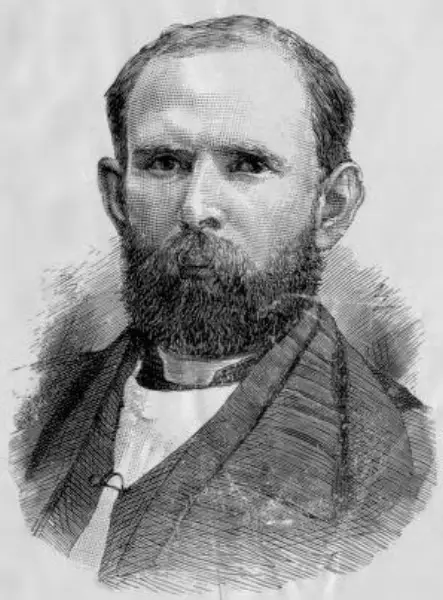
Overview
James Hannington — born 3 September 1847, killed 29 October 1885 — was an English missionary of the Anglican communion, the first of its bishops in East Africa, and one of the earliest of the Martyrs of Uganda. Born at Hurstpierpoint in Sussex into the family behind the Hanningtons department stores, he grew up a collector and an indifferent student, left school at fifteen for his father's counting house, and rose to major in the 1st Sussex Artillery Volunteer Corps. His family, formerly Congregationalist, joined the Church of England in 1867; at Oxford he prepared for orders, and after his mother's death in 1872 deepened his faith. Made deacon in 1874 and priest in 1875, he served as curate-in-charge at St George's, Hurstpierpoint until 1882, when news of missionaries murdered near Lake Victoria moved him to offer himself to the Church Missionary Society. Invalided home in 1883, he was consecrated bishop on 24 June 1884 by Archbishop Edward White Benson for the See of Eastern Equatorial Africa, returning to Africa in January 1885. Seeking a shorter highland route to Buganda that would undercut the Arab slave trade, he traversed Busoga against the prohibition of Kabaka Mwanga II, was imprisoned for eight days, and on 29 October 1885 was speared to death at Kyando village, reportedly saying he had purchased the road to Uganda with his blood.
The Complete Life
A Shopkeeper's Son from Sussex
James Hannington was born at Hurstpierpoint in Sussex on 3 September 1847, some eight miles from the resort town of Brighton; his father, Charles Smith Hannington, managed a warehouse there and belonged to the family behind the Hanningtons department stores. His father had recently acquired a property called St George's, which would later figure in his ministry. The boy was an amateur naturalist of sorts — a keen collector — and a reckless one: black powder cost him a thumb in a boyhood accident. A tutor oversaw his early education until, at thirteen his parents sent him to Brighton's Temple School, where two and a half years of study left him, by his own account, an indifferent scholar. At fifteen he left school altogether for the practical world of his father's Brighton counting house. Energy and discipline found their outlet elsewhere: in 1864 he received a commission in the 1st Sussex Artillery Volunteers, climbing to the rank of major; drilled under him, his detachment carried off prizes at the yearly camp contests. The family were Congregationalists who joined the Church of England in 1867, the year his father's private chapel, built in 1852, was licensed for Anglican services. The same year, aged twenty-one, Hannington resolved on a clerical career and went up to St Mary Hall, Oxford, where he led the Red Club as its president and captained the hall's boat.
§ Early life
From Oxford Curate to Missionary Volunteer
The turning point of Hannington's inner life came with grief. In 1872 his mother died, and the loss changed the direction of his faith; in the same period he completed his degree, taking his BA. On 1 March 1874 he was made a deacon by Frederick Temple, Bishop of Exeter, in Exeter Cathedral, and took a curacy at Martinhoe with Trentishoe in Devon — a remote Exmoor parish whose sea caves are still associated with his memory. Ordained priest the following year, he became in 1875 curate-in-charge of St George's, Hurstpierpoint, the church on his father's property, and there he settled into the respectable life of a country curate, married, and served for seven years. In 1882 everything changed. Word reached England that two missionaries had been murdered on the shores of Lake Victoria, and Hannington, in his mid-thirties, offered himself to the Church Missionary Society. He left England on 17 May 1882, and on 29 June set out for Zanzibar leading a band of six missionaries. The African climate proved crueler than any enemy: crippled by fever and dysentery, he was forced back to England in 1883 — a failure, as some saw it, that only sharpened his resolve to return.
§ Ministry
Bishop of Eastern Equatorial Africa
Recovery brought elevation. On 24 June 1884, the feast of St John the Baptist, Hannington was consecrated a bishop by Edward White Benson, Archbishop of Canterbury, at St Mary-at-Lambeth, for the newly created See of Eastern Equatorial Africa — the first Anglican bishop of East Africa. His diocese embraced the Church Missionary Society's stations on the coast and far inland among the missions of Buganda. In January 1885, aged thirty-seven, he sailed again for Africa. Arriving at Freretown near Mombasa, he made a decision that would seal his fate: rather than follow the established caravan route through the south, he meant to open a shorter and healthier route through the highlands to Buganda, staffed by Christian porters and aimed squarely at breaking the Arab slavers' southern road. The plan was bold but politically naive, for Busoga, through which he proposed to pass, was a strategically sensitive region for the Buganda state. The recent intrusion of German imperial power at the coast had made Kabaka Mwanga II intensely suspicious of European intentions, and a court oracle had foretold that the man who would conquer Buganda would arrive out of the east. Mwanga therefore commanded him to travel by water to Sukumaland; Hannington refused. On 21 October 1885 the party safely reached the neighborhood of Lake Victoria, but by the Kabaka's orders the missionaries were seized and imprisoned by Basoga chiefs.
§ Ministry
Martyrdom at Kyando
Hannington endured eight days of captivity in Basoga before the end came. First his porters were put to death on Mwanga's orders; then, on 29 October 1885, the bishop himself was speared in both sides at Kyando village. As he died he is said to have addressed his killers with the message that made him immortal: that they should go and tell Mwanga he had purchased the road to Uganda with his blood. His tombstone at Namirembe preserves a variant of the saying — that he died for Buganda and had bought the road with his life — together with the beatitude of Revelation 14:13 on those who die in the service of the Lord. Alexander Murdoch Mackay, writing from the Buganda side in May 1886, insisted the murder was unprovoked and unjustifiable: the king could simply have turned the bishop back, but was determined to kill a European of high standing as what Mwanga himself called a challenge to the whole of Europe — even though the missionaries had come at the king's own repeated invitation. Persecution of Christians swept Buganda in the aftermath; many were killed or sold to Arab slavers, and Joseph Mukasa Balikuddembe, a Catholic court official who rebuked the king, was beheaded. Hannington and his companions stand among the first Martyrs of Uganda.
§ Ministry
Martyr Remembered in Two Churches and Two Lands
As an Anglican, Hannington was not canonized by Rome, but the churches of the Anglican Communion rank him without hesitation among the saints, styling him Bishop and Martyr. The Church of England keeps his feast on 29 October, the day of his death, and the Episcopal Church in the United States honors him on the same date. In Uganda his memory is enshrined where his remains were laid: after the location of his bones was divulged to Bishop Alfred Tucker in 1892, they were reburied at Namirembe on 31 December of that year, and a memorial chapel in Namirembe Cathedral in Kampala commemorates him today. His tombstone records both the facts of his martyrdom and his reported last words, inviting pilgrims to read the cost of the faith in stone. In England, remembrance concentrated in his native Sussex: the Bishop Hannington Memorial Church at West Blatchington, Hove, was erected, its dedication stone of 1938 bearing the words "Thou hast turned my heaviness into joy" — an epitaph that captures the cheerfulness for which he was known. Even the map remembers him: Lake Bogoria in Kenya long bore the name Lake Hannington. In the Anglican calendar of martyrs he stands beside the Uganda Martyrs whose deaths, following his, watered one of Africa's most fruitful churches.
§ Ministry
The Road Bought with Blood
Hannington's legacy is inseparable from the church of Uganda. The road he purchased with his blood was, in the event, the road along which Christianity traveled into the heart of the Great Lakes: the persecution his murder ignited produced the Uganda Martyrs, Catholic and Anglican alike, whose witness transformed Buganda, and the Church of Uganda counts him among its founding witnesses. His instinct that the highland route could undercut the Arab slave trade placed the missionary enterprise, from the first, on the side of the enslaved, and his use of Christian porters modeled a self-consciously African church from the outset. In his homeland he became one of the great heroes of the Victorian missionary movement, the subject of near-contemporary biographies — Edwin Collas Dawson's life of 1887 appeared within two years of the martyrdom — and of retellings ever since, from Joyce Reason's Bishop Jim to modern studies. His scientific curiosity survived in the shell collections he sent home from Africa, described by E. A. Smith in the Annals and Magazine of Natural History, a reminder that this bishop-explorer belonged also to the tradition of naturalist travelers. Above all, his reported last words became proverbial in missionary circles, a summary of the conviction that no human kingdom can bar a road that God intends to open.
§ Legacy
Timeline
- 3 Sep 1847
Born at Hurstpierpoint, Sussex, into the family of Hanningtons department stores
§ Early life
- 1864
Obtains a commission in the 1st Sussex Artillery Volunteer Corps, eventually rising to major
§ Early life
- 1867
His family joins the Church of England; he resolves on a clerical career and enters St Mary Hall, Oxford
§ Ministry
- 1 Mar 1874
Made a deacon by Bishop Frederick Temple at Exeter Cathedral, taking a curacy at Martinhoe with Trentishoe, Devon
§ Ministry
- 1875
Ordained priest and becomes curate-in-charge of St George's, Hurstpierpoint
§ Ministry
- 1882
Volunteers for missionary work after hearing of two missionaries murdered near Lake Victoria; sails for Zanzibar at the head of six missionaries
§ Ministry
- 1883
Crippled by fever and dysentery, forced to return to England
§ Ministry
- 24 Jun 1884
Consecrated a bishop by Archbishop Edward White Benson at St Mary-at-Lambeth for the See of Eastern Equatorial Africa
§ Ministry
- Jan 1885
Departs again for Africa at age thirty-seven to take up his diocese
§ Ministry
- 21 Oct 1885
Reaches a spot near Lake Victoria with his team, but is imprisoned by Basoga chiefs on the orders of Kabaka Mwanga II
§ Ministry
- 29 Oct 1885
After eight days of captivity, speared to death at Kyando village in Busoga; his porters are killed beforehand
§ Ministry
- 31 Dec 1892
His remains, located through Bishop Alfred Tucker, are reburied at Namirembe
§ Ministry
In Their Own Words
Go, tell Mwanga I have purchased the road to Uganda with my blood.
Thou hast turned my heaviness into joy
The Record
- Major works
- Pioneering of a shorter highland road to Buganda intended to undercut the Arab slave route·Shell collections from East Africa described by E. A. Smith in the Annals and Magazine of Natural History·Service as first Bishop of the See of Eastern Equatorial Africa
- Patron of
- missionaries and bishops of East Africa·the Church of Uganda
- Symbols
- Bishop's mitre and crozier·palm of martyrdom·spear
- Canonization
- Not canonized; honored as a martyr in the Church of England and the Episcopal Church, feast October 29
Prayer
Bibliography
Show 7 sources
- Verdcourt, Bernard (June 1981). "James Hannington - 1847-1885 - Collectors in East Africa - 3". The Conchologists' Newsletter (77): 317–318
- "Looking back: A store with a special place in Brighton and Hove's history". The Argus. 8 July 2013
- Hansford, F. E. "James Hannington (1847-1885)". Great Churchmen No. 22. Church Book Room Press
- Anderson, Gerald H. (1999). Biographical Dictionary of Christian Missions. Wm. B. Eerdmans. p. 278. ISBN 978-0-8028-4680-8
- Dawson, Edwin Collas (1887). James Hannington, D.D., F.L.S., F.R.G.S., First Bishop of Eastern Equatorial Africa: A History of His Life and Work, 1847-1885. Seeley
- Mackay, J.W.H. (1970). A.M. Mackay: Pioneer Missionary of the Church Missionary Society Uganda. Routledge. ISBN 9780203770597
- Quinn, Frederick (2002). African Saints: Saints, Martyrs, and Holy People from the Continent of Africa. Crossroad. ISBN 978-0-8245-1971-1
Profile text adapted from the Wikipedia article, licensed CC BY-SA 4.0.
Pray with this saint every day
Save St. James Hannington to your favorites, read the full profile, and get feast-day reminders in the Saints app.
Get the Saints AppFree on the App Store for iPhone and iPad