
1854 – 1935·Feast November 25
St. James Huntington
Founder of the Order of the Holy Cross
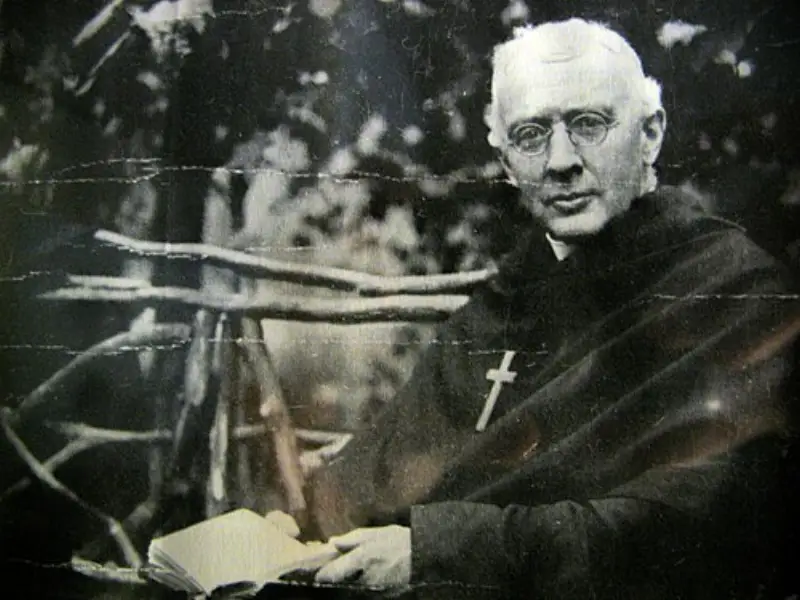
Overview
James Otis Sargent Huntington was an American Episcopal priest and professed monk, born in 1854 into a prominent Massachusetts family whose father, Frederick Dan Huntington, left Unitarian ministry to become Bishop of Central New York. Educated at Harvard and at St. Andrew's Divinity School in Syracuse, James was ordained priest in 1880 by his own father and began ministry among the urban poor, first in Syracuse and then on Manhattan's Lower East Side. A retreat experience drew him toward the religious life, and rather than joining an existing English community he founded a distinctly American one: the Order of the Holy Cross, a Benedictine community for men now based at West Park, New York. After his first companions withdrew, he made his profession alone on 25 November 1884, the date on which the Episcopal Church now remembers him. He served several terms as the order's Superior, guided its relocation to Maryland and then to West Park, championed the labor movement of his day, and helped establish schools, homes, and a mission in Liberia. He died on 28 June 1935 and is buried in the monastery church at West Park.
The Complete Life
A Household Converted
James Otis Sargent Huntington was born on 23 July 1854 at Roxbury, Massachusetts, the second of the two sons of Frederick Dan and Hannah Huntington. His childhood was shaped by an unusual religious reversal: his father, a Unitarian minister of cultivated Boston background, embraced the Episcopal Church while James was still a boy, was ordained in turn as deacon and priest, took charge of Emmanuel Episcopal Church in Boston, and rose quickly to the episcopate as Bishop of Central New York. The household thus moved within the highest circles of the American church, and the son's path followed the father's in striking detail. James was sent to St. John's Academy in Manlius, New York, where he distinguished himself sufficiently to serve as head boy in 1873. He then proceeded to Harvard College, as his father had done before him, and upon graduation turned to theological study at St. Andrew's Divinity School in Syracuse. By upbringing, education, and temperament he was formed for the leadership of the Episcopal Church; what remained was for him to discover a form of ministry unlike any his cultivated world expected.
§ Early and family life
Called to the Cloister in a New Land
Huntington was ordained priest by his own father on 30 May 1880 and went at once to minister to a working-class congregation at Calvary Mission in Syracuse. The following year he moved to Holy Cross Mission on Manhattan's Lower East Side, among the crowded tenements of the immigrant poor. Soon after his ordination he attended a retreat at St. Clement's Church in Philadelphia, and there the sense of a monastic calling took firm hold of him. The Episcopal Church of his day had long resisted religious orders, and the only men's community at work in the country, the Society of St. John the Evangelist, was an English foundation that had opened a Boston house a decade earlier. Huntington chose instead to plant something native to American soil. With two companions, Robert Dod and James Cameron, he established the Order of the Holy Cross, and the little band continued the punishing work among the poorest quarters of the Lower East Side. The hours were long and the common discipline severe; first one companion and then the other withdrew. Alone, Huntington made his profession as a monk on 25 November 1884, at the Chapel of the Sisters of St. John the Baptist in New York City, committing himself to an order that consisted, at that moment, of one man.
§ Ministry
Parishes, Schools, and a Mission Overseas
The order he had founded chose Huntington as its Superior repeatedly across the following decades, yet he never allowed administration to absorb him, concentrating instead on parish and missionary labor. Under his leadership the community left the city: it relocated in the 1890s to rural Westminster, Maryland, and in 1902 to West Park, New York, on the Hudson. That year the cornerstone was laid for the order's monastery, designed by the Gothic-Revival architect Henry Vaughan and finished in 1904; no Anglican order had raised a house of its own since the days of Henry VIII, and the monastery now serves the community as its guest house. Huntington's founding energy reached far beyond the cloister walls. He established or assisted in establishing St. Faith's Home for Wayward Girls in Tarrytown, New York, and St. Andrew's School at Sewanee; Kent School in Kent, Connecticut was founded in 1906 by Frederick H. Sill of his community; and a mission was planted in Liberia in West Africa. In each of these undertakings the same conviction appears: that the monastic life must issue in schools for the young, shelter for the vulnerable, and the gospel carried to those beyond the reach of the church.
§ Ministry
A Monk Among Working People
Huntington's spirituality joined the cloister to the picket line. At a time when religious life in America was regarded with deep suspicion, he insisted that vows and social conscience belonged together, and he put himself in the way of considerable unpopularity to prove it. He became active in the labor union movement and in the Georgist cause of land-value taxation, identifying himself with the struggles of the working people among whom his ministry had begun. He stood among the early members of the Knights of Labor, the great nineteenth-century labor organization, and was later among the founders of what became the Church Association — an organization devoted to advancing the interests of labor, a body that labored to bring the weight of the churches to the side of workers seeking just conditions. This social radicalism was not a departure from his monasticism but an expression of it: a man who had bound himself by vow to poverty could hardly preach the gospel to the hungry without demanding that society feed them. His daily regimen of prayer, community, and manual service gave his advocacy its permanence, and his advocacy gave his community a public face. In him the Episcopal Church saw, for the first time in generations, the old ideal of the religious renewed in an American industrial city.
§ Ministry
An Order That Outlived Its Founder
Huntington died on 28 June 1935, having led the Order of the Holy Cross from a companionship of one to a lasting American religious community. He was buried in the Monastery Church of St Augustine at West Park, the Gothic building he had raised on the Hudson half a century before. What he left behind proved durable. The order continues its life of prayer and service to the present day, and several of the schools that he and his community planted — most famously Kent School — still educate children more than a century after their founding. The Episcopal Church, once hostile to the very idea of monastic vows, took his memory into its calendar of saints, commemorating him each year on 25 November, the anniversary of the day in 1884 when he professed himself a monk while the order he founded existed in his person alone. That choice of date is fitting: it fixes his sainthood not at his death nor at his success, but at the moment of loneliest commitment, when the future of American monasticism rested on the perseverance of a single stubborn priest.
§ Death and legacy
Timeline
- 23 Jul 1854
Born at Roxbury, Massachusetts, the second of the two sons of Frederick Dan and Hannah Huntington
§ Early and family life
- 1873
Completes studies at St. John's Academy in Manlius, New York, serving as head boy
§ Early and family life
- 30 May 1880
Ordained priest by his father and begins ministry at Calvary Mission among working people in Syracuse
§ Ministry
- 1881
Moves to Holy Cross Mission on the Lower East Side of Manhattan
§ Ministry
- 25 Nov 1884
Makes lifelong profession as a monk at the Chapel of the Sisters of St. John the Baptist in New York City
§ Ministry
- 1902
Leads the Order of the Holy Cross from Maryland to West Park, New York, where the cornerstone of the new monastery is laid
§ Ministry
- 1904
The new monastery building at West Park, the first erected for an Anglican order since the reign of Henry VIII, is completed
§ Ministry
- 1906
Kent School is founded in Kent, Connecticut by Frederick H. Sill of the Order of the Holy Cross
§ Ministry
- 28 Jun 1935
Dies and is buried in the Monastery Church of St Augustine at West Park
§ Death and legacy
The Record
- Major works
- Order of the Holy Cross·St. Faith's Home for Wayward Girls, Tarrytown, New York·St. Andrew's School at Sewanee·Kent School, Kent, Connecticut·Mission in Liberia
- Patron of
- Labor movements and workers·Anglican religious orders
- Symbols
- Monk's habit·Benedictine cross
- Canonization
- Not canonized; commemorated on the calendar of saints of the Episcopal Church on 25 November, the anniversary of his monastic profession
Prayer
Bibliography
Show 4 sources
- "Huntington, James Otis Sargent", The Episcopal Church
- "James Otis Sargent Huntington, Priest and Monk, 1935", Standing Commission on Liturgy and Music of the Episcopal Church
- "Our History | Kent School", archived from the original on 19 January 2015
- Lesser Feasts and Fasts 2018, Church Publishing, Inc., 2019, ISBN 978-1-64065-235-4
Profile text adapted from the Wikipedia article, licensed CC BY-SA 4.0.
Pray with this saint every day
Save St. James Huntington to your favorites, read the full profile, and get feast-day reminders in the Saints app.
Get the Saints AppFree on the App Store for iPhone and iPad