
d. 420·Feast November 27
St. James Intercisus
Martyr (James the Persian, 'the Cut to Pieces')
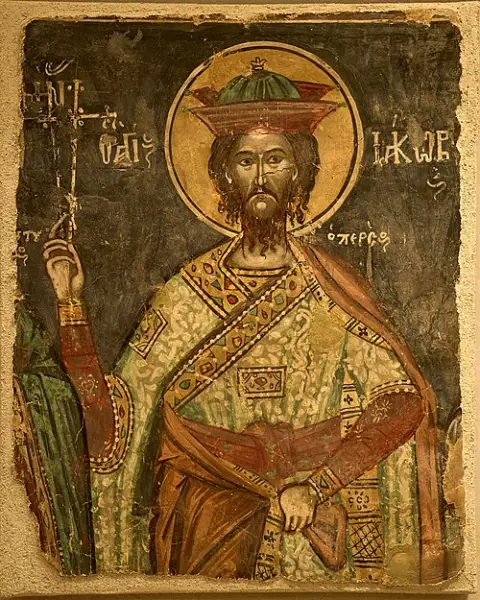
Overview
James Intercisus — the Persian deacon-soldier whose Latin epithet means cut into pieces, echoed in Syriac as Mor Yaqoub M'pasqo Sahada — was born in Beth Huzaye and died at Beth Lapat, the great Christian city of Sasanian Khuzestan, on 27 November 420. Tradition makes him a military officer and courtier of Yazdegerd I who, when that king turned against the Christians, lapsed from the faith to keep his place at court. At his family's urging, he went to Bahram V — Yazdegerd's successor, under whom the onslaught on Christians grew heavier — and openly professed Christ once more. The price was the manner of death that gave him his name: he was mutilated piece by piece and remained alive through the loss of his limbs until he was finally beheaded. His death, together with the wider persecution of Persian Christians, helped ignite the Roman-Sassanid War of 421-422. Followers who were refused his relics are said to have stolen them; portions reached the cathedral of Braga in Portugal, the abbey of Cormery by gift of Bishop Guillermus Ludovicus in 1103, and a finger bone enshrined at Pengamuck in Kerala. Rabenstein and others suggest he may be a composite of several Persian martyrs.
The Complete Life
Early Life
James, whose Latin name Intercisus means cut to pieces, and whose Syriac name Mor Yaqoub M'Pasqo Sahada carries the same meaning, was a Persian Christian of the early fifth century, born in Beth Huzaye, the ecclesiastical province of Khuzestan in the Sasanian empire. He lived at the court of the shah Yazdegerd I, whose reign, after initial tolerance, turned to a persecution that the Christian chronicles of the East remember as catastrophic. James served as a military officer and courtier, a Christian in the confidence of a Zoroastrian king, a position the Christians of the Iranian world occupied at their peril. His life falls in the century when the churches of Persia, suspected as a fifth column of Christian Rome, lived under recurring accusation, and his death became the emblem of that entire age of the Persian church.
§ Introduction
Conversion and Vocation
The tradition states that James apostatized during Yazdegerd's persecution, denying his faith to keep his place at court, an apostasy his Christian family refused to let stand. Under their influence, and above all at the appeal of his mother and his wife, he repented, and under Yazdegerd's successor Bahram V, whose persecution of Christians was fiercer than his father's, he went to the king and declared himself a Christian, reversing his denial before the court that had witnessed it. The return of the apostate is the theological center of his legend: his martyrdom was, in the church's memory, the second act of a faith first betrayed and then recovered, and the Syriac churches have always told the two acts as one story.
§ Life
Trial and Final Years
Condemned by Bahram, James was executed at Beth Lapat, the city near modern Dezful in Iran whose ruins remain, one of the chief sees of the Persian church and a principal seat of the persecution. The manner of his death gave him his name: he was cut to pieces limb by limb, and the tradition insists that he remained alive and confessing through the mutilation until he was beheaded. His followers asked to receive his remains as relics. His death, and the persecution it crowned, had consequences beyond the church: the Sasanian seizure of Christian property and the killing of clergy were among the causes of the brief Roman-Sasanian war of 421 and 422, in which Theodosius II intervened, and the memory of James was bound to that politics from the beginning.
§ Introduction
Canonization
James Intercisus is a pre-congregation saint, honored in the Syriac churches that inherited the tradition of Beth Lapat, and received into the Byzantine, Catholic, and Oriental Orthodox calendars. His feast is kept on 27 November in the western martyrologies, and on 27 Hathor in the Coptic synaxarium, the distribution showing how widely the legend of the Persian martyr travelled. A relic of the martyr was carried to Braga in Portugal in the medieval period, where his major shrine grew, an index of the reach of his cult into the far Latin West.
§ Introduction
Legacy
James Intercisus is invoked as a patron against deafness and hearing problems, a patronage that grew from the legend's detail of the mutilations. His deeper legacy is as the witness of the second chance: of all the martyr legends of antiquity, his is the one built explicitly on repentance after apostasy, and the Syriac tradition has used him ever since as the proof that a denial, however shameful, can be answered. Historically he stands for the whole Persian church of the fifth century, the church of the martyrs under the Sasanians, whose sufferings were political as much as religious, caught between two empires that made their faith a question of state. His name keeps that church, now nearly vanished from its homeland, in the memory of the whole Christian world.
§ Introduction
Timeline
- 27 Nov 420
Executed at Beth Lapat under Bahram V: cut limb from limb and finally beheaded for confessing Christ
§ Introduction
- 421
His killing, with the wider persecution of Christians in the Sasanian Empire, helps ignite the Roman-Sassanid War of 421-422
§ Introduction
- 19 Jul 1103
Bishop Guillermus Ludovicus of Salpi gives the martyr's head, with other relics, to the abbey of St Paul in Cormery
§ Relics, churches and monasteries
The Record
- Patron of
- Deafness and hearing problems (per the article)
- Symbols
- Cut or severed limbs·Executioner's blade·Persian court dress
- Canonization
- Pre-congregation (ancient cult in East and West); honored in East Syriac, Eastern Orthodox, Catholic, and Oriental Orthodox traditions
Prayer
Bibliography
Show 8 sources
- ↑ Shephard, Jonathan (2005). Zwischen Polis, Provinz und Peripherie: Beiträge zur byzantinischen Geschichte und Kultur Volumen 7 de Mainzer Veröffentlichungen zur Byzantinistik . Otto Harrassowitz Verlag. p. 302. ISBN 9783447051705 . Retrie
- ↑ "Hator 27 : Lives of Saints : Synaxarium - CopticChurch.net" .
- ↑ Pourshariati, Parvaneh (2008), Decline and Fall of the Sasanian Empire: The Sasanian-Parthian Confederacy and the Arab Conquest of Iran , London and New York: I.B. Tauris, ISBN 978-1-84511-645-3
- ↑ John J. Delaney, Dictionary of saints , (Image, 2005), 323.
- 1 2 Rabenstein, Katherine I. (1998). "saintpatrickdc.org" . St. Patrick Catholic Church . Archived from the original on 6 March 2012 . Retrieved 19 March 2020 .
- ↑ Shephard, Jonathan (2005). Zwischen Polis, Provinz und Peripherie: Beiträge zur byzantinischen Geschichte und Kultur Volumen 7 de Mainzer Veröffentlichungen zur Byzantinistik . Otto Harrassowitz Verlag. pp. 306– 311. ISBN 9783447051705 .
- ↑ Adrian J. Boas, Jerusalem in the time of the Crusades , (Routledge, 2001), 128.
- ↑ "Assyrian Roots" . www.assyrianroots.com . Retrieved 2 September 2023 .
Profile text adapted from the Wikipedia article, licensed CC BY-SA 4.0.
Pray with this saint every day
Save St. James Intercisus to your favorites, read the full profile, and get feast-day reminders in the Saints app.
Get the Saints AppFree on the App Store for iPhone and iPad