
c. 1534-1597·Feast February 6
St. James Kisai
Religious Brother and Martyr (Society of Jesus)
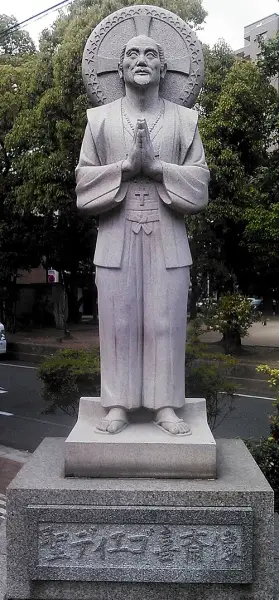
Overview
James Kisai, born Ichikawa Kisaemon around 1534 in the Tsudaka district of Bizen Province, spent most of his long life in quiet service to the Catholic mission of Japan — a lay catechist who for years hoped to be admitted to the Society of Jesus. The San Felipe incident of late 1596 unleashed the arrests that finally caught him up: in December he was imprisoned with twenty-three other Catholics. Inside the prison he and the young lay catechist John Soan de Goto pronounced their vows as Jesuits before Fathers John Rodriguez and Francis Pasia, and Kisai at last belonged fully to the order he had so long served. The prisoners were then forced to make a winter land journey from Sakai to Nagasaki. On 5 February 1597, on Nishizaka Hill above the city, Kisai — together with Paul Miki, John Soan de Goto, and the rest of the Twenty-Six Martyrs of Japan — was crucified and killed by the lance. He was one of only three Jesuits among the twenty-six. Urban VIII beatified the group in 1627, and Pius IX canonized them in 1862; he is invoked as a patron of Japan.
The Complete Life
Early Life
James Kisai was born Ichikawa Kisaemon around 1534 in the Tsudaka district of Bizen Province in Japan, which makes him, at about sixty-two, by far the oldest of the twenty-six martyrs killed at Nagasaki in 1597 — most of the others were young men and boys. His earlier life is thinly documented: by the last decade of the sixteenth century he was a lay catechist attached to the Jesuit mission, doing the ordinary work of a catechist in a church that had existed in Japan for only a generation, teaching, preparing converts, and serving the fathers in whatever way was needed. For years he had hoped to be admitted formally to the Society of Jesus, and had not been; the mission was young, its criteria uncertain, and an elderly lay catechist was perhaps not an obvious candidate. Bizen, in modern Okayama Prefecture, lay within the Jesuit mission's early field, and Kisai's generation of Japanese Christians was the first to have grown old in the faith; the mission had arrived with Francis Xavier in 1549, within the living memory of people he knew.
§ Introduction
Conversion and Vocation
Kisai's vocation was finally realized in prison. Arrested in December 1596 in the sweep that followed the San Felipe incident — the Spanish galleon whose wreck and whose captain's boasting had turned the regent Hideyoshi against the mission — he was jailed with twenty-three other Catholics, among them the young lay catechist John Soan de Goto and the Jesuit preacher Paul Miki. There, inside the prison, Kisai and Goto pronounced their vows as Jesuits before Fathers John Rodriguez and Francis Pasia. After a lifetime of waiting, Kisai belonged fully to the order he had so long served, and the admission was made in circumstances that made it a martyrdom application: the vows were taken by men who already knew they would not leave the prison alive. The San Felipe incident, in which a Spanish treasure galleon ran aground off Shikoku and her cargo and her crew's arrogance were reported to Hideyoshi, was the proximate cause of the whole persecution, and the sweep that followed it took in laymen like Kisai precisely because the regime had concluded that the mission's Japanese base, not just its foreign priests, was the problem.
§ Biography
Mission and Ministry
What is recorded of Kisai's work is catechetical and domestic. He served the Jesuit mission in Japan as a lay helper, and the little that survives about him emphasizes reliability and age rather than brilliance. That is his significance among the twenty-six: the group was deliberately assembled by the regime to display the whole range of the Japanese church — Franciscan friars from abroad, Jesuit priests, and Japanese laymen of every sort — and Kisai represents the old layman at the bottom of the hierarchy, a catechist of no standing whose Christianity was considered, by the state that killed him, worth a public execution on a hillside above Nagasaki. His last assignment, in the ordinary course of the mission's life, had been service at the Jesuit residence at Osaka, where the fathers had for years made use of him as a trusted lay helper — the standing that put his name on the list the authorities were working from.
§ Introduction
Trial and Final Years
The prisoners, twenty-six in all, were forced to make a land journey in the depth of winter from Sakai near Osaka to Nagasaki, a march of weeks intended to break them and to exhibit them to the country. Kisai, the oldest man among them, completed it. On 5 February 1597, at Nishizaka Hill above Nagasaki harbor, he was crucified with the rest and killed by the lance, together with Paul Miki and John Soan de Goto — the three Jesuits of the group, each representing a different rank of the Society: the priest-preacher, the young scholastic, and the elderly lay brother, professed on the way to the cross. Contemporary accounts of the march describe the prisoners being paraded and mutilated as they went, and the three Jesuits among them continuing to preach from the carts; the elderly Kisai is invariably described as having borne the winter journey without complaint. He was the last of the three to die on the hill that afternoon.
§ Biography
Canonization
The Twenty-six Martyrs of Japan were beatified by Pope Urban VIII on 14 September 1627 and canonized by Pope Pius IX on 8 June 1862, the first saints of Japan. Their joint feast is kept on 5 February. Kisai's inclusion in the group is what preserves his memory at all; individually he is one of the most obscure figures among the canonized saints of the Church, known almost entirely through the circumstances of his death, and precisely for that reason regularly cited as evidence that the earliest Japanese church had taken root among ordinary people and not only among the samurai elites who dominate the dramatic accounts. The 1862 canonization came, like the rest of the Japanese causes, long after the country had closed; the documentation had been carried out by Europeans at Nagasaki and Macau from testimony of witnesses who had left Japan, which is why the Japanese laymen among the twenty-six are so much more thinly recorded than the friars.
§ Introduction
Legacy
Kisai's afterlife is that of the twenty-six as a body: the Nishizaka hill, the museum and monument raised there in 1962, and the annual February pilgrimage of the Japanese church. Within the Society of Jesus he is honored as a martyr-brother, and his late profession in prison is a standing part of Jesuit self-understanding — the order's doors finally opened to a man at the point of death. He is invoked as a patron of Japan and of catechists, and his advanced age at martyrdom is usually the detail homiletics dwells on: a lifetime of quiet service crowned, in the last weeks of it, by the religious profession he had wanted for decades and the cross he had not. He is one of the very few canonized saints of whom no portrait, no writing, and no contemporary life survives — the record consists of his name, his age, his trade, his profession, and his death.
§ References
Timeline
- 1534
Born as Ichikawa Kisaemon in Tsudaka District, Bizen Province, now part of Okayama Prefecture.
§ Introduction
- Dec 1596
Imprisoned with 23 other Catholics in December 1596 after the San Felipe incident; in prison he and John Soan de Goto took vows to enter the Jesuits.
§ Biography
- 5 Feb 1597
Crucified and lanced to death on Nishizaka Hill in Nagasaki with Paul Miki and the other martyrs of Japan.
§ Biography
- 14 Sep 1627
Beatified by Pope Urban VIII.
§ Introduction
- 8 Jun 1862
Canonized by Pope Pius IX.
§ Introduction
The Record
- Patron of
- Japan
- Canonization
- Beatified by Pope Urban VIII on 14 September 1627; canonized with the 26 Martyrs of Japan by Pope Pius IX on 8 June 1862
Prayer
Bibliography
Show 11 sources
- ↑ "デジタル版 日本人名大辞典+Plusの解説" . Kotobank (in Japanese). The Asahi Shimbun Company . Archived from the original on 3 June 2015 . Retrieved 26 February 2020 .
- ↑ コトバンク-喜斎ディエゴとは
- ↑ Jennes, Joseph (1973). A History of the Catholic Church in Japan, from Its Beginnings to the Early Meiji Era (1549-1873): A Short Handbook . Tokyo : Oriens Institute for Religious Research. p. 245 . Retrieved 26 February 2020 .
- ↑ Molinari, Paolo (1974). Companions of Jesus: Spiritual Profiles of the Jesuit Saints and Beati . Translated by Edmund Dignam; Joseph Gill; Charles Hand; Hugh Kay; Nicholas King; Michael McMorrow; Anthony Nye; Paul Symonds. English Provinc
- ↑ de Lucena, Afonso (1972). Erinnerungen aus der Christenheit von Ōmura (in German). Translated by Josef Franz Schütte. Rome: Institutum historicum S.I. p. 193 . Retrieved 26 February 2020 .
- ↑ "St. James Kisai, martyr of Nagasaki, Japan with Paul Miki" . Catholic News Agency . EWTN News, Inc. Archived from the original on 22 May 2020 . Retrieved 26 February 2020 .
- ↑ Dewey, R. S., ed. (1889). The Pilgrim of Our Lady of Martyrs, Volume 5 . Philadelphia , PA: Messenger of the Sacred Heart . p. 110.
- 1 2 Murdoch, James ; Yamagata, Isoh (1903). A History of Japan: During the Century of Early Foreign Intercourse (1542-1651) . Kobe, Japan: Kobe Chronicle.
- ↑ Wiseman, Nicholas (November 1862). "Rome on the Day of Pentecost". The Dublin Review. Vol. LII . Thomas Richardson and Son. p. 55 . Retrieved 26 February 2020 .
- ↑ "Site of the Martyrdom of the 26 Saints of Japan" . Discover Nagasaki . Archived from the original on 26 February 2020 . Retrieved 26 February 2020 .
- ↑ "St. Paul Miki and the 26 Martyrs of Japan, feast day Feb. 6" . Catholic News Herald . 23 May 2016 . Retrieved 26 February 2020 .
Profile text adapted from the Wikipedia article, licensed CC BY-SA 4.0.
Pray with this saint every day
Save St. James Kisai to your favorites, read the full profile, and get feast-day reminders in the Saints app.
Get the Saints AppFree on the App Store for iPhone and iPad