
1818 – 1876·Feast April 2
St. James Lloyd Breck
Missionary Educator of the American Frontier
Overview
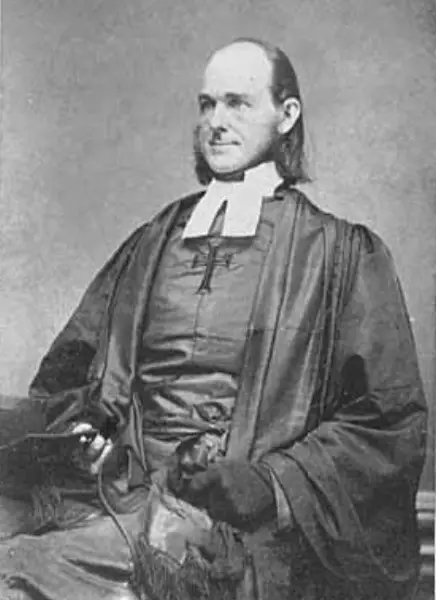
James Lloyd Breck — priest, teacher, and missionary of the Episcopal Church — gave three decades to carrying the church across the American frontier. Born near Philadelphia in 1818, he was formed at the Flushing Institute in New York under the educator William Augustus Muhlenberg, whose churchly ideal shaped him for life, and later at the General Theological Seminary, where he acquired a lasting devotion to the sixth-century missionary Columba. Resolving at sixteen to become a missionary educator, he went in 1842 to the Wisconsin wilderness with two classmates under Bishop Jackson Kemper and founded Nashotah House, intended as a monastic community and seminary. In 1850 he pushed on to Minnesota, where his missions among the Ojibway at La Crosse and Gull Lake earned the trust of Native communities, and in 1857 he settled at Faribault, where the school he began grew into Seabury Seminary. Twice widowed and twice married, he moved in 1867 to Benicia, California, to build yet more institutions. Known in his lifetime as the Apostle of the Wilderness, he died at Benicia on 2 April 1876; his body was later reinterred at Nashotah House, and the Episcopal Church keeps his memory on 2 April.
The Complete Life
A Philadelphia Boyhood
James Lloyd Breck was born on 27 June 1818 in Philadelphia County, Pennsylvania, the fourth son of Catherine D. Israell and George Breck. He was baptized in 1821 at All Saints Church in Torresdale, on the city's edge. In 1833, still a boy, he left Bristol for the Flushing Institute in Flushing, New York, a school founded in 1828 by the Reverend William Augustus Muhlenberg, one of the great educators of nineteenth-century America. The Flushing Institute was no ordinary academy: it was a self-consciously church school, and its daily pattern of worship, study, and disciplined community life worked its way deep into Breck's character. Muhlenberg, who described his own position as that of an evangelical catholic, profoundly impressed the boy with his religion, his personality, and his many gifts, and by the age of sixteen Breck had resolved to give his life to the missionary educator's work. The cost of his schooling at Flushing and afterward at the University of Pennsylvania, from which he took his bachelor's degree in 1838, was met by Senator James Lloyd of Massachusetts and an uncle. From such quiet Pennsylvania beginnings came the man who would spend his life founding schools on the far edges of the republic.
§ Early life and education
Formation and the Call to Missions
From Flushing, Breck passed to the General Theological Seminary in New York, taking the degree of Bachelor of Divinity in 1841. There a second formative influence took hold: William Whittingham, professor of church history and from 1840 Bishop of Maryland, planted in Breck a deep admiration for St. Columba, the sixth-century missionary who had planted both church and school on Iona, the island off the Scottish coast. The model of Columba — the monk-teacher who carried the gospel and built a school with it — became the pattern of Breck's entire career. His own churchmanship is hard to classify: Anglo-Catholics honor him as one of their founders, yet he was no ritualist and belonged to no church party. He simply regarded himself as a priest of the holy catholic church of the Creed, and he never departed from the religion of his school father Muhlenberg. Ordained deacon, he heard the frontier calling. In 1842, with two classmates and under the direction of Bishop Jackson Kemper, he traveled to the Wisconsin territory to found Nashotah House, conceived from the start as at once a religious community, a school of theology, and a working mission center. Later that same year Kemper ordained him priest at the Oneida Indian settlement, a hundred and fifty miles north of Nashotah.
§ Early life and education
Apostle of the Wilderness
Breck's missionary career moved ever westward. Nashotah House, planted in the Wisconsin forest in 1842, survives today as a seminary, but Breck did not stay to rest on it. In 1850 he moved to Minnesota, and on 23 June of that year he celebrated the first Episcopal Eucharist in the La Crosse area. Two years later he took up work among the Ojibwe, opening St. Columba Mission — the name an act of devotion to his hero of Iona. The Native communities came to trust him: something in his earnestness, energy, and openness disarmed the Mississippi tribes, and he had a rare gift for communicating with them on their own ground, assuring them that the Great Father sought not their destruction but peace among rival peoples gathered around Christ. A further station followed at Leech Lake in 1856, and in 1857 he removed to Faribault, where, with the Reverend Solon Manney, he established a mission school for training clergy for the Minnesota field. For nine years he carried the work of the church in that region virtually alone, since no bishop had yet been appointed; the school he began endured as Seabury Seminary, which survives today within Bexley-Seabury Western Seminary in Chicago.
§ Career
Toward the Pacific
Breck's personal life was marked by loss and second beginnings. In 1855 he married Jane Maria Mills, one of the teachers at St. Columba Mission; she died in 1862, and in 1864 he married Sarah Stiles. By then a new bishop, Henry Whipple, had begun his Minnesota episcopate in 1859, relieving Breck of responsibilities he had long shouldered without one. In 1867, ever restless, Breck moved west again, to Benicia, California, where he set out to build two further institutions. In Benicia he served as rector of a church there and labored to plant schools in the style he had practiced for thirty years, though the western foundations did not endure as his midwestern ones did. He died at Benicia on 2 April 1876, at the age of fifty-seven, far from the Wisconsin woods where his great work had begun. Sarah Stiles Breck survived him, and the institutions he had planted in California — like so much else of his restless building — outlasted his own part in them. His contemporaries already knew how to name him: the Apostle of the Wilderness, a title that gathered up a lifetime of first Eucharists, first schools, and first missions across half a continent.
§ Death
Institutions That Outlived Him
Breck was buried beneath the altar of the Benicia church he had served as rector, but his body did not rest long on the Pacific coast. It was removed and reinterred within the grounds of Nashotah House in the village of Nashotah, Wisconsin — a homecoming to the wilderness community where his life's work had begun; the recommittal service there drew fourteen bishops, about a hundred priests, and a great company of lay people, a measure of the esteem in which the frontier missionary was held. His major legacies were institutional: Nashotah House Seminary and Seabury Seminary both survive, and several other foundations of his, including Racine College in Delafield, Wisconsin, St. Augustine College in Benicia, California, and St. Mary's School in Benicia, have since closed after generations of service. Breck School in Golden Valley, Minnesota, founded in 1886 and named in his honor, continues his educational work to the present. The Episcopal Church keeps his commemoration on 2 April, the anniversary of his death, remembering the deacon who went west in 1842 and never stopped going west until he had carried the school-and-altar ideal of Columba's Iona clear across the American continent.
§ Legacy
Timeline
- 27 Jun 1818
Born in Philadelphia County, Pennsylvania, fourth son of Catherine D. Israell and George Breck
§ Early life and education
- 1821
Baptized at All Saints Church in Torresdale, Philadelphia
§ Early life and education
- 1833
Leaves Bristol for the Flushing Institute in New York, where Muhlenberg's teaching fixes his resolve to become a missionary educator
§ Early life and education
- 1838
Receives his Bachelor of Arts degree from the University of Pennsylvania
§ Early life and education
- 1841
Completes the Bachelor of Divinity at the General Theological Seminary in New York
§ Early life and education
- 1842
Goes as a deacon to the Wisconsin frontier with two classmates under Bishop Jackson Kemper to found Nashotah House
§ Career
- 1842
Ordained to the priesthood by Missionary Bishop Jackson Kemper at the Oneida Indian settlement north of Nashotah
§ Career
- 23 Jun 1850
Celebrates the first Episcopal Eucharist in the La Crosse area after moving his mission to Minnesota
§ Career
- 1852
Begins mission work among the Ojibwe, founding St. Columba Mission
§ Career
- 1855
Marries Jane Maria Mills, a teacher at St. Columba Mission
§ Career
- 1856
Opens a new mission at Leech Lake in Minnesota
§ Career
- 1857
Moves to Faribault, where with the Rev. Solon Manney he starts the clergy school that became Seabury Seminary
§ Career
- 1862
Suffers the death of his first wife, Jane Breck
§ Career
- 1864
Marries his second wife, Sarah Stiles
§ Career
- 1867
Moves to Benicia, California, to establish two more church institutions there
§ Career
- 2 Apr 1876
Dies at Benicia, California, at the age of fifty-seven
§ Death
The Record
- Major works
- Nashotah House·St. Columba Mission among the Ojibwe·The clergy school at Faribault that became Seabury Seminary·Racine College, Delafield, Wisconsin·St. Augustine College, Benicia, California·St. Mary's School, Benicia
- Patron of
- Frontier missionaries·Episcopal seminaries and church schools
- Symbols
- Missionary's traveling cassock·Book and Indian mission cross
- Canonization
- Not canonized; commemorated on the calendar of saints of the Episcopal Church on 2 April, the anniversary of his death
Prayer
Bibliography
Show 5 sources
- Hein, David, and Shattuck, Gardiner H., Jr., The Episcopalians, Westport, Connecticut: Praeger, 2004, pp. 172–174, ISBN 0-313-22958-9
- Prichard, Robert W., "Breck, James Lloyd", American National Biography Online, February 2000
- Holcombe, T. I. (1903). An Apostle of the Wilderness: James Lloyd Breck, D.D., His Missions and His Schools. T. Whittaker
- "The Life of the Reverend James Lloyd Breck, D.D.", anglicanhistory.org, retrieved 13 April 2015
- Lesser Feasts and Fasts 2018, Church Publishing, Inc., 1 December 2019, ISBN 978-1-64065-234-7
Profile text adapted from the Wikipedia article, licensed CC BY-SA 4.0.
Pray with this saint every day
Save St. James Lloyd Breck to your favorites, read the full profile, and get feast-day reminders in the Saints app.
Get the Saints AppFree on the App Store for iPhone and iPad