
c. 1391 – 1476·Feast November 28
St. James of the Marches
Franciscan Preacher, Inquisitor, and Legate
Overview
James of the Marches, born Domenico Gangala in the early 1390s at Monteprandone in the March of Ancona, was an Italian Friar Minor, preacher, and writer who spent half a century evangelizing the Italian peninsula and half of Europe. A doctor of civil and canon law from Perugia, he abandoned a promising secular career for the Franciscans, entering the order at the Portiuncula in 1416 and taking the name Jacobus. Trained in theology at Fiesole alongside John of Capistrano under Bernardine of Siena, he was ordained priest in 1420 and preached with extraordinary fruit across Tuscany, the Marches, and Umbria, spreading devotion to the Holy Name of Jesus. From 1427 he preached penance and combated heresy on legations that led him through Germany and Austria, across Sweden and Denmark, and into Bohemia, Poland, Hungary, and Bosnia, serving as papal inquisitor against the Fraticelli and as vicar of the Bosnian mission. He promoted the reunion of the Hussites and of the Eastern churches, preached crusade against the Ottoman advance, founded charitable pawn banks, and declined the bishopric of Milan. He died at Naples on 28 November 1476, was beatified in 1624 and canonized in 1726, and is honored as a patron of Monteprandone and co-patron of Naples.
The Complete Life
From Monteprandone to the Doctorate
The future saint first saw the light at Monteprandone, a hill town in the March of Ancona near Ascoli Piceno on the Adriatic coast, born around 1391 — the sources place his birth in the early 1390s — and named Domenico Gangala. His family was poor, but his ability was noticed early. His schooling began in childhood at Offida, where an uncle who was a priest directed his early lessons, and the uncle, judging the boy capable of more, sent him onward to school in the neighboring city of Ascoli Piceno. From there James advanced to the University of Perugia, taking the doctorate in both civil and canon law — a credential that opened the way to the influential secular career his gifts promised. For a short time he remained in Florence, serving as tutor to the children of a noble family and acting as a judge in cases of sorcery. By every outward sign he was set for a life of law, court, and comfort. Instead, the young doctor laid his learning at the feet of Francis of Assisi: on 26 July 1416 he entered the Friars Minor at the Portiuncula chapel, assuming the religious name Jacobus, and finished his novitiate at the Carceri hermitage above Assisi.
§ Early life
Formation in the Franciscan School
James's formation as a friar placed him at the center of the great Franciscan revival of the fifteenth century. From the hermitage of the Carceri he went to study theology at Fiesole, near Florence, where he was a fellow student of John of Capistrano, the future apostle of Europe, under the teaching of Bernardine of Siena, the order's most celebrated preacher. From these men he received both doctrine and fire; he would spend his life spreading Bernardine's devotion to the Holy Name of Jesus and laboring beside and after Capistrano. His austerity, even among Franciscans, was extreme: he began at that time a manner of life so severe that he fasted through nine months of every year, until Bernardine himself, judging the discipline excessive, ordered him to moderate his penances. He was ordained priest on 13 June 1420 and immediately threw himself into preaching through Tuscany, the Marches, and Umbria, with such fruit that his half century in the pulpit was remembered for the miracles attributed to him and the multitude of conversions he accomplished. He followed the Observant wing of the Friars Minor — the reforming current then spreading rapidly and stirring fierce controversy within the order — and he spent much of his life encouraging and defending that reform.
§ Priest and inquisitor
Inquisitor and Legate Across Europe
From 1427 James's field of labor widened from the Italian towns to half of Europe. Preaching penance and contending against heresy, he carried his legations through the German lands and Austria, onward to Sweden and Denmark, and across Bohemia, Poland, Hungary, and the Bosnian field. He was appointed inquisitor against the Fraticelli, the heretical sect that had broken with the Franciscans over the vow of poverty, and in 1432 the papal council sent him as inquisitor to the Bosnian vicariate. He was back in Bosnia in 1435, holding its vicariate until 1439 and wrestling with the heresies he found in that hard mission field — labors that earned him the bitter hostility of the Bosnian ruler, King Tvrtko II, and still more of Queen Dorothea, whom James accused of attempting to poison him. When he finally left the country he laid the failure of the Franciscan mission at the king's door. Between 1434 and 1439 he also worked in southern Hungary against heretics, and in August 1439 he imprisoned Bálint Újlaki, the noble who had first translated the Bible into Hungarian. During the Council of Basle he worked for the return of the moderate Hussites to communion with Rome, and later that of the Eastern churches at the Council of Ferrara-Florence. Against the advancing Ottomans he preached several crusades; on the death of John of Capistrano in 1456 James was dispatched to Hungary to carry on his work, and in 1457 he brought the same cause to King Christian I of Denmark.
§ Priest and inquisitor
Poverty, Mercy, and the Holy Name
Beneath the inquisitor's office lay a pastor's heart, and James's most enduring institution was an act of economic mercy. He established several montes pietatis — literally mountains of piety — the charitable loan funds that advanced money at almost no interest against goods left in pledge, rescuing the poor of the greater cities from usury; through them his preaching took flesh in the marketplace. His spirituality remained that of the Observant reform: the strict observance of the Franciscan rule, relentless fasting, and devotion to the Holy Name of Jesus, for which he composed a treatise on the miracles worked through that Name. His zeal for reform cost him dearly; he belonged to the Observant branch precisely when it was spreading and provoking violent controversy, and he suffered much on that account, as his own letter to John of Capistrano records. In 1455 Pope Callistus III named him arbiter of the quarrel between the Conventuals and the Observants; his decision, published in a papal bull on 2 February 1456, pleased neither party — an outcome that perhaps measures his honesty. He refused the bishopric of Milan when it was offered in 1460, choosing the poverty he had vowed at the Portiuncula over one of the greatest sees in Christendom.
§ Priest and inquisitor
The Brescia Controversy and Naples
James's last decades were clouded by a strange theological storm. On Easter Monday of 1462, preaching at Brescia, he repeated the view of certain theologians that the blood which flowed from Christ in his Passion lacked, while his body lay three days in the tomb, its union with his Divinity. James of Brescia, the Dominican who acted as inquisitor there, at once cited him to appear before his tribunal; James refused to appear and appealed to the Holy See. The question was argued at Rome during Christmas of 1462 before Pope Pius II and the cardinals, but no judgment was ever rendered, and the old friar emerged from the affair with his reputation intact, though the dispute would cling to his memory. He spent the final three years of his life in Naples, that city of his order's southern provinces, and died there on 28 November 1476, closing more than fifty years of preaching. He was buried in the Franciscan church of Santa Maria La Nova in Naples, where his body rested for five and a quarter centuries — until 2001, when it was translated to Monteprandone, where the incorrupt body can still be seen by pilgrims.
§ Priest and inquisitor
Beatified and Canonized
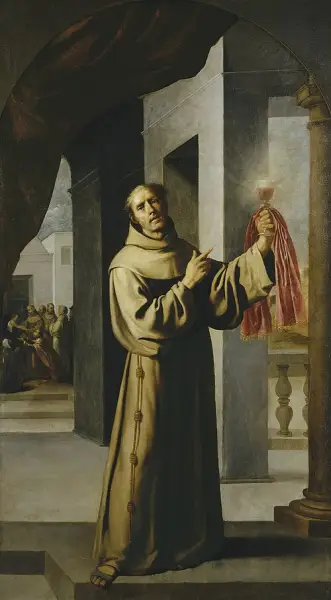
The church moved deliberately to honor the friar whose labors had spanned the papacy of six pontiffs. He was beatified in 1624 by Pope Urban VIII, less than a hundred and fifty years after his death, and canonized in 1726 by Pope Benedict XIII. His liturgical feast is kept on 28 November, the day of his death, observed by the Franciscan Order and in the Roman calendar. Naples came to number him among its patron saints, sharing that dignity with its older protectors, and his birthplace of Monteprandone honors him as its own patron; his shrine there, the Sanctuary of St. James of the Marches, receives the pilgrims who come before his incorrupt body. In iconography he is customarily painted with a chalice in his right hand, a serpent slipping out of it — an image the tradition explains in two ways, either as an allusion to the attempts of heretics to poison him during the Bosnian mission, or, less probably, to the Brescia controversy over the Precious Blood. Either way, the emblem binds his memory to the chalice he defended and the enemies he outlasted.
§ Veneration
Writings and Enduring Memory
James's writings were never collected, a curious fate for so celebrated a figure, but what survives shows a mind turned to controversy and pastoral use. His Dialogus contra Fraticellos, directed against the heretical sect he hunted in Bosnia, was printed in the Baluze-Mansi Miscellanea; his little manual Regula confitendi peccata, a rule for confessing sins, went through several Latin and Italian editions in the fifteenth century itself; his treatise De Sanguine Christi effuso preserves his side of the Brescia question; and his reflections on the miracles of the Name of Jesus feed the Bernardine devotion he spread. His notebook, or Itinerarium, records his endless journeys. His library and autograph manuscripts are preserved in part at the municipality of Monteprandone, gathered from the convent of Santa Maria delle Grazie he founded there. Beyond the books, his foundations endure in the institutions he planted: the montes pietatis that became the ancestors of European pawn banking, the Franciscan reform he defended, and the faith of Bosnia, Hungary, and the Adriatic towns that heard him. His memory lives wherever the Franciscan calendar is kept, on 28 November, in the cities that made him a patron and the order that made him a saint.
§ Writings
Timeline
- 1391
Born Domenico Gangala to a poor family at Monteprandone in the March of Ancona on the Adriatic
§ Early life
- 26 Jul 1416
Received into the Order of Friars Minor at the Portiuncula in Assisi, taking the name Jacobus
§ Early life
- 13 Jun 1420
Ordained a priest and begins the preaching career across Tuscany, the Marches, and Umbria that will occupy half a century
§ Priest and inquisitor
- 1427
Begins preaching penance and contending with heresy on legations that lead him from Germany and Austria to Scandinavia, Bohemia, Poland, Hungary, and Bosnia
§ Priest and inquisitor
- 1432
Sent by the papal council as Inquisitor to the Bosnian vicariate
§ Priest and inquisitor
- 1435
Returns to Bosnia to serve as Vicar of the Bosnian mission, holding the office until 1439
§ Priest and inquisitor
- Aug 1439
Imprisons Bálint Újlaki, the nobleman who first translated the Bible into Hungarian
§ Priest and inquisitor
- 1455
Appointed by Pope Callistus III as arbiter in the dispute between the Conventual and Observant Franciscans
§ Priest and inquisitor
- 1456
Sent to Hungary as successor to the deceased John of Capistrano
§ Priest and inquisitor
- 2 Feb 1456
Has his arbitral decision between the two Franciscan branches published in a papal bull that satisfies neither party
§ Priest and inquisitor
- 1457
Sent to King Christian I of Denmark to discuss the Turkish crusade and the Bohemian question
§ Priest and inquisitor
- 1460
Declines the bishopric of Milan when it is offered to him
§ Priest and inquisitor
- 1462
Preaching at Brescia on Easter Monday, utters a disputed opinion on the Precious Blood and is summoned by the local inquisitor; he refuses to appear and appeals to the Holy See
§ Priest and inquisitor
- 28 Nov 1476
Dies in Naples, which had been his home through the closing three years of his life
§ Priest and inquisitor
- 1624
Beatified by Pope Urban VIII
§ Veneration
- 1726
Canonized by Pope Benedict XIII
§ Veneration
- 2001
Relics translated from the Franciscan church of Santa Maria La Nova in Naples to Monteprandone, where the body remains incorrupt
§ Veneration
The Record
- Major works
- Dialogus contra Fraticellos·Regula confitendi peccata·De Sanguine Christi effusi·Treatise on the Miracles of the Name of Jesus·Monti di pietà — charitable pawn institutions
- Patron of
- Monteprandone, Italy·Co-patron of Naples, Italy
- Symbols
- Chalice with a serpent escaping from it
- Canonization
- Beatified in 1624 by Pope Urban VIII; canonized in 1726 by Pope Benedict XIII
Prayer
Bibliography
Show 6 sources
- Oliger, Livarius, "St. James of the Marches", The Catholic Encyclopedia, Vol. 8, New York: Robert Appleton Company, 1910
- Foley, Leonard, "St. James of the Marches", Saint of the Day, Lives, Lessons, and Feast, Franciscan Media, ISBN 978-0-86716-887-7
- "St. James of the Marches", Catholic News Agency, archived from the original on 30 January 2016
- Runciman, Steven (1947). The Medieval Manichee: A Study of the Christian Dualist Heresy. Cambridge University Press, pp. 112ff., ISBN 978-0-521-28926-9
- Fine, John Van Antwerp (1975). The Bosnian Church: Its Place in State and Society from the Thirteenth to the Fifteenth Century. New York: Columbia University Press, p. 206
- Jensen, Janus Møller (24 April 2007). Denmark and the Crusades, 1400-1650. BRILL, pp. 67ff., ISBN 978-90-474-1984-6
Profile text adapted from the Wikipedia article, licensed CC BY-SA 4.0.
Pray with this saint every day
Save St. James of the Marches to your favorites, read the full profile, and get feast-day reminders in the Saints app.
Get the Saints AppFree on the App Store for iPhone and iPad