
c. 10 BC – c. 62·Feast May 3
St. James, Son of Alphaeus
Apostle of the Twelve, James the Less
Overview
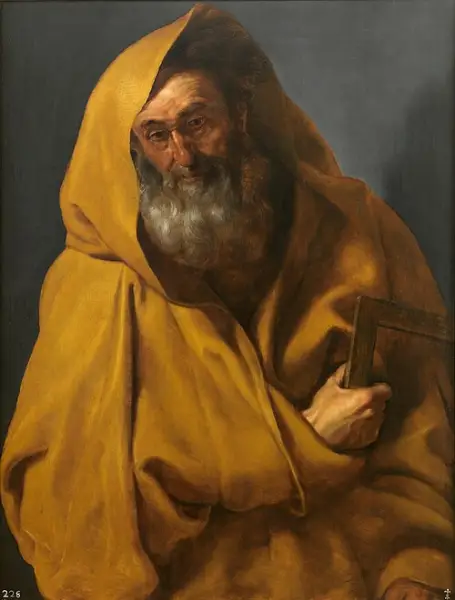
James, son of Alphaeus, was one of the Twelve Apostles of Jesus, named in the apostolic lists of all three Synoptic Gospels and in the Acts of the Apostles. Church tradition has commonly identified him with James the Less, the son of Mary mentioned at the cross, and Jerome went further, holding that he was the James called the brother of the Lord, kinsman rather than sibling of Jesus. He must always be distinguished from James the son of Zebedee, the brother of John. The New Testament records him only within lists of the Twelve and tells nothing of his words or deeds, so nearly everything about his career comes from later tradition, which is divided. One line, preserved in works ascribed to Hippolytus, says he preached in Jerusalem and was stoned to death there, a death also attributed to James the brother of Jesus; another tradition holds that he was crucified at Ostrakine in Lower Egypt while evangelizing. In art he carries a fuller's club or a carpenter's saw, and he is invoked as patron of fullers, pharmacists, druggists, and dying people, and of Frascati, Monterotondo, and Uruguay.
The Complete Life
Son of Alphaeus
The Gospels preserve almost nothing of this apostle beyond his patronymic. He was born in Galilee around 10 BC, the son of a man named Alphaeus, and that father's name is the only family fact Scripture states about him. Yet even it has generated conjecture, for Alphaeus was also the name of the father of Levi, the tax collector whom Matthew's Gospel makes one of the Twelve under the name Matthew. Since Mark 2:14 calls the publican the son of Alphaeus, some interpreters have concluded that James and Matthew were brothers, an inference encouraged by the fact that other sibling pairs appear among the Twelve, such as Peter and Andrew or James and John the sons of Zebedee. In the four lists where James appears, however, no brother is attached to his name, while the sons of Zebedee are explicitly paired, which suggests that the evangelists would have said so had James and Matthew been kin. The conjecture remains a conjecture, defended by some modern commentators and left unconfirmed by the biblical texts, one more thread in the tangled question of who this quiet apostle was.
§ Possible brother of Matthew
Chosen Among the Twelve
James belongs to the inner circle of witnesses whom Jesus chose, and his name appears every time the early church recited its roll of the Twelve. Mark, the earliest Gospel to give a list, names him once, among the apostles appointed after the calling of Peter and Andrew, the sons of Zebedee, and Matthew. Matthew's Gospel and Luke's catalog do the same, and the first chapter of Acts still finds him standing with the Eleven after the ascension. Beyond these four notices the New Testament is silent: he speaks no recorded word, performs no reported deed, and receives no narrative of his own. The Gospel lists surround him with ambiguity, for Mark and Matthew each write of other men named James, the son of Zebedee and the brother of the Lord, and on several occasions mention a James without saying which one, at the transfiguration, on the Mount of Olives, and in Gethsemane. All twelve were present at the Last Supper before those scenes, so James son of Alphaeus walked through the decisive hours of the Gospel story, even where the texts no longer distinguish his steps.
§ Gospel of Mark
Preacher and Martyr
The traditions of his preaching and death come from sources outside Scripture, and they do not entirely agree. Works ascribed to Hippolytus of Rome, surviving only in manuscripts recovered in Greece during the nineteenth century and now generally judged spurious, report that James the son of Alphaeus, preaching in Jerusalem, met death by stoning at the hands of the Jews and was laid to rest beside the temple. The detail matters for another question, since the same stoning death is attributed to James the brother of Jesus, so the testimony, if authentic, would support identifying the two men as one. An Eastern tradition instead holds that he was crucified at Ostrakine in Lower Egypt, where he had gone to preach the gospel. The attempts to find his death in the New Testament fare no better: the James arrested and executed by Herod Agrippa in Acts 12 is described there as the brother of John, and both Robert Eisenman and the Catholic encyclopedia tradition assign that martyrdom to the son of Zebedee rather than to James the son of Alphaeus. What all the accounts agree upon is the apostolic office and a martyr's end.
§ Death
The Least and the Lesser
The church's memory entwined him with the other Jameses of the New Testament. Because a second James, the son of Zebedee, already stood among the Twelve and came to be called the Greater, equating the son of Alphaeus with James the Less, the son of Mary named at the cross, seemed natural, and Jerome endorsed it, reasoning that the mother of James the Less was Alphaeus's wife and at the same time kin to the Lord's own mother, Mary of Clopas. Jerome pressed further, proposing the Hieronymian view that this James was the Lord's brother of Galatians 1:19, brother in the sense of cousin, a position widely received in the Catholic Church, though John Paul Meier finds the identification of Alphaeus's son with James the Less without grounds, and scholars such as Carson and Bock call it possible but unproved. A fragment attributed to Papias making Mary of Cleophas the mother of James the bishop is now thought to belong to a medieval lexicographer, and Lightfoot judged the passage spurious. The Golden Legend gathers the whole harvest, styling him the Less, the brother of the Lord, the Just, and first bishop of Jerusalem. His feasts fall on May 3 in the Roman Catholic Church, May 1 in the Anglican Communion, and October 9, with the Synaxis of the Apostles on June 30, in the Eastern Orthodox Church.
§ Identity
Timeline
- -10
Born around this year in Galilee, the son of Alphaeus.
§ Introduction
- 62
Died around this year, by one tradition stoned in Jerusalem, by another crucified at Ostrakine in Lower Egypt.
§ Death
In Their Own Words
He sang in Jerusalem the first mass that ever was there, and he was first bishop of Jerusalem.
The Record
- Patron of
- apothecaries·druggists·dying people·fullers·milliners·pharmacists·Frascati, Italy·Monterotondo, Italy·Uruguay
- Symbols
- carpenter's saw·fuller's club
- Canonization
- Pre-congregation; honored as apostle and martyr since the earliest Christian centuries
Prayer
Bibliography
Show 6 sources
- "St. James, Apostle, son of Alphaeus". Encyclopædia Britannica. Encyclopædia Britannica, Inc.
- Jerome. The Perpetual Virginity of Blessed Mary, Fragment 15. newadvent.org.
- Papias. Exposition of the Sayings of the Lord, Fragment X. earlychristianwritings.com.
- Meier, John Paul. A Marginal Jew, Volume 3, p. 201.
- Geikie, John Cunningham. The Life and Words of Christ, Volume 1, 1884.
- Schaff, Philip. History of the Apostolic Church, p. 389. New York: Charles Scribner, 1853.
Profile text adapted from the Wikipedia article, licensed CC BY-SA 4.0.
Pray with this saint every day
Save St. James, Son of Alphaeus to your favorites, read the full profile, and get feast-day reminders in the Saints app.
Get the Saints AppFree on the App Store for iPhone and iPad