
died c. 44·Feast July 25 (Western Christianity); April 30 (Eastern Christianity); December 30 (Mozarabic Rite)
St. James the Great
Apostle, Son of Zebedee, Martyr of Jerusalem
Overview
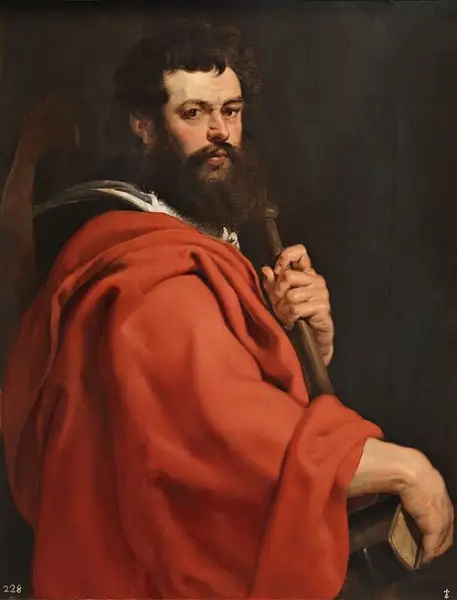
James the Great, son of Zebedee and brother of John the Evangelist, was one of the Twelve Apostles of Jesus and the first of them to die a martyr's death. A fisherman of the Sea of Galilee and, by tradition, a cousin of Jesus through his mother Salome, he was called from his nets together with John to follow Christ, and with Peter formed the inner circle of the Twelve — present at the raising of Jairus's daughter, the Transfiguration, and the agony in Gethsemane. His fiery temper with his brother earned from Jesus the nickname Boanerges, Sons of Thunder. The Acts of the Apostles records that Herod Agrippa had him put to death by the sword at Jerusalem around the year 44, after Judas Iscariot he was the second apostle to die — and the first to be slain for the faith. Spanish tradition holds that he preached the gospel in Hispania and that his disciples brought his remains by sea to Galicia, where they were discovered in the ninth century at what became Santiago de Compostela. His shrine became the destination of the Way of St. James, the great pilgrimage of medieval Western Europe, and he is honored as the patron saint of Spain.
The Complete Life
A Fisherman of Galilee
James was born into a family of fishermen on the Sea of Galilee, the son of Zebedee and Salome. The house was not obscure: Salome, according to a long tradition, was a sister of the Virgin Mary, which would make James a cousin of Jesus himself, and the family was prosperous enough to employ hired men. His younger brother was John, the future evangelist, and the two were so ardent in temperament that Jesus gave them together the nickname Boanerges — Sons of Thunder — a title the gospel attaches to their impetuous proposal to call down fire upon an unfriendly Samaritan town. To distinguish him from the other apostle of the same name, James son of Alphaeus, he is styled James the Greater or James the Great, the epithet pointing simply to the greater age or stature of the elder man. In the listings of the Twelve he stands close beside Peter and John, the men with whom his life in the apostolate would be joined. Beyond these family outlines the gospels record almost nothing of his first decades; his biography begins, as the biographies of the apostles generally do, on the day a passing teacher stopped at his boat.
§ In the New Testament
Called from the Nets
The Synoptic Gospels describe the call of James with wonderful economy: he and his brother John were in the boat with their father Zebedee, mending their nets, when Jesus passed by and summoned them, and leaving their father with the hired servants they followed him at once. From that day James belonged to the innermost circle of the apostolic company. Together with Peter and John he formed an informal triumvirate among the Twelve, and Jesus admitted these three alone to the three most solemn moments of his public ministry: the raising of Jairus's daughter, the Transfiguration on the mountain, and the agony in the garden of Gethsemane. The privilege did not make the brothers wise. James and John — or, in another version of the story, their mother on their behalf — asked Jesus for the seats at his right and left hand in his coming glory, and drew from him the question whether they could drink the cup he was to drink, together with the rebuke that the places were not his to give. Their fellow apostles were indignant at the request. The ambition was punished, in a sense, by fulfillment: James would indeed drink the cup, becoming the first of the apostolic college to be poured out in martyrdom.
§ In the New Testament
Preacher in Hispania
After the resurrection and the outpouring of the Spirit, the apostolic tradition assigned James a field of labor in the far west. According to the legend summarized in the twelfth-century Historia Compostelana, James had evangelized Hispania no less than the Holy Land, sailing first to Sardinia and landing in Spain at Cartagena before making his way through the towns of the Roman province of Tarraconensis, preaching to the populace in places such as Bracara Augusta. Tradition adds that on 2 January of the year 40, while James was preaching on the bank of the Ebro river at Caesaraugusta — modern Zaragoza — the Virgin Mary appeared to him standing upon a pillar; that pillar is preserved and venerated today in the Basilica of Our Lady of the Pillar, one of the great Marian shrines of the world. Following the apparition, the tradition says, James returned to Judaea. No New Testament writing confirms the Spanish mission, and historians regard the whole western legend with reserve, but it took possession of the devotion of the Iberian peninsula so completely that Spain has never had any apostle but James.
§ Spain
Martyrdom at Jerusalem
James's life ended where his apostolate had begun, in the Holy Land. The Acts of the Apostles records with singular brevity that Herod the king — identified with Herod Agrippa I — laid violent hands upon some who belonged to the church, and killed James the brother of John with the sword. He died in the year 44 at Jerusalem, no apostle had died before him save Judas the traitor, and none before him had died a martyr. Commentators ancient and modern have read the event in different keys: the scholar Henry Alford judged that he was probably beheaded, while R. E. Nixon connected the severity of Herod's action to the fiery temper that had won James and John the name Sons of Thunder. F. F. Bruce drew out the mystery that Luke deliberately sets beside it: at the same persecution Peter was seized and delivered by an angel, and the church asked why James should die while Peter should escape, and answered only that it was a mystery of divine providence. The site of his execution is shown today within the Armenian Apostolic Cathedral of St. James in the Armenian Quarter of Jerusalem, where a chapel marks the traditional place of his beheading and his head is believed to rest beneath the altar, marked by a slab of red marble and encircled by six votive lamps.
§ Jerusalem
Feast and Holy Years
Venerated from the apostolic age as a martyr, James needed no process of canonization; his feast belongs to the oldest stratum of the Christian calendar. The Western churches — Catholic, Anglican, Lutheran, and others — keep his feast on 25 July, a date the tradition connects with the belief that he was martyred on that day in the year 44, though some historians have suggested it was chosen to coincide with the festival of St. Christopher. The Eastern Orthodox churches commemorate him on 30 April, and the Mozarabic rite of Spain on 30 December. Because he is the patron saint of Galicia, 25 July is also the national day of that land. When the feast falls on a Sunday the church of Santiago de Compostela celebrates a Jacobean Holy Year: the holy door of the cathedral is opened, and a Jubilee is granted, the holy years following a pattern of six, five, six, and eleven years. The Holy Year of 2010 drew 272,412 pilgrims to Compostela; the most recent was 2021, and the next falls in 2027. Few saints of the first century possess so living a liturgy, renewed by millions of feet every year.
§ Feast
Compostela and the Way of St. James
The great monument to James is not a writing but a road. Spanish tradition holds that after his martyrdom his disciples bore his remains by sea to Hispania, putting ashore at Padrón on the Galician coast, and that his relics were discovered in the ninth century in the Libredón forest, in the time of Bishop Theodemir and King Alfonso II. On that spot arose Santiago de Compostela, whose very name descends from the Latin Sancti Jacobi and whose cathedral crypt enshrines the tomb of the apostle. From the early Middle Ages to the present the Way of St. James — the network of pilgrimage routes that crosses Western Europe into northern Spain — has been the foremost pilgrimage of Western Christendom; in 2018 alone, 327,378 pilgrims registered their completion of the final hundred kilometers. The pilgrimage revived spectacularly in modern times, and the apostle's emblem, the scallop shell, is worn still by pilgrims on every road of Europe. His chivalric afterlife was equally vivid: the Order of Santiago, founded in the twelfth century, bore his cross, and the legend of Santiago Matamoros — the Moor-slayer who fought for the Christian army at Clavijo — made him the battle patron of medieval Spain, invoked in the war cry of its armies.
§ Veneration
Timeline
- 28
Called by Jesus at the Sea of Galilee together with his brother John, leaving their father Zebedee and the fishing nets to follow him as one of the first disciples
§ New Testament
- 30
With Peter and John, witnessed the raising of Jairus' daughter, the Transfiguration, and the agony in the Garden of Gethsemane - the three occasions Jesus admitted only their inner circle
§ New Testament
- 2 Jan 40
By local tradition the Virgin Mary appears to James upon a pillar on the bank of the Ebro at Caesaraugusta while he is preaching the gospel in Hispania
§ Spain
- 25 Jul 44
Suffers martyrdom at Jerusalem by the sword on the order of Herod Agrippa, traditionally by beheading on this date
§ Feast
- 813
His relics were discovered in the Libredon forest near Iria Flavia by the hermit Pelayo, in the days of Bishop Theodemir and King Alfonso II of Asturias
§ Mission in Hispania and burial at Compostela
- 844
By later tradition he appeared armed on a white horse at the legendary battle of Clavijo, winning the name Santiago Matamoros - the battle cry of medieval Spanish armies
§ Mission in Hispania and burial at Compostela
In Their Own Words
the great knight of the russet cross was given by God to Spain as patron and protector
mystery of divine providence
The Record
- Patron of
- Spain·Guatemala·Nicaragua·Seattle and Orlando, United States·Levoča, Slovakia·Santiago de Compostela and the Way of St. James·Veterinarians·Equestrians·Furriers·Tanners·Pharmacists·Oyster fishers·Woodcarvers·Pilgrims
- Symbols
- Scallop shell·Pilgrim's hat and staff·Sword (red martyrdom)
- Canonization
- Pre-congregation; one of the Twelve Apostles, venerated as a martyr from the earliest Christian times
Prayer
Bibliography
Show 6 sources
- Bruce, F. F. (1964). Commentary on the Book of the Acts. Grand Rapids: Wm. B. Eerdmans
- Camerlynck, Achille (1910). "St. James the Greater". In Herbermann, Charles (ed.). Catholic Encyclopedia. Vol. 8. New York: Robert Appleton Company
- Chadwick, Henry (1976). Priscillian of Avila. Oxford University Press. ISBN 978-0-19-826643-3
- Fletcher, Richard A. (1984). Saint James's Catapult: The Life and Times of Diego Gelmírez of Santiago de Compostela. Oxford: Clarendon Press. ISBN 978-0-19-822581-2
- Kendrick, T. D. (1960). St. James in Spain. London: Methuen
- Starkie, Walter (1957). The Road to Santiago: The Pilgrims of St. James. New York: E. P. Dutton. OCLC 28087235
Profile text adapted from the Wikipedia article, licensed CC BY-SA 4.0.
Pray with this saint every day
Save St. James the Great to your favorites, read the full profile, and get feast-day reminders in the Saints app.
Get the Saints AppFree on the App Store for iPhone and iPad