
1576-1620·Feast March 17
St. Jan Sarkander
Priest and Martyr
Overview
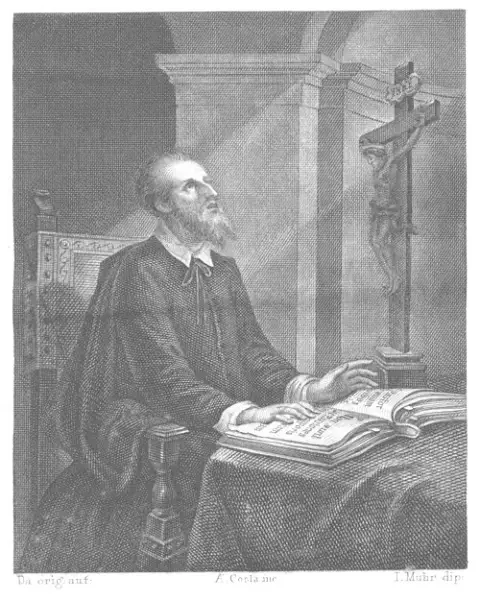
Born at Skoczów in Silesia on 20 December 1576, Jan Sarkander was the child of Georg Mathias Sarkander and of Helena Górecka. Widowed after barely a year of marriage and left childless, he concluded that God was calling him after all, and took up studies for the priesthood that ran through Olomouc, Prague — where he earned his master's in philosophy in 1603 — and Graz in Austria. Ordained at Graz on 22 March 1609, he served as a parish priest at Boskovice and from 1616 at Holešov, where he enjoyed the backing of the Catholic noble Ladislav IV Popel of Lobkowicz and the enmity of the anti-Catholic Wenceslas Bítovský of Bítov, who wanted him dead. When the Thirty Years War broke out and Protestants occupied Holešov, he withdrew briefly to Poland, praying at Częstochowa, then returned home. In February 1620, accused falsely of conspiring to bring Polish troops into Moravia, he was imprisoned at Olomouc and interrogated about his dealings, his contacts, and what Lobkowicz had told him in confession. He refused to break the seal. Racked repeatedly and burned with lighted candles and burning feathers soaked in oil, pitch, and sulphur, he lingered a month and died from his injuries in prison on 17 March 1620.
The Complete Life
Early Life
Jan Sarkander was born on 20 December 1576 at Skoczów in Silesia, born to Georg Mathias Sarkander and Helena Górecka, in the confessionally shattered world of the Bohemian crown lands a generation after the Reformation had broken the region into competing churches. His family life was marked early: his mother was widowed, and the losses of his childhood seem to have formed the seriousness that contemporaries noted in him. His studies ran along the Catholic remnants of the old university network — Olomouc, then Prague, where he took his master's degree in philosophy in 1603, and finally Graz in Austria, the Catholic stronghold where his theology was completed and where he passed his theological examinations in December 1607.
§ Life
Conversion and Vocation
Sarkander was ordained a priest at Graz on 22 March 1609, by a bishop of Olomouc — the Moravian see to which his life would return. He served as a parish priest, at Boskovice and then, from 1616, at Holešov, a living he held under the protection of the Catholic noble Ladislav IV Popel of Lobkowicz. The arrangement gave him security and made him a target at once: in the estates and villages of Moravia, a priest's patron was his politics, and Sarkander's ministry under a leading Catholic magnate placed him in the front line of the Counter-Reformation's local struggles. His particular enemy was the anti-Catholic Wenceslas Bítovský of Bítov, a neighboring noble who, the record states plainly, wanted him dead.
§ Life
Mission and Ministry
Sarkander's ministry was parochial and pastoral — the Mass, the sacraments, and the catechesis of a mixed population in the years when the Bohemian crisis was building toward war. At Holešov he worked with the support of Lobkowicz to strengthen the Catholic life of the town, a work that in that region and decade meant visible partisanship as much as quiet shepherding. When the Thirty Years War broke out and the Protestant estates occupied Holešov, Sarkander withdrew briefly to Poland, praying at Częstochowa, and then returned to his parish — a decision that his enemies were waiting to interpret. His priesthood was thus exercised in a country where the confession of the ruler was the question of public life, and where a priest's faithfulness was read as conspiracy.
§ Life
Trial and Final Years
In February 1620, accused falsely of conspiring to bring Polish troops into Moravia, Sarkander was imprisoned at Olomouc. His interrogators wanted specifics: his dealings, his contacts, and — the point of the whole exercise — what Lobkowicz had said to him in confession. To convict the patron through the priest would have been the political prize, and Sarkander held in his hands the means of delivering it. He refused to break the seal of confession. He was racked repeatedly — on 13, 17, and 18 February — and burned with candles and with feathers dipped in oil, pitch, and sulphur; he lingered a month, dying in prison on 17 March 1620 of his injuries, aged forty-three.
§ Life
Spirituality and Teaching
Sarkander's spirituality is contained almost entirely in his refusal. The seal of confession is absolute in Catholic doctrine — no cause, civil or ecclesiastical, can license its breach — and the Church has always held that a priest who dies rather than reveal it dies a martyr for the sacrament itself. Sarkander's month of torture was thus, in the strict sense, a magisterial act: a priest teaching, by his endurance, that the confessional is not an intelligence source and that no state's emergency overrides it. The tradition also remembers his patience with his torturers and his concern for the other prisoners, the ordinary fabric of a pastoral character under the pressure that revealed it.
§ Introduction
Canonization
Sarkander was beatified by Pope Pius IX on 6 May 1860, in the same era's recovery of the Central European martyr traditions. His canonization came on 21 May 1995, when Pope John Paul II declared him a saint at Olomouc itself — the city of his imprisonment and death — during the Pope's visit to the Czech lands, an act of repair performed in the very place of the crime, four centuries after the event.
§ Introduction
Legacy
Sarkander is the patron saint of the seal of confession — the one saint whose entire claim rests on that single fidelity, invoked whenever the confidentiality of the sacrament is challenged by civil power. In Moravia and Silesia his memory belongs to the confessional history of the Czech lands, claimed by Catholics as the proof that their church's presence there was bought and not merely granted. A lamp has burned at his tomb in Olomouc as a public memorial, and his statute stands as a lesson in the cost of a promise kept under torture.
§ Introduction
Timeline
- 20 Dec 1576
Born at Skoczów, Silesia on 20 December, son of Georg Mathias Sarkander and Helena Górecka.
§ Life
- 1589
His father died, and the family moved to Příbor.
§ Life
- 1603
Master of philosophy at Charles University, Prague
§ Life
- 21 Dec 1607
Passed his theological examinations at the University of Graz on 21 December.
§ Life
- 22 Dec 1607
Received the minor orders from Cardinal Franz von Dietrichstein on 22 December.
§ Life
- 20 Dec 1608
Made a sub-deacon on 20 December.
§ Life
- 16 Mar 1609
Elevated to the diaconate on 16 March.
§ Life
- 22 Mar 1609
Ordained priest at Graz on 22 March by the bishop of Olomouc
§ Life
- 1616
Assigned as parish priest to Holešov
§ Life
- 17 May 1619
Fled to Poland on 17 May when Protestants occupied Holešov; pilgrimages to Częstochowa, then returns
§ Life
- 13 Feb 1620
Arrested on false charges; racked on 13 and again on 17 and 18 February for up to three hours, refusing to reveal confessional matter
§ Life
- 17 Mar 1620
Dies in prison at Olomouc on 17 March of his injuries
§ Introduction
- 11 Sep 1859
Pope Pius IX ruled on 11 September that he had been killed in hatred of the faith.
§ Introduction
- 6 May 1860
Beatified by Pope Pius IX on 6 May at Saint Peter's
§ Introduction
- 2 Apr 1993
A miracle through his intercession was approved by Pope John Paul II on 2 April.
§ Introduction
- 21 May 1995
Canonized by Pope John Paul II on 21 May at Olomouc
§ Introduction
The Record
- Symbols
- Rack (instrument of his torture)·Priestly vestments
- Canonization
- Beatified by Pope Pius IX on 6 May 1860; canonized by Pope John Paul II on 21 May 1995 at Olomouc
Prayer
Bibliography
Show 8 sources
- ↑ Chronique, Éditions; Larebière, Bruno (2013). Jean-Paul II (in French). Éditions Chronique. ISBN 979-10-90871-95-3 .
- ↑ Saint Jan Sarkander Archived 2024-07-25 at the Wayback Machine Article in French
- 1 2 3 4 "Saint Jan Sarkander" . Saints SQPN. 31 May 2016. Archived from the original on 31 July 2016 . Retrieved 2 October 2016 .
- 1 2 "Saint John Sarkander" . Santi e Beati . Retrieved 2 October 2016 .
- 1 2 3 "St. John Sarkander" . Saint Kateri. Archived from the original on 15 February 2019 . Retrieved 2 October 2016 .
- 1 2 "Blessed John Sarkander". New Catholic Dictionary Archived 2021-11-01 at the Wayback Machine CatholicSaints.Info. 15 August 2018
- 1 2 3 4 Mershman, Francis. "Bl. John Sarkander." The Catholic Encyclopedia Archived 2017-03-21 at the Wayback Machine Vol. 8. New York: Robert Appleton Company, 1910. This article incorporates text from this source, which is in the public d
- ↑ "St. Jan Sarkander" .
Profile text adapted from the Wikipedia article, licensed CC BY-SA 4.0.
Pray with this saint every day
Save St. Jan Sarkander to your favorites, read the full profile, and get feast-day reminders in the Saints app.
Get the Saints AppFree on the App Store for iPhone and iPad