
1572 – 1641·Feast August 12
St. Jane Frances de Chantal
Widow and foundress of the Visitation
Overview
Jane Frances de Chantal, born Jeanne-Françoise Frémyot, Baroness of Chantal, was a French noblewoman who exchanged the life of a provincial chatelaine for that of a religious foundress. Born at Dijon in 1572, she married the Baron de Chantal at twenty, managed his estates with skill, and was left a widow at twenty-eight when a hunting accident killed her husband in 1601. Under the spiritual direction of Francis de Sales, bishop of Geneva, whom she met in 1604, she founded the Order of the Visitation of Holy Mary at Annecy in 1610, a congregation remarkable for accepting women whom other orders rejected because of poor health or age. She oversaw its growth from a poor house on the shore of Lake Annecy to eighty-six convents before her death at Moulins in 1641. Beatified by Benedict XIV in 1751 and canonized by Clement XIII in 1767, she is honored as a patron of widows, of the forgotten, and of parents separated from their children, and her letters of spiritual direction remain valued reading.
The Complete Life
A Daughter of Dijon
Jane Frances de Chantal was born at Dijon on 28 January 1572, into one of the leading families of Burgundy. Her father, Bénigne Frémyot, served as the royalist president of the Parliament of Burgundy, and her mother, Margaret de Berbisey, died before Jane reached the age of two, leaving the child's formation largely in her father's hands. An uncle was prior of Val des Choux, and her brother André would later become Archbishop of Bourges, occupying that see from 1602 to 1621. She grew into a woman noted for beauty and refinement, educated with a care unusual even among the provincial nobility. At twenty, after declining two earlier suitors, she married the Baron de Chantal in 1592 and took up residence at the feudal castle of Bourbilly, where the couple entertained neighboring nobles with hunting parties and festivities. The deaths of her first two children in infancy, followed by the loss of her sister Margaret, brought three small children into her care; she and the baron then had a son and three daughters of their own. Neighbors came to know her as a capable estate manager and a generous provider of alms and nursing care to the poor.
§ Biography
Widow at Bourbilly
The baron's death in a hunting accident in 1601 transformed Jane's life. Left a widow at twenty-eight with four children, she took a vow of chastity, put her husband's affairs in order, and spent a period with her father in Dijon before her widowed father-in-law demanded that she come to live with him at his castle in Monthelon. Toward the end of 1602 she closed Bourbilly and moved there, shouldering obligations to both households. In 1604 her father invited her to Dijon to hear the Lenten sermons preached at the Sainte Chapelle by Francis de Sales, bishop of Geneva. The meeting proved decisive. The two formed a deep spiritual friendship, and de Sales became her director, counseling her against scruples, haste, and anxious thoughts, which he counted the chief obstacles to a soul's advance toward perfection. Her longing for religious life surfaced soon after: when Anne of Jesus arrived in Dijon in 1605 to found a Carmelite house, Pierre de Bérulle persuaded Jane to defer the decision. De Sales, for his part, refused her requests for additional austerities, prescribing instead a full seven or eight hours of sleep each night.
§ Francis de Sales
The Founding at Annecy
Under de Sales's guidance Jane prepared a foundation unlike the austere orders she had once considered. He purchased a small house on Lake Annecy, where she was joined by Marie Favre, daughter of the president of Savoy, and Charlotte de Bréchard, the third recruit of de Sales. On Trinity Sunday, 6 June 1610, the community of the Visitation of Holy Mary received its canonical erection at Annecy, amid conditions of real poverty, since Jane had already made over her wealth to her children. The new order was remarkable for its welcome: it received women whom other communities rejected on account of poor health or age, their daily office being the Little Office of Our Lady. For its opening eight years the community maintained an unusual degree of outreach beyond the cloister, in contrast with most female religious of the era, who remained cloistered under strict ascetic discipline. Confronted by critics, Jane answered with plain directness, saying that she liked sick people herself and was on their side. Mounting opposition to women in active ministry eventually obliged de Sales to make the community cloistered, following the Rule of Saint Augustine; for these daughters he composed his Treatise on the Love of God.
§ Nuns of the Visitation
A Spirituality of Peace
Jane's interior life bore the imprint of two great directors: Francis de Sales first, and Vincent de Paul after de Sales's death. From de Sales she learned a spirituality of moderation and interior freedom, one that distrusted scrupulousness, haste, and anxiety, and trusted that souls advance toward perfection through peace rather than severity. His firm prescription of seven or eight hours of sleep, when she begged leave for harsher disciplines, expressed the same doctrine: holiness does not demand the ruin of the body. Her favorite devotions were directed to the Sacred Heart of Jesus and the Sacred Heart of Mary. She left a substantial correspondence of letters of spiritual direction, later published and prized as wise, humane counsel, and modern editors have presented them as an enduring contribution to French spiritual literature in their own right. Her famous remark about liking sick people herself captured the founding instinct of the Visitation: to make room in religious life for the weak, the aging, and the ailing rather than turn them away. Generosity to the suffering had marked her already as baroness, when she gave alms and nursing care to needy neighbors alongside the management of great estates.
§ Francis de Sales
Growth and Farewell
Jane's reputation for sanctity and sound administration drew visits and donations from aristocratic women, and the congregation grew steadily. By the time Francis de Sales died, the order possessed thirteen houses; before her own death the number had reached eighty-six. Her closing decades carried heavy domestic sorrows. Her young daughter Charlotte died of an illness not long after Marie Aymée's marriage to Bernard, de Sales's youngest brother, and Jane eventually outlived her son Celse Bénigne, who fell in battle against Huguenot and English troops on the Île de Ré in that age's wars of religion, as well as two of her three daughters. She herself died at the Visitation Convent in Moulins on 13 December 1641, at the age of sixty-nine, on the feast of Saint Lucy. She was buried in the convent at Annecy, beside Francis de Sales, the companion of her first spiritual journey. Her extensive correspondence survived her, a Treasury of counsel to souls high and low, and through her granddaughter Marie de Rabutin-Chantal, the celebrated Marquise de Sévigné, the family name remained prominent in the literary history of France. The convent where she died kept her memory in honor, and the congregation she had guided through its fragile beginnings went on growing on the strength of the reputation for sanctity and sound management that had drawn visitors and benefactors to her door.
§ Nuns of the Visitation
Honors of the Church
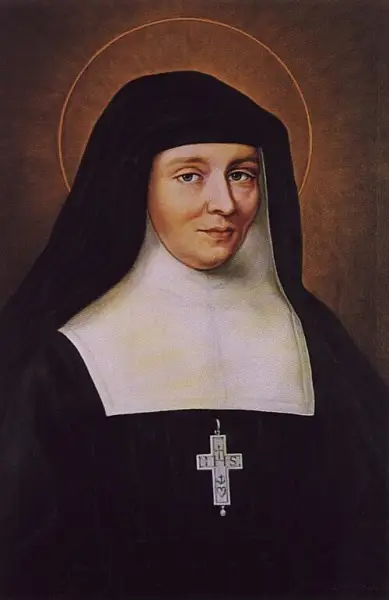
Recognition of Jane's sanctity followed within a century of her death. Pope Benedict XIV beatified her in Rome on 21 November 1751, and Pope Clement XIII canonized her there on 16 July 1767, by which time the Visitation had grown to 164 houses. Her feast entered the General Roman Calendar in 1769, two years after the canonization, assigned to 21 August. The revision of 1969 moved the celebration to 12 December, bringing it nearer the anniversary of her death on 13 December 1641, which fell on the feast of Saint Lucy; but when Pope John Paul II placed the memorial of Our Lady of Guadalupe on 12 December in 2001, he transferred the memorial of Saint Jane Frances to 12 August, where the Roman calendar keeps it. The Episcopal Church added her to its own calendar of saints in 2022, with a feast on 12 December shared with Francis de Sales, extending her commemoration into the Anglican Communion, which venerates her alongside the Roman Catholic Church. In sacred art she is depicted in the black religious habit of her congregation, wearing a silver cross necklace.
§ Veneration
Patron of the Forgotten
The Church invokes her on behalf of forgotten people and widows, of households troubled by in-law difficulties, of those who mourn the loss of parents, and of parents living separated from their children. The Order of the Visitation of Holy Mary, founded in 1610 with Francis de Sales, remains her principal monument, a community established on the conviction that religious life should be open to women whom poor health or age shut out elsewhere. Her letters of spiritual direction, edited and translated in modern critical editions, continue to be read as humane, practical counsel on the interior life, given in the same gentle tradition her director taught her. Her reply to critics of her congregation, a plain declaration of loyalty to the sick, has become one of the most quoted sayings of any French saint. Her major shrine stands at Annecy in Savoy, where she lies buried next to Francis de Sales. Her family, meanwhile, gave France one of its greatest letter writers in her granddaughter, the marquise de Sévigné, so that the name of Chantal endures both in the history of spirituality and in French literature.
§ Veneration
Timeline
- 28 Jan 1572
Born at Dijon, daughter of Bénigne Frémyot, president of the Parliament of Burgundy.
§ Biography
- 1592
Married the Baron de Chantal and took up residence at the castle of Bourbilly.
§ Baroness
- 1601
Left a widow when the Baron died in a hunting accident; took a vow of chastity.
§ Baroness
- 1602
Closed Bourbilly and moved to Monthelon to live with her father-in-law.
§ Baroness
- 1604
Heard Francis de Sales preach the Lenten sermons at Dijon; he became her spiritual director.
§ Francis de Sales
- 6 Jun 1610
On Trinity Sunday the community of the Visitation received its canonical establishment at Annecy.
§ Nuns of the Visitation
- 13 Dec 1641
Died at the Visitation Convent in Moulins at the age of sixty-nine.
§ Nuns of the Visitation
- 21 Nov 1751
Beatified in Rome by Pope Benedict XIV.
§ Veneration
- 16 Jul 1767
Canonized in Rome by Pope Clement XIII; the order then numbered 164 houses.
§ Veneration
- 1769
Her feast entered the General Roman Calendar, set on 21 August.
§ Veneration
- 1969
The calendar revision moved her feast to 12 December, near the day of her death.
§ Veneration
- 2001
Pope John Paul II transferred her memorial to 12 August to make room for Our Lady of Guadalupe.
§ Veneration
- 2022
Received into the Episcopal Church's calendar of saints, keeping the day with Francis de Sales.
§ Veneration
In Their Own Words
What do you want me to do? I like sick people myself; I'm on their side.
The Record
- Major works
- Order of the Visitation of Holy Mary·Letters of spiritual direction
- Patron of
- forgotten people·in-law problems·loss of parents·parents separated from children·widows
- Symbols
- black religious habit with a silver cross necklace
- Canonization
- Canonized 16 July 1767 in Rome by Pope Clement XIII, after beatification by Benedict XIV in 1751
Prayer
Bibliography
Show 5 sources
- Francis de Sales, Jane de Chantal: Letters of Spiritual Direction. Paulist Press, 1988.
- Brémond, Henri (1912). Sainte Chantal (1572-1641). Paris: J. Gabalda et Cie.
- Bowles, Emily. The Life of St. Jane Frances Fremyot de Chantal. London: Burns and Oates, 1872.
- Pernin, Raphael (1910). St. Jane Frances de Chantal. Vol. 8. New York: Robert Appleton Company: The Catholic Encyclopedia.
- Roditi, Édouard (June 1946). "Henri Brémond: Poetics as Mystagogy". The Journal of Aesthetics and Art Criticism. 4 (4): 229–235.
Profile text adapted from the Wikipedia article, licensed CC BY-SA 4.0.
Pray with this saint every day
Save St. Jane Frances de Chantal to your favorites, read the full profile, and get feast-day reminders in the Saints app.
Get the Saints AppFree on the App Store for iPhone and iPad