
c. 232 – c. 305·Feast September 19
St. Januarius (San Gennaro)
Bishop of Benevento, patron of Naples
Overview
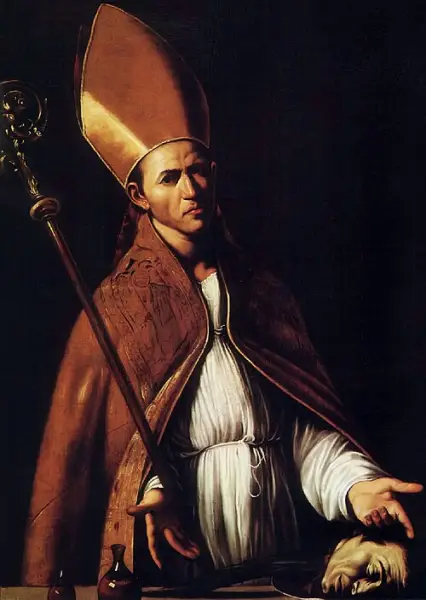
Januarius, known in Neapolitan and Italian as Gennaro, was Bishop of Benevento and a martyr of the Great Persecution under Diocletian, and he remains the principal patron saint of Naples. No contemporary account of his life survives; what is known comes from later acts and legends, which tell of a patrician youth ordained priest at fifteen and bishop at twenty, who sheltered fellow Christians during the persecution, was arrested while visiting his imprisoned friend Sossius, and was beheaded with his companions near Pozzuoli after the sentence of the beasts was changed for fear of unrest. His cult is historically attested from a letter of 432, and his relics, translated more than once in the Middle Ages, have rested since 1497 in Naples Cathedral. He is celebrated above all for the blood said to have been collected at his death, preserved in sealed ampoules and reported to liquefy several times a year before crowds in the cathedral, a phenomenon the Church leaves unexplained and science has long tried to account for. Naples keeps his feast on September 19; the East keeps it on April 21.
The Complete Life
A Patrician of Campania
The legends agree in making Januarius a child of privilege. Born around the year 232 at Benevento, his family was wealthy and patrician, claiming descent from the Caudini, one of the clans of the Samnites, the hardy mountain people of ancient Italy. The Christian community of Benevento in his boyhood was small, yet the boy inclined to the church rather than to the ambitions of his class. At the age of fifteen he was ordained the local priest of his parish in Benevento, an extraordinarily early commission even by the standards of a persecuted community that needed ministers wherever it could find them. While pursuing his studies for the priesthood he formed the friendships that would shape the rest of his life, above all with Sossius, who served the church of Misenum as deacon, and with Juliana of Nicomedia, herself destined for the martyrs' calendar. At twenty, still a young man, he was raised to the episcopate, an office the traditions variously connect with Naples and with his native Benevento. Whatever the precise sequence, he stood from youth at the head of the Christians of Campania when the storm of Diocletian's persecution broke over them.
§ Legend
Shepherd in Time of Persecution
The Great Persecution, the last and fiercest assault of the empire on the church, lasted through the final years of Diocletian's reign and tested every Christian community of Campania. The traditions present Januarius as a shepherd who did not flee it. He concealed some of his fellow Christians, harboring them in safety and preventing them from being taken, an act that made him liable to the capital penalties then in force against clergy. His capture came not through his own ministry but through charity: going to visit Sossius, his friend from the days of his studies, who had been thrown into prison, Januarius was arrested there as well. With him were taken the companions whom the calendars would ever afterward name together: Festus, his deacon, and Desiderius, his lector, together with Sossius of Misenum, Proculus, deacon of Pozzuoli, and the laymen Eutyches and Acutius. The acts of the saints record that after chains and imprisonment the whole company was condemned together, bishop, deacons, lector, and faithful alike, a cross-section of a fully ordered church punished as one body for the faith of its head.
§ Legend
Martyrdom at Pozzuoli
The sentence first passed on Januarius and his companions was the spectacle death of the arena: they were to be thrown to the wild bears in the Flavian Amphitheater at Pozzuoli. The authorities, fearing a public disturbance in a region thick with Christians devoted to their bishop, changed the punishment, and the company was led instead to the Solfatara, the smoking volcanic crater near Pozzuoli, where they were beheaded on September 19, around the year 305. Later traditions enriched the passion with marvels: one tells that the wild beasts refused to touch the bishop when he was exposed to them; another that he was cast into a furnace and came out unharmed, a deliverance depicted for the cathedral of Naples by Ribera. History, as distinct from legend, can add little to the outline, for no contemporary record of the trial or death survives. Yet the memory of the event is early and firm. The acts preserved at Bologna list the martyrs by name and place, and within little more than a century of the supposed date the bishop of Nola could invoke Januarius as a bishop crowned with martyrdom and an ornament of the church of Naples.
§ History
Patron and Protector of Naples
Januarius was never formally canonized; his cult rose from the devotion of the churches of Campania and was in full flower by the fifth century, when Uranius of Nola attested it. Naples, which keeps more than fifty official patrons, has always ranked him first among them. His feast of September 19, commemorating his martyrdom, stands in the General Roman Calendar, while the East celebrates him on April 21 and the Armenian Church on the Monday after the second Sunday of Advent. The people of Naples have invoked him in every calamity, most memorably in 1631, when an eruption of Vesuvius threatened the towns on its slopes; the lava, they believed, slowed at his intercession, and a spire in his honor rose over the cathedral in thanksgiving. Three times each year crowds fill the cathedral: on his feast day, on December 16 in celebration of his patronage of the city and archdiocese, and on the Saturday before the first Sunday of May in memory of the reunion of his relics. His devotion crossed the ocean with Neapolitan emigrants, and the Feast of San Gennaro in New York's Little Italy, its street fair carrying the saint's statue through the neighborhood, has become an American institution, glimpsed even in The Godfather Part II.
§ Celebrations
The Blood of San Gennaro
The relic that made Januarius famous is his blood. Legend says a woman named Eusebia gathered it at his death; it is kept in two hermetically sealed ampoules held since the seventeenth century in a silver reliquary between glass plates, and stored in a bank vault whose keys rest with a commission of Neapolitan notables. A chronicle of 1382 describes his cult without mentioning the miracle; the first certain report of liquefaction dates to 1389, and over the following two and a half centuries official attestations multiplied from once a year to three. The archbishop tilts the reliquary to show the contents solid, and after the prayers of the faithful, especially the saint's "relatives", the dark substance in the larger vial is typically found liquid, remaining exposed for eight days. Failure is read as an omen; the blood failed in September 1939, 1940, and 1943, in 1973, 1980, December 2016, and December 2020. Popes have venerated it, Francis in 2015; it liquefied for Pius IX but not for John Paul II or Benedict XVI. The Church keeps a deliberate neutrality, forbidding the ampoules to be opened, while scientists have proposed hemoglobin, thixotropic gels, and thermal explanations, none yet accepted as settled.
§ Blood
Timeline
- 21 Apr 232
Born around this date, according to tradition at Benevento, to a rich patrician family of Samnite descent.
§ Legend
- 19 Sep 305
Beheaded with his companions near Pozzuoli during the persecution of Diocletian.
§ History
- 432
Uranius, bishop of Nola, records in a letter the appearance of Januarius, "bishop as well as martyr", to the dying Paulinus of Nola.
§ History
- 1382
A Neapolitan chronicle of 1382 portrays the saint's devotion richly, yet says nothing of the relic of blood or the miracle.
§ Blood
- 1389
The first certain record that the saint's blood was found melted in its ampoule.
§ Blood
- 1480
His body, kept at the Abbey of Montevergine since the time of Frederick Barbarossa, was rediscovered there.
§ Relics
- 1497
At the urging of Cardinal Oliviero Carafa, the body was transferred to Naples, reuniting it with the head.
§ Relics
- 1506
Carafa's richly decorated crypt, the Succorpo beneath Naples Cathedral, was completed to house the relics.
§ Relics
- 1527
The city of Naples founded the Deputation of the Chapel of St Januarius by public vote to keep the Treasure untouched.
§ Museum of the Treasure of St Januarius
- 1631
Invoked during the eruption of Vesuvius, he was credited with slowing the lava that threatened the towns about the mountain.
§ Celebrations
- 1848
The blood was reported to have liquefied in the presence of Pope Pius IX.
§ Blood
- 1979
The blood failed to liquefy during the visit of Pope John Paul II to Naples.
§ Blood
- 2007
The blood again failed to liquefy during the visit of Pope Benedict XVI.
§ Blood
- 21 Mar 2015
Pope Francis venerated the dried blood in Naples Cathedral, praying over it and kissing it; it was said to have half liquefied.
§ Blood
In Their Own Words
Bishop as well as martyr, an illustrious member of the Neapolitan church.
The blood has half liquefied, which shows that Saint Januarius loves our pope and Naples.
The Record
- Patron of
- blood banks·Naples·volcanic eruptions
- Symbols
- vials of blood·palms·Mount Vesuvius
- Canonization
- Pre-congregation martyr; his cult is attested from the fifth century onward
Prayer
Bibliography
Show 6 sources
- Thurston, Herbert (1913). "St. Januarius". In Herbermann, Charles (ed.). Catholic Encyclopedia. New York: Robert Appleton Company.
- Uranius Nolanius (432). De Vita et Obitu Paulini Nolani.
- Norman, Diana (1986). "The Succorpo in the Cathedral of Naples: 'Empress of All Chapels'". Zeitschrift für Kunstgeschichte. 49 (3): 323–355.
- Garlaschelli, L.; Ramaccini, F.; Della Sala, S. (1994). "The Blood of St. Januarius". Chemistry in Britain. 30 (2): 123.
- de Ceglia, Francesco Paolo (2025). The Natural History of a Neapolitan Miracle: The Secret of San Gennaro's Blood. London–New York: Routledge.
- Randi, James (2002). "The Liquefying 'Blood' of St. Januarius". In Shermer, Michael (ed.). The Skeptic Encyclopedia of Pseudoscience. ABC-CLIO. pp. 371–372.
Profile text adapted from the Wikipedia article, licensed CC BY-SA 4.0.
Pray with this saint every day
Save St. Januarius (San Gennaro) to your favorites, read the full profile, and get feast-day reminders in the Saints app.
Get the Saints AppFree on the App Store for iPhone and iPad