
1809-1837·Feast November 24 (with the 117 Martyrs of Vietnam)
St. Jean-Charles Cornay
Priest of the Paris Foreign Missions Society and Martyr
Overview
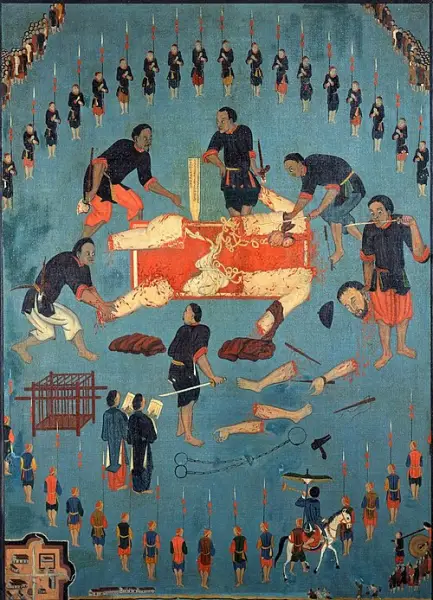
Jean-Charles Cornay, born at Loudun in Vienne on 27 February 1809 and baptized there days later, grew up the third of six children in a devout Catholic family. Schooled at Saumur, Montmorillon and Poitiers, he was an unremarkable student — humble, gentle, ordinary — until a missionary vocation set him against his parents' wishes. He won the argument gently, telling his mother that three years in Paris would let him test the call honestly. Entering the Paris Foreign Missions seminary in October 1830, he found it targeted by the unrest after the July Revolution; his diary records posters threatening death to its students. Ordained deacon in 1831, he sailed for China — hurriedly, to replace another missionary — aiming for distant Sichuan. The guides who were to take him up the Yangtze never came, and he was stranded in Tonkin amid persecution. Traveling the Red River disguised as a Chinese, he was secretly ordained a priest on 26 April 1834 by Bishop Havard; when Sichuan proved unreachable he gave himself to the Tonkinese mission with calm, even joy, as his health broke. Arrested in 1837 on charges of leading an evil sect, he answered the cangue and the cage by singing. On 20 September 1837, by decree of the Emperor Minh Mạng, he was cut apart and beheaded by the Son-Tay citadel outside Hanoi; his severed head was shown for three days, then thrown into the river. His remains rest at the church of Chieu-Ung. His example later kindled the vocation of Théophane Vénard, canonized the same day.
The Complete Life
Early Life
Jean-Charles Cornay was born at Loudun in Vienne on 27 February 1809, the third of six children of Jean-Baptiste Cornay and Françoise Mayaud, and baptized on 3 March in the church of Saint-Pierre-du-Marché. His parents brought the children up as good Catholics. He studied at the school of Saint-Louis at Saumur, then the Jesuit minor seminary at Montmorillon, then the major seminary of Poitiers — an ordinary progress for a French seminarian of his class. Fellows remembered him as an ordinary student — humble, and gentle in disposition: no one's idea of a hero, which his biographers have always made the point of saying. At Poitiers he received the tonsure in 1828, minor orders in 1829, and the subdiaconate in June 1830.
§ Biography
The Missionary Vocation
Cornay's missionary vocation set him against his parents' wishes — his first struggle to stay true to God's call put him at odds with them, his filial love remaining whole. What he said to his mother was: only let me go to Paris; three years at least I shall have there, with every chance to test my vocation and all the means of getting ready for it should it prove authentic. On 13 October 1830 he entered the seminary of the Paris Foreign Missions Society. The timing was terrible: the July Revolution had just swept Paris, and his diary records posters threatening death to the seminary's students. Ordained deacon in 1831, he sailed for China — hurriedly, to replace another missionary — aiming for distant Sichuan.
§ Biography
Stranded in Tonkin
The guides who were to take Cornay up the Yangtze never came, and he was stranded in Tonkin amid persecution — the mission field of another nation, at war with his own plans. Traveling the Red River disguised as a Chinese, he was secretly ordained a priest on 26 April 1834 by Bishop Havard, in Western Tonkin. When it was finally confirmed, in 1836, that no guides could reach Sichuan, he chose to remain in Tonkin and gave himself to the Tonkinese mission with calm and even joy, as his health broke — the missionary's obedience taking the shape of a change of continent. His ministry in the villages of Son-Tay was the usual clandestine round: night circuits, hidden Masses, catechumens instructed in private houses.
§ Biography
Martyrdom
Arrested in 1837, Cornay was tortured with the cangue and the cage — the standing instruments of Tonkinese interrogation — and the witnesses remembered that he responded by singing. Condemned by decree of the emperor Minh Mạng, he was executed by dismemberment and beheading near the Son-Tay citadel on 20 September 1837, at twenty-eight years of age. The manner of his death, and the ordinary gentleness of his life, made him one of the best-loved of the French missionaries of the Vietnamese martyrology; in France a town still bears his name.
§ Introduction
Canonization
Cornay was beatified by Pope Leo XIII on 27 May 1900, among the first great group of Vietnamese martyrs. Pope John Paul II canonized him on 19 June 1988 among the 117 Martyrs of Vietnam. He is honored with the whole body on 24 November, the memorial of Saint Andrew Dũng-Lạc and Companions, and in France his cause has been kept by the Paris Foreign Missions, whose house at Rue du Bac holds the memory of him among its martyrs.
§ Biography
Legacy
Jean-Charles Cornay is remembered as the ordinary missionary made extraordinary by his death: the unremarkable student, the obedient son, the priest sent to one country and martyred in another. His diary and letters, preserved in the Paris Foreign Missions archives, give his life a documentation few of the 117 possess — including the posters threatening the seminary in 1830 and his own last imprisonment. For French Catholic memory he belongs to the heroic generation of the Rue du Bac; for the Vietnamese church he is one of its own martyrs, killed at Son-Tay in the persecution of Minh Mạng, and venerated in the diocese where he died.
§ Biography
Timeline
- 27 Feb 1809
Born at Loudun, Vienne, on 27 February, third child of Jean-Baptiste Cornay and Françoise Mayaud
§ Biography
- 3 Mar 1809
Baptized on 3 March in the Church of Saint-Pierre-du-Marché at Loudun
§ Biography
- 1 Jun 1828
Received the tonsure at Poitiers on 1 June
§ Biography
- 14 Jun 1829
Admitted to Minor Orders at Poitiers on 14 June
§ Biography
- 6 Jun 1830
Made a sub-deacon on 6 June while completing his studies at Poitiers
§ Biography
- 13 Oct 1830
Entered the Paris Foreign Missions seminary on 13 October, over his parents' reluctance
§ Biography
- 1831
Ordained deacon and sailed for Sichuan; after six months of travel landed at Macau amid the persecution of 1831
§ Biography
- 26 Apr 1834
Secretly ordained priest in Western Tonkin on 26 April by Bishop Havard, having travelled the Red River disguised as a Chinese
§ Biography
- Jan 1836
In January a letter from the Apostolic Vicar of Szechwan left him the choice of staying in Tonkin or returning to Macao; he remained
§ Biography
- 1837
Arrested, tortured with the cangue and the cage; responds by singing
§ Biography
- 20 Sep 1837
Under Minh Mạng's decree he was cut to pieces and beheaded on 20 September close to the Son-Tay citadel
§ Introduction
- 19 Jun 1840
Declared Venerable by Pope Gregory XVI on 19 June
§ Biography
- 2 Jul 1899
Inserted in the Martyrology by Pope Leo XIII on 2 July
§ Biography
- 27 May 1900
Beatified by Pope Leo XIII on 27 May
§ Introduction
- 19 Jun 1988
Canonized by Pope John Paul II on 19 June with the 117 Martyrs of Vietnam
§ Biography
In Their Own Words
Just let me go to Paris, I will have at least three years there with every opportunity to examine my vocation, and all the means of preparing for it if it is authentic.
After fifty blows I was untied. Arriving at the prison, I sang the Salve Regina... the hymn to the Virgin.
The Lord is faithful: he expects from us a total trust in his promises.
When you receive this letter, my dear father, my dear mother, do not grieve for my death; by consenting to my departure, you have already made most of the sacrifice.
The Record
- Symbols
- Cangue (wooden torture collar) and cage·Singing the Salve Regina under torture
- Canonization
- Beatified by Pope Leo XIII on 27 May 1900; canonized by Pope John Paul II on 19 June 1988 among the 117 Martyrs of Vietnam
Prayer
Bibliography
Show 4 sources
- 1 2 A New Dictionary of Saints: East and West by Michael Walsh p. 295.
- ↑ "Bishop Joseph-Marie-Pélagie Havard, M.E.P." Catholic Hierarchy .
- 1 2 "},"date":{"wt":"<!--Not stated-->"},"website":{"wt":"irfa.paris"},"language":{"wt":"fr"},"access-date":{"wt":"27 June 2024"}},"i":0}}]}' id="mwhg"/> "Jean-Charles CORNAY" . irfa.paris (in French) . Retrieved 27 June 2024 .
- ↑ "Mártires de Vietnam (+1745-1862)" . Vatican News Service (in Spanish) . Retrieved 10 December 2012 .
Profile text adapted from the Wikipedia article, licensed CC BY-SA 4.0.
Pray with this saint every day
Save St. Jean-Charles Cornay to your favorites, read the full profile, and get feast-day reminders in the Saints app.
Get the Saints AppFree on the App Store for iPhone and iPad