
1593 – 1649·Feast March 16
St. Jean de Brébeuf
Jesuit missionary and martyr of the Hurons
Overview
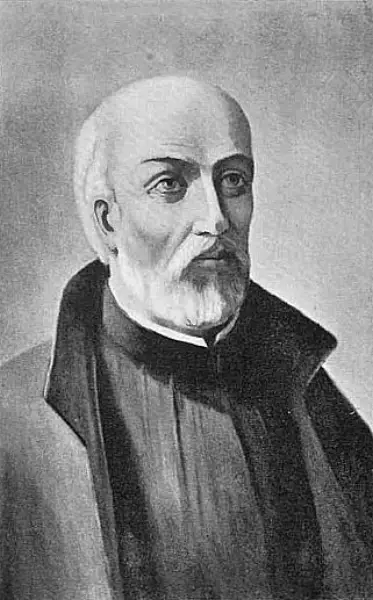
Jean de Brébeuf was a French Jesuit priest who gave nearly his whole adult life to missionary work among the Wendat (Huron) people of New France. Born into a Norman family in 1593, he entered the Society of Jesus at twenty-four and was ordained in 1622, after tuberculosis nearly cut short his religious career. He sailed to Canada in 1625 and, apart from a forced absence in France between 1629 and 1633, laboured among the Indigenous nations of the Saint Lawrence and Georgian Bay country until his death. The Wendat called him Échon and admired his command of their language, which he mastered, taught to other missionaries, and put into print. His ethnographic writings on Wendat customs constitute the longest such study in the Jesuit Relations, and his Wendat Christmas carol is counted as Canada's oldest. In March 1649, during a Haudenosaunee raid on a Wendat village, he was captured together with Gabriel Lalemant and died under ritual torture at St. Ignace. Beatified in 1925, he was canonized among the North American Martyrs by Pope Pius XI in 1930 and later named a patron of Canada.
The Complete Life
A Norman Youth and a Delayed Calling
Jean de Brébeuf came into the world at Condé-sur-Vire in Normandy on 25 March 1593, into a family of some standing that would later include the poet Georges de Brébeuf, his nephew. He was twenty-four when he entered the Society of Jesus in 1617, an age later than many novices, and he spent his first two years of formation under the guidance of Lancelot Marin. From 1619 to 1621 he taught at the college of Rouen, and his student record, though unremarkable, already revealed a gift for languages that would define his later work. That promise was nearly cut short: in 1620 he caught tuberculosis, then usually a fatal diagnosis, and the illness forced long interruptions in both his studies and his teaching. He recovered, however, and in February 1622 he was ordained a priest at Pontoise Cathedral. After three further years as steward at the Rouen college, his superiors marked him out for the missions of New France. The sickly novice from Normandy would become one of the most durable missionaries the colony ever sent inland.
§ Early years
Called to New France
Father Pierre Coton, provincial of France, chose Brébeuf for the Canadian mission, and in June 1625 he landed at Québec with Charles Lalemant, Énemond Massé, and two lay brothers. His apprenticeship began among the Innu, with whom he lived for roughly five months, before his 1626 assignment to the Wendat, an Iroquoian-speaking nation far inland. He settled briefly with the Bear Tribe at Toanché but made no conversions there, and the growing danger from the English forced his recall; he arrived back at Québec on 17 July 1628 after two years in the interior. When Champlain surrendered the colony on 19 July 1629, the missionaries withdrew to France. Brébeuf spent the exile well, preaching and hearing confessions in Rouen, where he pronounced his final vows in 1630, and then serving at the College of Eu in northern France as steward, minister, and confessor. In 1633 he returned to New France for good. With Antoine Daniel and Ambroise Davost he chose Ihonatiria, known as Saint-Joseph I, as the centre of the Wendat mission, and there he settled into the work that would occupy him for the rest of his life.
§ Missionary
Mission Among the Wendat
Brébeuf's mission unfolded against a demographic catastrophe. Eurasian diseases, previously unknown among the Wendat, swept through their villages and killed enormous numbers, and the people naturally blamed the Europeans who had brought the sickness, though neither side understood its causes. By 1640 smallpox alone had claimed nearly half the population, and as children and elders died around them, many Wendat began to listen to the missionaries who seemed mysteriously immune. The Jesuit they called Échon was slow to win converts: only in 1635 did he record his first fourteen baptisms, rising to eighty-six the following year. He turned the years of listening to good account, composing an extensive record of Wendat religion and custom, including a detailed 1636 description of the Feast of the Dead, the great ceremony of reburial that followed a village's removal. In 1638 he yielded leadership of Saint-Joseph I to Jérôme Lalemant and took charge of the new Saint-Joseph II. In 1640 an unsuccessful journey into Neutral Nation territory cost him a broken collarbone; he recuperated in Québec as mission procurator, advising the Ursulines and the Religious Hospitallers and preaching to the French colonists on Sundays and feast days.
§ Missionary
A Mind for Languages, a Heart for Souls
Brébeuf's spirituality was inseparable from his linguistics. He believed that no missionary could communicate the mysteries of faith without first mastering the language of the people, and he warned his correspondents how punishing that work was, consuming most of a priest's time. He judged that his earliest years in the mission should be devoted to exactly this study, and his long conversations with Wendat friends gave him a deep knowledge of their culture and spiritual outlook. Rather than dismissing Wendat religion outright, he searched for parallels with Christianity that might ease conversion, though privately he regarded the traditional beliefs as delusions and worked steadily to replace them. The Wendat, for their part, attributed shamanistic powers to him, particularly in bringing rain, while others suspected him of sorcery. His scholarly achievement was lasting: building on the earlier work of Recollect priests, he improved the representation of Wendat sounds and identified the language's system of compound words, a discovery that grounded all subsequent Jesuit linguistics in the region. He translated Ledesma's catechism into Wendat and arranged its printing, the first book in that language using French orthography, and compiled a dictionary focused on religious expression.
§ Linguistic work
Martyrdom at St. Ignace
The war between the Haudenosaunee and the Wendat brought the mission to a brutal end. In March 1649 a Haudenosaunee war party destroyed the Wendat village of Saint-Louis and took Brébeuf and Gabriel Lalemant captive, along with many Wendat. The priests were carried to the occupied village of Taenhatenteron, also called St. Ignace, where on 16 March 1649 they and the Native converts among them were subjected to ritual torture and killed. The torturers poured boiling water over Brébeuf's head in a mocking baptism and, in the end, scalped him and consumed his heart. Witnesses among the Wendat refugees reported that throughout his ordeal he thought less of his own sufferings than of his fellow Jesuits and the captured converts, enduring in silence. The principal accounts of his death came from Fathers Christophe Regnault and Paul Ragueneau: Regnault visited the site, examined the bodies, and reported to his superior, and their testimony was preserved in the Jesuit Relations. For the Jesuits of New France, the deaths of Brébeuf and his companions confirmed their conviction that the mission to the Native peoples was blessed, whatever the cost.
§ Death
From Relics to the Altar
The bodies of Brébeuf and Lalemant were recovered on 21 March 1649 and laid side by side in the cemetery at Sainte-Marie. When spring turned toward summer that year, Christophe Regnault readied the bones for their journey to Québec, boiling away the remaining flesh, drying and wrapping each relic in silk, and packing them in small chests for safekeeping. Brébeuf's family later gave his skull, set in a silver reliquary, to the religious communities of Québec, where the women of the Hôtel-Dieu and the Ursuline convent guarded it from 1650 until 1925. Stories of healing gathered around the relics, several involving Catherine de Saint-Augustin, who claimed Brébeuf had appeared to her in vision and acted as her spiritual guide. In 1652 Ragueneau compiled the Memoires touchant la mort et les vertus, the documentary basis for future canonization proceedings. Beatification came on 12 June 1925, with the relics moved to the Québec Seminary for the ceremony, and Pope Pius XI canonized Brébeuf with seven fellow Jesuits on 29 June 1930. On 16 October 1940 Pope Pius XII declared him one of the patron saints of Canada.
§ Relics, beatification and canonization
Memory in Canada and Beyond
Brébeuf's mark on Canadian culture has proved durable. Tradition credits him with naming the game of lacrosse, the sticks having reminded him of a bishop's crosier, and his Huron Carol, set to a French folk melody, remains a staple of the Canadian Christmas season. His grave lies in the church of St. Joseph at Sainte-Marie among the Hurons, the rebuilt mission site opposite the Martyrs' Shrine at Midland in Ontario, where excavations in 1954 unearthed a plaque recording his death at Iroquois hands in March 1649. In September 1984 Pope John Paul II prayed over his skull before joining an outdoor ecumenical service at the shrine attended by some 75,000 people, and in 2024 the Jesuits of Canada and the United States mounted a tour of his relics through both countries. Schools, parishes, and municipalities across Canada and the United States bear his name, from Collège Jean-de-Brébeuf in Montreal to Brebeuf Jesuit Preparatory School in Indianapolis. Literature has claimed him too: E. J. Pratt's verse epic Brébeuf and his Brethren won a Governor General's Award in 1940, and Joseph Boyden's 2013 novel The Orenda, winner of Canada Reads 2014, draws its central character from his life.
§ Modern era
Timeline
- 25 Mar 1593
Born at Condé-sur-Vire in Normandy, France.
§ Early years
- 1617
Entered the Society of Jesus at the age of twenty-four.
§ Early years
- 1620
Contracted tuberculosis, which interrupted his studies and teaching.
§ Early years
- Feb 1622
Ordained a priest at Pontoise Cathedral.
§ Early years
- Jun 1625
Landed at Québec with Fathers Charles Lalemant and Énemond Massé.
§ Missionary
- 1626
Assigned to the Wendat (Huron) mission with Father Anne Nouée.
§ Missionary
- 17 Jul 1628
Reached Québec again after two years away, amid the English threat to the colony.
§ Missionary
- 19 Jul 1629
Champlain surrendered and the missionaries withdrew to France.
§ Missionary
- 1630
Pronounced his final Jesuit vows while serving in Rouen.
§ Missionary
- 1633
Sailed back to New France, where he remained for the rest of his life.
§ Missionary
- 1635
Recorded his first fourteen Wendat baptisms after years of slow progress.
§ Missionary
- 1636
Wrote a detailed description of the Huron Feast of the Dead.
§ Missionary
- 1638
Handed the Saint-Joseph I mission to Jérôme Lalemant and became Superior of the new Saint-Joseph II.
§ Missionary
- 1640
Broke his collarbone during a failed mission into Neutral Nation territory.
§ Missionary
- 1642
Composed the Huron Carol, the oldest Canadian Christmas song, in the Wendat language.
§ Missionary
- 16 Mar 1649
Tortured and killed at St. Ignace alongside Gabriel Lalemant during a Haudenosaunee raid.
§ Death
- 21 Mar 1649
Jesuit inspectors located the bodies of Brébeuf and Lalemant.
§ Relics, beatification and canonization
- 12 Jun 1925
Beatified, with his relics transferred to the Québec Seminary for the ceremony.
§ Relics, beatification and canonization
- 29 Jun 1930
Canonized by Pope Pius XI together with seven other Jesuit missionaries.
§ Relics, beatification and canonization
- 16 Oct 1940
Pope Pius XII declared him a patron saint of Canada.
§ Relics, beatification and canonization
The Record
- Major works
- Huron Carol (Jesous Ahatonhia)·Wendat translation of Ledesma's catechism, the first printed text in that language·Wendat dictionary of religious vocabulary·Ethnographic account of Wendat customs in The Jesuit Relations·Manuscript of 1652 materials on the martyrs' deaths (compiled by Paul Ragueneau from his reports)
- Patron of
- Canada
- Symbols
- Pyx
- Canonization
- Canonized by Pope Pius XI on 29 June 1930
Prayer
Bibliography
Show 8 sources
- Campbell, T.J. (1907). "Jean de Brébeuf". In Herbermann, Charles (ed.). Catholic Encyclopedia. Vol. 2. New York: Robert Appleton Company. pp. 751–752.
- Latourelle, René (1979) [1966]. "Brébeuf, Jean de (Échon)". In Brown, George Williams (ed.). Dictionary of Canadian Biography. Vol. I (1000–1700) (online ed.). University of Toronto Press.
- Talbot, Francis X. (1949). Saint Among the Hurons: The Life of Jean de Brébeuf. New York: Harper & Brothers.
- Parkman, Francis (1888). The Jesuits in North America in the Seventeenth Century. Boston: Little, Brown, and Company.
- Greer, Allan, ed. (2000). The Jesuit Relations: Natives and Missionaries in Seventeenth-Century North America. Boston: Bedford/St. Martins. ISBN 0-3122-2744-2.
- Leahey, Margaret J. (1995). "'Comment peut un muet prescher l'évangile' Jesuit Missionaries and the Native Languages of New France". French Historical Studies. 19 (1). Duke University Press: 105–131. doi:10.2307/286901.
- Cortesi, Arnaldo (30 June 1930). "8 Jesuit Martyrs Declared Saints". The New York Times.
- Trigger, Bruce (1986). Natives and Newcomers: Canada's "Heroic Age" Reconsidered. Montreal: McGill–Queen's University Press. ISBN 0-7735-0595-4.
Profile text adapted from the Wikipedia article, licensed CC BY-SA 4.0.
Pray with this saint every day
Save St. Jean de Brébeuf to your favorites, read the full profile, and get feast-day reminders in the Saints app.
Get the Saints AppFree on the App Store for iPhone and iPad