
1824-1852·Feast May 1
St. Jean-Louis Bonnard
Priest, Missionary, and Martyr
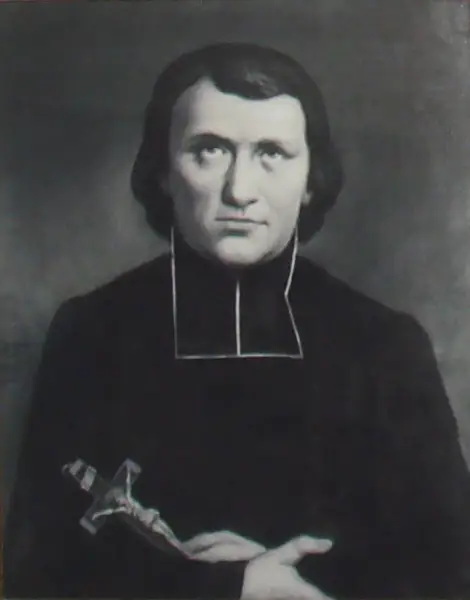
Overview
Born on 1 March 1824 in the village of Saint-Christôt-en-Jarret, within the diocese of Lyon, Jean-Louis Bonnard came out of the Catholic countryside of the French provinces. When his collegiate studies at Saint-Jodard were done, he went on to the seminary of Lyon, leaving it at twenty-two to complete his theology at the Paris house of the Foreign Missions society, the society that supplied priests for East Asia. Ordained at Nantes, he embarked for the missions of Western Tongking in northern Vietnam, landing in May 1850, and within a year was entrusted with the care of two parishes. It was a criminal work he had taken up: the preaching of Christianity was forbidden under penalty of death in the emperor's realms. Bonnard was seized on 21 March 1852 and thrown into prison; a capital sentence was handed down and carried out at once on confirmation by the Emperor Tự Đức, and he was beheaded on 1 May 1852, twenty-eight years old. His body was cast into the river, but Vietnamese Christians quietly recovered the remains and sent them home to the Paris seminary, where they arrived as a testimony to the mission's cost. He is one of the French missionaries numbered among the Martyrs of Vietnam canonized by Pope John Paul II in 1988.
The Complete Life
Early Life
Jean-Louis Bonnard was born on 1 March 1824 at Saint-Christot-en-Jarret in the diocese of Lyon, into the Catholic France of the Restoration. His childhood and schooling were unremarkable except for the piety that pointed him early toward the priesthood. He followed the ordinary course open to a French boy of devout family: collegiate studies at Saint-Jodard, then entry into the diocesan seminary of Lyon. There he encountered the missionary culture of nineteenth-century France, in which the newly revived societies of mission, above all the Paris Society of Foreign Missions, recruited seminarians for the churches of Asia. The Society's seminary in the rue du Bac, filled with the memory of its martyrs in Vietnam, Korea, and China, drew a steady stream of volunteers who understood that a mission posting meant hardship and, under several Asian governments, a real likelihood of execution.
§ Introduction
Conversion and Vocation
At twenty-two Bonnard left the seminary of Lyon to complete his theological formation at the Seminary of Foreign Missions in Paris, the decisive step from diocesan student to missionary. He was ordained at Nantes and immediately offered himself for the missions of western Tonking, the northern region of Vietnam, where the Society had served since the seventeenth century and where its members had already been put to death. Nothing in his record marks him out as exceptional; his superiors' judgment of him, preserved in the ordinary language of such assessments, was of a zealous, obedient, capable priest. He sailed from France in the ordinary way, knowing that proselytism was banned under Vietnamese law and that the penalty for a missionary caught in the country was death. He reached his mission in May 1850.
§ Life
Mission and Ministry
Bonnard worked in western Tonking at a moment of rising danger. In 1851 he was given charge of two parishes, a phrase that in missionary Vietnam meant clusters of villages with Christian communities meeting discreetly, served by native catechists and visited by the priest in rotation. The Church he served was substantial and long-established, with Vietnamese priests, lay leaders, and a devotional life organized around the liturgical year rather than around buildings, since churches could be confiscated or burned. Bonnard's ministry was the classic round of the Foreign Missions in Tonking: Mass in hiding, confessions by night, the training and encouragement of catechists, the administration of the sacraments to villages that might see a priest twice a year. The same year he took up this charge, the imperial government's pressure on the mission increased, and arrests of Christians began to close in on the districts he served.
§ Life
Trial and Final Years
On 21 March 1852 Bonnard was arrested and imprisoned. The court pronounced a death sentence against him, and under the procedure of the Nguyen court it awaited confirmation by the emperor, Tu Duc, whose reign was to prove the bloodiest for the Vietnamese church. Confirmation came from Hue, and the sentence was carried out at once: Bonnard was beheaded on 1 May 1852. He was twenty-eight. His remains were thrown into the river in the customary attempt to prevent Christians from recovering relics, but Vietnamese Catholics retrieved them and sent them back to France, to the Seminary of Foreign Missions in Paris, where they remain among the relics of the Society's martyred members.
§ Life
Canonization
Bonnard was one of the martyrs whose cause advanced with the great group of Vietnamese sufferers. The martyrs of Tonking and Cochinchina were beatified in stages in 1900 and later, and Jean-Louis Bonnard was beatified with the group beatified by Pope Pius X in 1906. On 19 June 1988 Pope John Paul II canonized 117 martyrs of Vietnam, Vietnamese laypeople, Vietnamese clergy, Spanish Dominicans, and French members of the Foreign Missions, and Bonnard's name stands in that roll. He is commemorated with the martyrs of Vietnam on 24 November and individually in the liturgical calendars of the Society of Foreign Missions and of the French dioceses that remember their missionary sons.
§ Introduction
Legacy
Bonnard's legacy is that of the whole French missionary generation in Vietnam: a two-year mission ended by the axe, remembered not for any single achievement but for the completeness of the offering. Within the history of the Foreign Missions he belongs to the line of the rue du Bac's dead, the priests whose relics returning to Paris kept the Society's vocation visible to French Catholics and recruits flowing to Asia through the whole era of persecutions. In Vietnam his memory is part of the long account between the Nguyen state and the church, the account that culminated in the canonization of 1988 and in the pilgrimage of Vietnamese Catholics, at home and in the diaspora, to the martyrs' shrines. His brief pastorate of two parishes is a reminder that the Vietnamese church was built by short lives spent at full pace.
§ External links
Timeline
- 1 Mar 1824
Born at Saint-Christôt-en-Jarret in the diocese of Lyon, France.
§ Introduction
- May 1850
Ordained at Nantes, he sails for Western Tongking and reaches the mission there in May.
§ Life
- 1851
Put in charge of two parishes in Western Tongking, at a time when proselytising was banned in Vietnam.
§ Life
- 21 Mar 1852
Arrested on 21 March and thrown into prison; a death sentence is pronounced against him.
§ Life
- 1 May 1852
Beheaded on 1 May, aged twenty-eight, once Emperor Tự Đức confirms the sentence; his remains are cast into the river.
§ Life
- 19 Jun 1988
Canonized by Pope John Paul II among the Martyrs of Vietnam.
§ Introduction
The Record
- Canonization
- Canonized by Pope John Paul II on 19 June 1988 among the 117 Martyrs of Vietnam
Prayer
Bibliography
Show 2 sources
Profile text adapted from the Wikipedia article, licensed CC BY-SA 4.0.
Pray with this saint every day
Save St. Jean-Louis Bonnard to your favorites, read the full profile, and get feast-day reminders in the Saints app.
Get the Saints AppFree on the App Store for iPhone and iPad