
1556 – 1640·Feast May 15
St. Jeanne de Lestonnac
Widow who founded the first teaching order of women
Overview
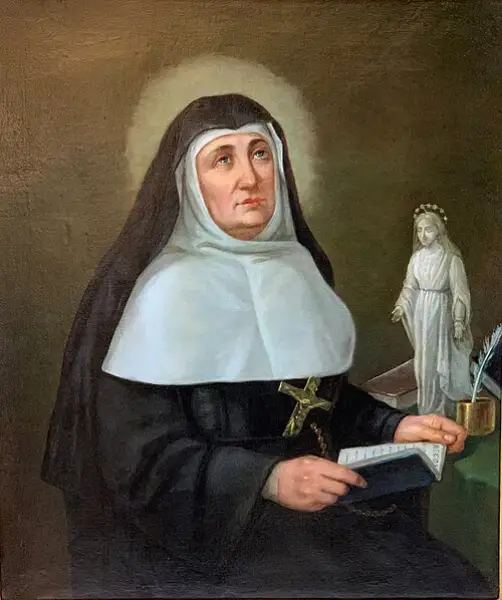
Jeanne de Lestonnac was a French widow and religious foundress who established the Sisters of the Company of Mary, Our Lady, the earliest congregation of teaching sisters that Rome ever approved. Born in Bordeaux in 1556, she was the niece of the philosopher Michel de Montaigne and grew up in a family divided by the wars of religion, her mother an ardent Calvinist, her father and uncle firm Catholics. Married at seventeen to Gaston de Montferrant, she bore seven children and endured, at the end of twenty-four years of marriage, the death of her husband and, within seven months, of her father, her uncle, and her eldest son. At forty-six she entered the Cistercians at Toulouse but left after six months of illness, living afterward as a charitable laywoman. When plague struck Bordeaux in 1605 she returned to nurse the sick in its slums, and two Jesuits then asked her to found a teaching congregation for girls. The Compagnie de Notre-Dame received papal approval in 1607, opened its first school in Bordeaux, and numbered thirty houses in France by her death on 2 February 1640. Beatified in 1900, she was canonized by Pius XII in 1949.
The Complete Life
A House Divided
Jeanne de Lestonnac was born in Bordeaux on 27 December 1556, into a prominent family of the city. Her father, Richard de Lestonnac, sat in the Parlement of Bordeaux; her mother, Jeanne Eyquem, was the sister of the celebrated philosopher Michel Eyquem de Montaigne. She grew up at the very height of the confrontation between Protestant reform and Catholic defence, and the conflict ran straight through her home. Her mother embraced Calvinism with enthusiasm and pressed her daughter to convert, while her father and her uncle Montaigne held to the Catholic faith and became the young girl's support in remaining Catholic. This experience of a family split by confession marked her for life. At seventeen she became the wife of Gaston de Montferrant; seven children were born to them, though three did not outlive their first years. After twenty-four years of marriage her husband died, opening the most painful chapter of her life: within seven months she also lost her father, her uncle, and her eldest son, four bereavements in a single year that stripped her of nearly everyone who had anchored her.
§ Early years
Late Vocation, Broken Health
Left a widow at about forty-six, with her surviving children grown, Jeanne turned to the contemplative life and entered the Cistercian monastery at Toulouse, taking the religious name Jeanne of Saint Bernard. She found deep peace and satisfaction in the cloister, but after only six months she fell gravely ill and was forced to leave. Recovery brought her to her estate of La Mothe Lusié, where she adopted the life of a secular dévote, a devout laywoman living in the world. She distributed food and alms, and gathered the young women of her own social class regularly for prayer and discussion of religious questions. Seeking models of Catholic womanhood to guide her, she cultivated a particular interest in Scholastica, Clare of Assisi, Catherine of Siena, and Teresa of Avila, a programme of spiritual reading that shaped her own future as a foundress. The decisive test came in 1605, when plague broke out in Bordeaux: at the risk of her own life she made her way back to Bordeaux to tend the sick in the poorest quarters of the stricken city.
§ Religious life
A School for Girls, a Company of Mary
The institution Jeanne eventually founded was not her own idea but a request. The initiative came from others. Her brother, himself a Jesuit of the Bordeaux college, brought her together with two fathers of that Society, Jean de Bordes and François de Raymond, and the pair urged her to take charge of a new teaching congregation for girls, so that daughters might receive the formal schooling the Jesuits provided for sons. The three settled on a cloistered community following the Benedictine rule, modified to allow the sisters to teach, and Pope Paul V approved the institute in 1607 under the name of the Compagnie de Notre-Dame. The community bought an old priory near the Château Trompette, then relocated in September 1610 to a larger former monastery on the rue du Hâ, where the city's leading families welcomed them and backed the house with money. On 10 December 1610 the first five members professed their vows, and the community opened its first school for girls in Bordeaux. Using her personal connections and those of the Jesuits and Bordeaux's political families, Jeanne planted further foundations in Beziers, Périgueux, and Toulouse. When she died on 2 February 1640, thirty houses of the order stood in France.
§ Foundress
A Spirituality of Charity and Learning
Jeanne's spiritual formation ran through loss. Widowed and bereaved of father, uncle, and son in a single year, she sought first the silence of the Cistercian cloister, and when illness expelled her after six months she refused to abandon the search for God. Her life at La Mothe Lusié showed the pattern of her sanctity: prayer joined to organized charity, with the food and alms she distributed reaching the poor of her district and the young women of her class gathered for regular prayer and religious conversation. The saints she studied, Scholastica, Clare of Assisi, Catherine of Siena, and Teresa of Avila, were all women of sturdy faith in turbulent times, and their example prepared her for the risk she took in the plague of 1605, nursing the sick in Bordeaux's slums at the possible cost of her life. The congregation she finally shaped carried this spirituality into its structure: a cloistered community under a modified Benedictine rule whose cloister existed, unusually, to make teachers, so that contemplation and the instruction of girls were held together in one vocation.
§ Religious life
Thirty Houses and a Quiet Death
The last decades of Jeanne's life were spent extending the Compagnie de Notre-Dame through the network of kinship and patronage she commanded. The Bordeaux house on the rue du Hâ became the model, and foundations followed at Beziers, Périgueux, and Toulouse, each built on her personal ties, her Jesuit connections, and the goodwill of Bordeaux's political elite. The order she had accepted as a burden laid on her by others grew into the first congregation of women teachers approved by the Catholic Church. She lived to see thirty houses established across France, an extraordinary expansion for an institute barely a generation old, founded by a woman who had entered religious life only in her forties. She died on 2 February 1640, in her eighty-fourth year, in the Bordeaux where she had been born, married, buried her family, nursed plague victims, and built her schools. The work outlived her handsomely, and the memory of its foundress passed into the congregation's own tradition as the measure of its vocation.
§ Foundress
From Beatification to the Altars
The Church's recognition of Jeanne de Lestonnac came in two steps separated by half a century. Pope Leo XIII beatified her in 1900, honouring the widow-turned-foundress whose order had by then spread far beyond Bordeaux. Pope Pius XII canonized her on 15 May 1949, fixing her feast on the anniversary of that ceremony. The dates bracketed the most violent half-century in French history, through which her congregations of teaching sisters continued their work. The Church also honoured the particular experiences of her life in her patronage: she is invoked by abuse victims, by people rejected by religious orders, and by widows, the three trials, division, exclusion, and bereavement, that her own story had dramatized. For the Company of Mary her canonization confirmed the charism first approved by Paul V in 1607: that the formal education of girls is itself a work of the Church, and that women religious may claim it as their proper apostolate.
§ Legacy
A Global Company of Mary
The congregation Jeanne founded has become a worldwide educational network. As of 2016, the Sisters of the Company of Mary, Our Lady numbered more than 1,450 sisters working in twenty-seven countries across Europe, Africa, North America, and South America, a growth from the five women who took vows in a Bordeaux monastery in 1610 that could scarcely have been imagined by the Jesuits who first proposed the venture. From its first school for girls in the city of her birth, the order carried into every continent the principle for which she was canonized: that women religious could be, and should be, professional teachers of the young. Schools bearing the name of Saint Jeanne de Lestonnac, in France and in the lands of the Company's expansion, keep her memory tied to the daily work of classrooms rather than to monuments. For the Church's wider history she remains a landmark figure, the foundress of the first religious order of women teachers ever approved, whose institute opened the long tradition of congregations dedicated to the education of girls.
§ Legacy
Timeline
- 27 Dec 1556
Born in Bordeaux to Richard de Lestonnac and Jeanne Eyquem, sister of Montaigne.
§ Early years
- 1605
During the Bordeaux plague, returned to her native city to nurse the sick in its slums.
§ Religious life
- 1607
Pope Paul V approved her new teaching congregation, the Compagnie de Notre-Dame.
§ Foundress
- Sep 1610
The community moved from a priory near the Château Trompette to a larger monastery on rue du Hâ.
§ Foundress
- 10 Dec 1610
The first five members of the order took their religious vows.
§ Foundress
- 2 Feb 1640
Died at about eighty-three, with thirty houses of her order established across France.
§ Foundress
- 1900
Beatified by Pope Leo XIII.
§ Legacy
- 15 May 1949
Canonized by Pope Pius XII.
§ Legacy
The Record
- Major works
- Sisters of the Company of Mary, Our Lady (Compagnie de Notre-Dame)·First school for girls established by the order in Bordeaux·Houses of the Company of Mary in Beziers, Périgueux, and Toulouse
- Patron of
- Abuse victims·People rejected by religious orders·Widows
- Canonization
- Canonized by Pope Pius XII on 15 May 1949
Prayer
Bibliography
Show 7 sources
- "Saint Jeanne". Company of Mary.
- "Saint Jeanne de Lestonnac", International Catholic Stewardship Council.
- "Biography of Saint Jeanne de Lestonnac" (PDF). Company of Mary. Archived from the original (PDF) on 2015-05-26.
- Wright, Anthony D., The Divisions of French Catholicism, 1629–1645, Ashgate Publishing, Ltd., 2013. ISBN 9781409482246.
- Dast le Vacher de Boisville, La Vénérable Jeanne de Lestonnac et la fondation de l'Ordre des Filles de Notre Dame, (Bordeaux: R. Coussau, 1899).
- Marshman, Michelle. "Patronage and Kinship in Women's Teaching Orders of Seventeenth-Century Bordeaux", Proceedings of the Western Society of French History, Vol. 31, 2003.
- "Sisters of the Company of Mary, Our Lady". Saint Jeanne de Lestonnac School.
Profile text adapted from the Wikipedia article, licensed CC BY-SA 4.0.
Pray with this saint every day
Save St. Jeanne de Lestonnac to your favorites, read the full profile, and get feast-day reminders in the Saints app.
Get the Saints AppFree on the App Store for iPhone and iPad