
1666 – 1736·Feast August 17
St. Jeanne Delanoue
Foundress of the Sisters of Saint Anne of Providence
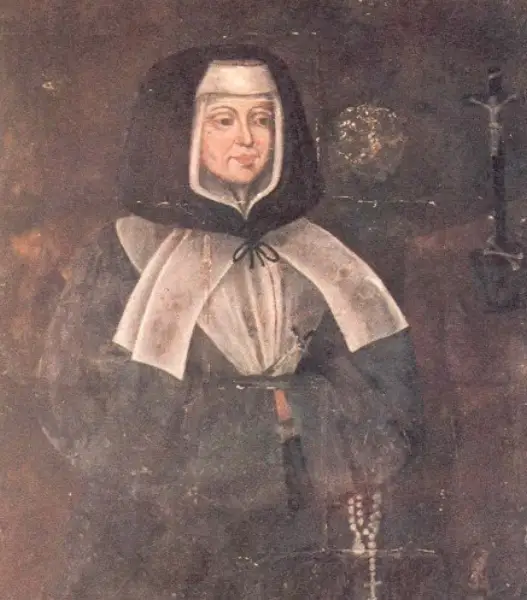
Overview
Jeanne Delanoue, known in religion as Joan of the Cross, was a French woman of Saumur who turned from a grasping merchant's life to become a radical servant of the destitute and founder of the Congregation of St. Anne of Providence. Born in 1666, the youngest of twelve children of a draper, she grew up minding a shop of religious goods beside the shrine of Notre-Dame-des-Ardilliers and took it over when her widowed mother died. Contemporaries judged her early character self-centred, proud, and avaricious. Everything changed after Pentecost 1693, when a poor pilgrim foretold that she would one day spend her life with the poor. The prophecy took hold: she shut the shop and opened her house, and its Loire-side caves and cellars, to orphans, the sick, the aged, abandoned mothers, and prostitutes. Other women joined her, and in 1704 the community that became the Sisters of Saint Anne of Providence of Saumur was born, with the approval of the Bishop of Angers in 1709. She survived the loss of her home in the earthquake of 1703 and fed about a hundred people during the famine of 1709. When she died in 1736, twelve communities of her sisters served throughout France.
The Complete Life
The Merchant of the Fenêt
Jeanne Delanoue was born at Saumur in Anjou on 18 June 1666, the last of twelve children. Her parents kept a shop in the city's Fenêt quarter, close by the pilgrimage shrine of Notre-Dame-des-Ardilliers, and her father, a draper, died when Jeanne was six years old. The girl grew up helping her mother serve the pilgrims who came to the shrine, selling religious goods and lodging travellers in the family house. When her mother died, twenty-five-year-old Jeanne took the business over entirely. She proved an able merchant, so able that she kept the doors open even on Sundays and holy days, a practice that raised eyebrows in the devout France of the seventeenth century. Her biographers are frank about her disposition in those years: self-centred, proud, and avaricious, a businesswoman whose religion sat comfortably alongside the till. Nothing in her outward life suggested that within a few years the shop would be shut, the profits given away, and the caves beneath her house filled with the people she had never spared a thought for.
§ Early life
A Pilgrim's Prophecy
On Pentecost 1693 Jeanne met Francoise Fouchet, a poor widowed pilgrim who had come to Saumur from Rennes. Fouchet told her that one day she would spend her life caring for the poor. Jeanne received the prediction with some skepticism, and who could have blamed her: she had a business to run and, by every account, a fortune to make. But the words lodged. Caring for the less fortunate began to absorb more and more of her time, at first in visits to the poor of her own neighbourhood. The merchant's instincts did not so much die as turn inside out: the skill that had kept a shop open on Sundays now organized soup, bedding, and shelter. In time she closed the family business altogether and committed herself to the work full time. Her house by the Loire, with its caves and cellars like those of the wine merchants, was emptied of goods and filled with people, orphans, the sick, the old, and the destitute, with a particular welcome for abandoned single mothers and prostitutes whom few others would take in.
§ Conversion
Providence in the Caves of the Loire
The work grew faster than the walls that held it. In 1703 an earthquake set off a landslide that destroyed her home; she was undeterred and simply found another. Many of the poor could find shelter nowhere but the caves carved out of the tufa along the Loire, and she made them as comfortable as such dwellings allowed. In 1704 several young women who shared her vision joined her, and from this band came the Sisters of Saint Anne of Providence of Saumur. The celebrated preacher Louis de Montfort endorsed her work, lending it weight in the Church. In 1709, a year of terrible famine, her Providence House fed about a hundred people, and that same year brought the approval of the community's constitutions by Michel Poncet de La Rivière, bishop of Angers. In 1715 she founded Saumur's first home for the poor, crowning a quarter-century of labour. By the time of her death the institute had grown to twelve communities scattered across France, each serving the poor and needy in her spirit of confidence in God's Providence.
§ Conversion
Confidence in Providence
The single thread running through Jeanne's long conversion was trust in the Providence of God. The Roman Martyrology summarizes her sanctity in exactly those terms: with total confidence in Providence she took into her home the orphaned, the aged, the ailing, and women gone astray, and then, in company, brought her institute into being. That confidence was not passivity but a habit of bold improvisation. She gambled her livelihood on a pilgrim's word; she reopened her ruined charity after an earthquake; she fed a hundred mouths in a famine year without knowing where the next season's bread would come from. Her religion also carried a marked preference for the rejected. Abandoned mothers and prostitutes, the women whom respectable Saumur preferred not to see, received her particular attention, and the caves that sheltered them were named for Providence itself. Her own religious name, Joan of the Cross, signalled the shape of this spirituality: a life taken up daily in the service of suffering people, without guarantees, sustained by the conviction that the God who feeds the birds would not abandon those who fed the poor for his sake.
§ Veneration
Last Years in the Fenêt
Jeanne spent her entire life in the Fenêt district of Saumur, the quarter where she had been born, kept shop, and begun her secret transformation. In her final years she watched the little congregation she had gathered from a handful of volunteers mature into a stable institute with houses across France, its constitutions approved, its work recognized by bishop and preacher alike. Her death came from natural causes on 17 August 1736, in her seventieth year, in the quarter where all her labours had unfolded. At her death twelve communities of her sisters were at work throughout France, serving the poor and needy she had made her life's concern. The woman who had once kept her shop open on holy days was buried in the memory of the city as its servant, and the cause that would carry her name to the altars began quietly, in the testimony of the poor who had lived in her caves and the sisters who had learned from her the practice of Providence.
§ Conversion
Honours of the Church
Two centuries after her death, the Church formally recognized the sanctity that Saumur had long venerated. Pope Pius XII beatified Jeanne Delanoue on 8 November 1947, and the formal inquiry toward sainthood was opened on 7 January 1951. Pope John Paul II canonized her on 31 October 1982, among the many saints he raised during the jubilee year of 1982. Her feast is kept on 17 August, the anniversary of her death. The Roman Martyrology records her in a single luminous sentence, praising her total confidence in the Providence of God and her sheltering of the orphaned, the aged, the ailing, and women gone astray before her institute existed. From a scandalous merchant of the Fenêt to a saint in the universal calendar of the Church, her cause traced the same arc as her life: the last placed first, and the woman the city once judged harshly proposed to the whole world as a model of mercy.
§ Veneration
The Sisters of Saint Anne Today
The congregation Jeanne founded has never ceased its work. On 3 December 1964 it took the name Congregation of the Sisters of St. Anne of Providence, and as of 2021 it counted more than four hundred members serving the poor in France, Madagascar, and Sumatra, a reach across three continents that the twelve communities of 1736 could scarcely have imagined. Her memory has also entered the arts: the composer Michel Bosc wrote La Nef ardente, an oratorio on her life, giving her story to concert halls as well as to churches. In Saumur itself the institutions she began, from Providence House to the first home for the poor, mark the city's memory of the merchant's daughter who fed its hungry. For the Sisters who follow her, the style of that memory is practical rather than monumental: shelter for those without it, confidence in Providence in seasons of scarcity, and a particular tenderness for women whom the world has given up on.
§ Veneration
Timeline
- 18 Jun 1666
Born at Saumur in Anjou, the youngest of twelve children.
§ Early life
- 1693
Met the pilgrim Francoise Fouchet at Pentecost, who foretold a life spent caring for the poor.
§ Conversion
- 1703
Lost her home when an earthquake-triggered landslide destroyed it, and found another.
§ Conversion
- 1704
Joined by young women who shared her vision, founded the Sisters of Saint Anne of Providence of Saumur.
§ Conversion
- 1709
Cared for about one hundred people at Providence House during the famine.
§ Conversion
- 1709
Received approval of the congregation's constitutions from Michel Poncet de La Rivière, Bishop of Angers.
§ Conversion
- 1715
Established Saumur's first home for the poor.
§ Conversion
- 17 Aug 1736
Died of natural causes in the Fenêt district of Saumur, leaving twelve communities of sisters.
§ Conversion
- 8 Nov 1947
Beatified by Pope Pius XII.
§ Veneration
- 7 Jan 1951
The cause for her canonization was formally opened.
§ Veneration
- 31 Oct 1982
Canonized by Pope John Paul II.
§ Veneration
- 3 Dec 1964
Her congregation was renamed the Congregation of the Sisters of St. Anne of Providence.
§ Veneration
In Their Own Words
With total confidence in the Providence of God, she first welcomed home orphans, old women, the sick, and lost women, then, with companions, she founded the Institute of the Sisters of Saint Anne-of-Providence.
The Record
- Major works
- Congregation of St. Anne of Providence (Sisters of Saint Anne of Providence of Saumur)·Providence House, Saumur·Saumur's first home for the poor (1715)·Shelter in the Loire caves for orphans, the sick, the aged, and indigent women
- Patron of
- The poor and destitute·Abandoned single mothers
- Canonization
- Canonized by Pope John Paul II on 31 October 1982
Prayer
Bibliography
Show 8 sources
- "Jeanne Delanoue (1666-1736)", Vatican News Service.
- Joseph SJ, St. Jeanne Delanoue, Vatican Radio.
- Duffy, Patrick. "Aug 17 – St Jeanne Delanoue (1666-1736) Founder", Catholic Ireland, 17 August, 2012.
- "Saint Jeanne Delanoue", Independent Catholic News.
- Trochu, F., "Jeanne Delanoue", The Oxford Dictionary of Saints 5th rev. ed., (David Farmer, ed.) OUP, 2011, ISBN 9780199596607.
- Girouard, Auguste (1941). Saumur: Vieux logis, vieux souvenirs (in French). Angers: Petit Courrier. pp. 26–28.
- Index ac status causarum beatificationis servorum dei et canonizationis beatorum (in Latin). Typis polyglottis vaticanis. January 1953. p. 107.
- "Sainte Jeanne Delanoue", Nominis.
Profile text adapted from the Wikipedia article, licensed CC BY-SA 4.0.
Pray with this saint every day
Save St. Jeanne Delanoue to your favorites, read the full profile, and get feast-day reminders in the Saints app.
Get the Saints AppFree on the App Store for iPhone and iPad