
1792 – 1879·Feast August 30
St. Jeanne Jugan
Foundress of the Little Sisters of the Poor
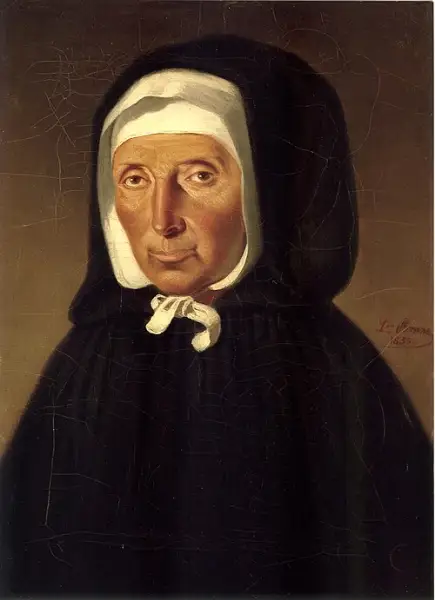
Overview
Jeanne Jugan, known in religion as Mary of the Cross, was a French religious sister who gave her life without reserve to old people sunk in poverty and brought into being the Little Sisters of the Poor. Born in the Breton port of Cancale in 1792, she lost her fisherman father to the sea in childhood and grew up in poverty during the Revolution, secretly taught the faith by her mother. She worked as a shepherdess, a kitchen maid, a hospital nurse at Saint-Servan, and finally as a servant of a fellow Eudist associate, with whom she taught catechism and served the poor. In the winter of 1839 she carried a blind and paralyzed old woman home and gave her own bed to her, keeping for herself the attic. From that act grew a congregation of women who begged in the streets to sustain homes for the abandoned elderly. By 1879 the Little Sisters of the Poor numbered 2,400 across Europe and North America, though their foundress had been pushed aside years earlier by the priest who controlled the institute, and she died in obscurity at Saint-Pern in 1879. Her role was formally acknowledged after her superior's dismissal in 1890; she was beatified in 1982 and canonized by Pope Benedict XVI in 2009.
The Complete Life
A Breton Childhood in Revolutionary France
Jeanne Jugan was born on 25 October 1792 in Cancale, a fishing port in Brittany, the sixth of eight children born to Joseph and Marie Jugan. Her childhood unfolded amid the political and religious convulsions of the French Revolution. Some four years into her childhood her fisherman father vanished at sea, leaving her mother to keep the family fed on her own, while slipping the Catholic faith to her children in secret, since anti-Catholic persecution made open teaching impossible. As a very small girl Jeanne guarded sheep and picked up knitting and the spinning of wool; schooling hardly touched her, and she could scarcely manage to read or write. At sixteen she entered domestic service as kitchen maid to the Viscountess de la Choue, a devout Catholic who took the girl along on her visits to the sick and the poor, an apprenticeship in charity that left its mark. Twice, at eighteen and again six years later, she refused a marriage proposal from the same man, telling her mother that God had other plans for her, a work not yet founded.
§ Early life
A Work Not Yet Founded
At twenty-five Jugan enrolled among the associates of the Eudists, the congregation John Eudes had established, and began the series of services that prepared her for the mission she could not yet see. For six years she nursed at the town hospital of Saint-Servan, leaving only when her own health failed. She then spent twelve years as servant to a fellow member of the Eudist Third Order, and the two women, recognizing a shared spirituality, taught catechism to the town's children and cared for the poor and the unfortunates together, until the older woman's death in 1835. In 1837 Jugan took the decisive step of common life: she and Françoise Aubert, a widow in her seventies, took rooms in a modest cottage, and before long the orphan Virginie Tredaniel, then seventeen, completed their little company. The trio bound themselves into a praying Catholic circle whose labour was catechism for children and help for the needy, a small seed awaiting only the encounter that would define the rest of Jeanne's life.
§ Early life
The Old Woman at the Door
In the winter of 1839 Jugan came upon Anne Chauvin, aged and blind and half paralyzed, with nobody left to look after her. Jugan carried her to her own apartment and cared for her from that day forward, giving her the bed and sleeping herself in the attic. Two more old women soon joined the first; by 1841 Jugan had rented a room to house a dozen of the elderly poor, and the following year she obtained a disused convent able to hold forty residents. With her companions' blessing she turned entirely to the aid of old women left desolate, and out of that modest start emerged the Little Sisters of the Poor. She wrote the community a simple Rule of Life, and the sisters went out daily, door to door, begging food, clothing, and money for those in their care, a practice that became the congregation's hallmark. During the 1840s young women joined in numbers, and by the end of the decade her begging had established four more homes. In 1847, at the request of Leo Dupont, the Holy Man of Tours, she founded a house in that city, and she was much sought after whenever difficulties arose, working with religious and civil authorities on the poor's behalf.
§ Foundress
Hospitality and Holy Begging
Jugan's spirituality joined two practices the world despises: serving those who can give nothing back, and begging. The Little Sisters owed their existence not to endowment but to the daily collection of alms, and the foundress led them into the streets herself, convinced that asking for the poor was a dignity and not a disgrace. Pope Benedict XVI, at her canonization, located the source of her spirit of hospitality and fraternal love in the Beatitudes, founded on an unlimited trust in Providence that illuminated her whole life. She had tested that trust early: the woman she took in from the winter street received her bed, while she climbed to the attic, and every later expansion of the work asked the same confidence of her. The Rule she wrote was simple, suited to women of little education, and oriented entirely to the elderly poor, particularly abandoned women. Her sanctity, recognized only slowly, lay in this unremarkable consistency, a lifetime of small renunciations offered for people the age preferred to forget, until the enterprise of mercy outgrew every plan she could have made for herself.
§ Foundress
Displaced and Forgotten
The congregation's success brought tragedy to its foundress. As it grew past a hundred members by 1850, the local bishop appointed Abbé Auguste Le Pailleur Superior General, and Jugan was forced out of leadership. In what appears to have been a deliberate effort to suppress her true role, he assigned her nothing but street begging, and eventually sent her into twenty-seven years of retirement and obscurity, her eyesight failing in her last years. She did not protest. On 1 March 1879 Pope Leo XIII approved the congregation's Constitutions for an initial period of seven years, and the institute she founded then counted 2,400 Little Sisters spread across Europe and North America. When Jugan died at Saint-Pern on 29 August 1879, aged eighty-six, many of the sisters did not even know she had founded their congregation. She was buried in the graveyard of the General Motherhouse at Saint-Pern, where she had spent the last twenty-three years of her life. Justice came posthumously: Le Pailleur was investigated and dismissed in 1890, and Jeanne Jugan came to be acknowledged as the foundress she had always been.
§ Expansion
Raised to the Altars
Recognition of Jugan's sanctity followed her restoration to the congregation's memory. Pope John Paul II beatified her in Rome on 3 October 1982, and on 11 October 2009 Pope Benedict XVI canonized her in Vatican City, together with Zygmunt Szczęsny Feliński, Francisco Coll y Guitart, Damien of Molokai, and Rafael Arnáiz Barón. At the canonization Benedict XVI said that in the Beatitudes she had found the source of her spirit of hospitality and fraternal love, resting on unlimited trust in Providence. Pilgrims today can visit the places of her life: the house where she was born in Cancale, the House of the Cross at Saint-Servan where she received Anne Chauvin, and La Tour Saint-Joseph at Saint-Pern, the motherhouse where she lived her final twenty-three years and which holds her shrine. Her feast is kept on 30 August. From a woman erased from her own congregation's history, she became a saint proposed to the whole Church, the correction of an old injustice accomplished by the slow machinery of canonization itself.
§ Veneration
A Worldwide Work for the Elderly
The Little Sisters of the Poor carried Jugan's model across the world. After spreading throughout France the mission reached England in 1851; between 1866 and 1871 five communities were founded across the United States; and in September 1885 the sisters arrived in South America with a first foundation at Valparaíso, Chile, from which the work expanded further. By the year of her death the congregation had 2,400 members serving the elderly poor on two continents, and it has continued to grow since. Her memory is honoured in practical ways by those who follow her example: at the Queen of Peace Residence in Queens Village, New York, the Little Sisters established the Jeanne Jugan Award, given to the staff member who best exemplifies her spirit of service to the aged. Her story has also become a lesson in institutional humility, cited whenever the founders of works of charity are written out of their own foundations, and her quiet endurance of that erasure has become part of the reason the Church holds her up as a model of humility.
§ Legacy
Timeline
- 25 Oct 1792
Born at Cancale in Brittany, the sixth of eight children.
§ Early life
- 1835
Her Eudist employer died, ending twelve years of domestic service and catechetical work.
§ Early life
- 1837
Formed a prayer community with Françoise Aubert and Virginie Tredaniel in a rented cottage.
§ Early life
- 1839
Took the blind and paralyzed Anne Chauvin into her home, giving her her own bed.
§ Foundress
- 1841
Rented a room to house a dozen elderly people.
§ Foundress
- 1842
Acquired an unused convent building able to shelter forty of them.
§ Foundress
- 1847
Established a house in Tours at the request of Leo Dupont, the Holy Man of Tours.
§ Foundress
- 1850
More than one hundred women had joined the young congregation.
§ Expansion
- 1851
The Little Sisters of the Poor expanded to England.
§ Expansion
- 1866
The first of five American communities was founded, the last following by 1871.
§ Expansion
- 1 Mar 1879
Pope Leo XIII approved the congregation's Constitutions for an initial seven-year period.
§ Expansion
- 29 Aug 1879
Died aged 86 at Saint-Pern, with the community grown to 2,400 Little Sisters.
§ Expansion
- Sep 1885
The congregation made its first South American foundation at Valparaíso, Chile.
§ Expansion
- 1890
Abbé Le Pailleur was investigated and dismissed, and Jugan was acknowledged as foundress.
§ Expansion
- 3 Oct 1982
Beatified by Pope John Paul II in Rome.
§ Veneration
- 11 Oct 2009
Canonized by Pope Benedict XVI in Vatican City.
§ Veneration
In Their Own Words
In the Beatitudes, Jeanne Jugan found the source of the spirit of hospitality and fraternal love, founded on unlimited trust in Providence, which illuminated her whole life.
The Record
- Major works
- Little Sisters of the Poor·Simple Rule of Life for the new community·Homes for the abandoned elderly across France, England, and the United States
- Canonization
- Canonized by Pope Benedict XVI on 11 October 2009
Prayer
Bibliography
Show 7 sources
- "Who is Jean Jugan?", Little Sisters of the Poor, US.
- "St Jeanne Jugan", SaintsResource.com. Accessed 8 August 2023.
- Lafon, Michel (2009). 15 Days of Prayer with Saint Jeanne Jugan. New City Press. ISBN 1-56548-329-4, p. 20.
- Morrow, Carol Ann. Little Sister, Big Heart: St. Jeanne Jugan, americancatholic.org, October 2009.
- Kurian, Anna. "Once shunned and forgotten, Little Sisters of the Poor founder Jeanne Jugan now shines", Catholic News Agency, August 30, 2023.
- "11 October 2009: Canonization of five new Saints". vatican.va. Retrieved 18 February 2017.
- Milcen, Paul (2000). Jeanne Jugan: Humble, So as to Love More. Darton, Longman & Todd. ISBN 0-232-52383-5.
Profile text adapted from the Wikipedia article, licensed CC BY-SA 4.0.
Pray with this saint every day
Save St. Jeanne Jugan to your favorites, read the full profile, and get feast-day reminders in the Saints app.
Get the Saints AppFree on the App Store for iPhone and iPad