
c. 347-420·Feast September 30
St. Jerome
Priest, Translator of Scripture, Doctor of the Church
Overview
Eusebius Sophronius Hieronymus was born at Stridon, on the border of Dalmatia and Pannonia, sometime in the 340s. Sent to Rome to study under the grammarian Donatus, he was baptized there as a young man, though the Sunday descents into the martyr-filled catacombs filled him with more terror than comfort. Drawn to the desert of Chalcis near Antioch, he began studying Hebrew with a converted Jew and copied out a Hebrew gospel. Back in Rome as protege of Pope Damasus I, he revised the Latin Gospels and Psalter, gathering around himself a circle of ascetically minded patrician women — Marcella, Paula, Eustochium — whose vocations he directed by letter. After Damasus died and hostile clergy moved against him, he went east; Paula's money settled him in a Bethlehem monastery beside the Church of the Nativity, where from about 390 he laboured to render the Hebrew Scriptures directly into Latin, against the counsel of almost everyone, Augustine included. The result, the Vulgate, served as the Church's Bible for a thousand years. His later years brought biblical commentaries, a world chronicle, and On Illustrious Men, the first Christian biobibliography. He died at Bethlehem on 30 September 420.
The Complete Life
Early Life
Eusebius Sophronius Hieronymus — Jerome of Stridon — was born around 342–347 at Stridon, a town on the border of Dalmatia and Pannonia, into a Christian family of the provincial Latin-speaking world. His education gave him the full classical inheritance — Cicero, Vergil, the rhetors — and took him to Rome and to the Catechetical School of Alexandria, the great centre of Greek Christian learning; he emerged with the Greek and later the Hebrew that set him apart from almost every Latin Christian of his age. His earliest surviving writing already shows the temperament his readers would know for forty years: immense learning, a cutting tongue, and a piety that pulled him toward the desert while his books pulled him toward the cities.
§ Introduction
Conversion and Vocation
Jerome's conversion of direction was the classic one of the cultivated fourth century: a serious illness and a celebrated dream in which he was taken before the judgment seat and told he was a Ciceronian, not a Christian, turned him from the classics to Scripture. He spent years as an ascetic in the Syrian desert at Chalcis — a desert he populated, in his letters, with the classical library he claimed to renounce. There he undertook his first effort at Hebrew, guided by a converted Jew, and carried on a correspondence with Jewish Christians in Antioch; he made a copy of a Hebrew Gospel for himself, fragments of which live on in his notes — a text now called the Gospel of the Hebrews. When ordination came — with his usual misgivings about the office — he made himself useful to Pope Damasus I in Rome as scholar and secretary, directing a circle of wealthy Roman women — Paula, Marcella, Blaesilla — toward the ascetic life.
§ English translations (Physical)
Mission and Ministry
Under Damasus, Jerome undertook the work that defines him: a revision of the Vetus Latina Gospels from Greek manuscripts, and an updated Psalter for liturgical use — the first instalments of the vast project of putting the Latin Bible in order. His Roman years ended badly. His unsparing criticism of the secular clergy and of the indulgent life of the city earned him a growing hostility, and when Damasus died on 10 December 384 the Roman clergy opened an inquiry into allegations of an improper relationship with the widow Paula. Jerome left. He went east to the Holy Land, moving to Jerusalem to strengthen his grasp of Jewish scriptural commentary, and with Paula's fortune funding a monastery at Bethlehem, beside the Church of the Nativity, he settled there for the last decades of his life — teaching, quarrelling by letter, and translating.
§ Translation of the Bible (382–405)
Spirituality and Teaching
Between 382 and 405 Jerome produced the Latin Bible later called the Vulgate: the Old Testament translated from the Hebrew rather than from the Greek Septuagint, a decision he defended against Augustine himself, and the whole revised to serve a Latin church whose scriptures were a patchwork of varying renderings. Alongside it came biblical commentaries, the De viris illustribus (the first history of Christian literature), the Chronicon, and a correspondence of extraordinary range and savagery. Those letters circulated widely across the Christian empire, and many of their readers were women: his direction of consecrated virgins was his most contested work — the death of the young Blaesilla four months after adopting the ascetic regimen he prescribed, and his insistence to Paula that her grief was excessive, outraged Rome and polarized opinion against him. He defended the perpetual virginity of Mary, fought Origen's legacy, and conducted pamphlet wars with Rufinus that make the patristic era's least edifying and most human reading.
§ Introduction
Trial and Final Years
Jerome's last years at Bethlehem were those of a scholar in a collapsing world. The sack of Rome in 410 brought refugees to Palestine and brought from him the letter that is almost his elegy; the Pelagian controversy reached Bethlehem in violence, with his monastery attacked. He continued to dictate to the end, correcting and answering. He died at Bethlehem on 30 September 420, and was buried there, beside the basilica and the cave he had served.
§ Introduction
Canonization
Jerome belongs to the ancient cult, canonized by no formal process but by the consensus of the undivided Church; his authority over the Latin Bible made him unavoidable. In 1298 Boniface VIII numbered him among the four great Doctors of the Latin Church with Ambrose, Augustine and Gregory the Great. His feast is 30 September in the West and 15 June in the East, and he is invoked as patron of archaeologists, archivists, Bible scholars, librarians, libraries, schoolchildren, students and translators — and, in Dalmatia, against anger.
§ English translations (Physical)
Legacy
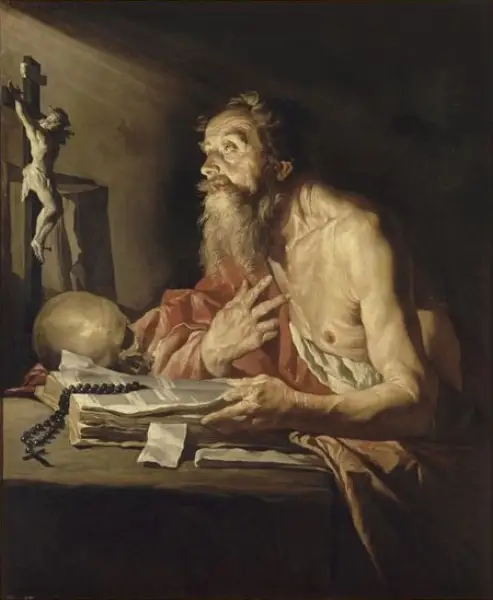
Jerome's legacy is the book he made. The Vulgate was the Bible of the Latin Church for a thousand years, the text of every medieval theology, and — through the insistence on the Hebrew that was its scandal — a standing argument for returning to the sources. Erasmus edited him; the Renaissance humanists claimed him as their own; every translator since has worked in his shadow, which is why the patron of translators is the man who wrote that he was a Ciceronian and spent his life making Scripture speak Latin. In art he is the scholar in his study, with the lion of the legend and the stone with which he was said to beat his breast — the icon of penitential scholarship the West has never replaced.
§ English translations (Physical)
Timeline
- 347
Born at Stridon, on the border of Dalmatia and Pannonia, of Illyrian ancestry; the article dates the birth to about 342-347.
§ Early life
- 360
Baptized in Rome, where he had gone with Bonosus of Sardica to study rhetoric and philosophy; the article gives roughly 360-369.
§ Early life
- 380
Writes the Chronicon at Constantinople, a reworking and continuation of Eusebius that becomes influential in Latin Christendom.
§ Historical and hagiographic writings
- 382
Begins the biblical project by correcting the Vetus Latina New Testament from Greek manuscripts while serving Pope Damasus I in Rome.
§ Translation of the Bible (382–405)
- 10 Dec 384
His patron Pope Damasus I dies on 10 December; soon afterwards a clergy inquiry over the widow Paula forces Jerome to leave Rome.
§ Ministry in Rome
- 390
Turns to translating the Hebrew Bible directly from the original Hebrew, breaking with the Septuagint-based tradition.
§ Translation of the Bible (382–405)
- 392
Produces De viris illustribus between 392 and 393, a biobibliography of Christian writers from the apostolic age to his own day.
§ De Viris Illustribus
- 405
Completes the Bible translation that becomes known as the Vulgate, then devotes his remaining years to scriptural commentaries.
§ Translation of the Bible (382–405)
- 417
Writes against the doctrine of Pelagianism three years before his death.
§ Theological writings
- 30 Sep 420
Dies at Bethlehem in Palaestina Prima on 30 September, aged roughly seventy-five to seventy-eight.
§ Introduction
- 1546
The Council of Trent gives the Vulgate an official, authoritative standing in Catholic teaching and preaching.
§ Reception by later Christianity
In Their Own Words
Ignorance of the Scriptures is ignorance of Christ.
Thou liest; thou art a follower of Cicero and not of Christ. For where thy treasure is, there will thy heart be also.
The face is the mirror of the mind, and eyes without speaking confess the secrets of the heart.
Every day we are changing, every day we are dying, and yet we fancy ourselves eternal.
Do not let your deeds belie your words, lest when you speak in church someone may say to himself, "Why do you not practice what you preach?"
No athlete is crowned but in the sweat of his brow.
The Record
- Major works
- The Vulgate (Latin Bible)·De viris illustribus (On Illustrious Men)·Chronicon·Commentaries on the Prophets and Daniel·Letters (a large surviving corpus)
- Patron of
- Archaeologists·Archivists·Bible scholars·Librarians and libraries·School children and students·Translators·Dalmatia; against anger
- Symbols
- Lion·Cardinal's attire·Skull·Books and writing materials·Trumpet·Owl
- Canonization
- Pre-congregation (ancient cult); numbered among the four great Latin Doctors by Pope Boniface VIII in 1298
Prayer
Bibliography
Show 4 sources
- ↑ In the Eastern Orthodox Church he is known as Saint Jerome of Stridonium or Blessed Jerome . "Blessed" in this context does not have the sense of being less than a saint, as it does in the West.
- ↑ Patrologia Latina 25, 373 : Crebroque cryptas ingredi, quae in terrarum profunda defossae, ex utraque parte ingredientium per parietes habent corpora sepultorum, et ita obscura sunt omnia, ut propemodum illud propheticum compleatur: Desce
- ↑ "(...) die griechische Bibelübersetzung, die einem innerjüdischen Bedürfnis entsprang (...) [von den] Rabbinen zuerst gerühmt (...) Später jedoch, als manche ungenaue Übertragung des hebräischen Textes in der Septuaginta und Übersetzungsf
- ↑ Eugene Rice has suggested that in all probability the story of Gerasimus's lion became attached to the figure of Jerome some time during the seventh century, after the military invasions of the Arabs had forced many Greek monks who were l
Profile text adapted from the Wikipedia article, licensed CC BY-SA 4.0.
Pray with this saint every day
Save St. Jerome to your favorites, read the full profile, and get feast-day reminders in the Saints app.
Get the Saints AppFree on the App Store for iPhone and iPad