
died 4 January 1286·Feast January 4
St. Jevstatije I
Sixth Serbian Archbishop, Hegumen of Hilandar, Bishop of Zeta
Overview
Jevstatije I led the Serbian Church as its sixth archbishop, from 1279 until his death early in 1286. The sources open his story in the Budimlje parish, near Berane in the medieval land of Zeta, in what is now Montenegro, where he received the monastic habit before leaving for the Hilandar monastery to devote himself to study and contemplation. There he rose to become hegumen, succeeding a monk named Joanikije. He subsequently left the Athonite house to serve as the fourth bishop of Zeta, returning as chief pastor to the region of his birth, and he also headed the monastery of Saint Archangel Michael at Prevlaka. His election to the archiepiscopal throne at Peć followed in 1279. Contemporaries regarded him as a true authority of the Serbian Orthodox Church: his career joined the discipline of the ascetic to the experience of communal life and pilgrimage to holy places. As archbishop he worked to preserve Orthodoxy throughout the archbishopric and took particular care over the works at the church of the Lord's Ascension at Žiča, where his body was laid after he died on 4 January 1286. His cult found literary form under Archbishop Danilo II of Peć, who composed both his biography and his liturgical service.
The Complete Life
A Monk of Budimlje
The sources introduce Jevstatije as a native of the Budimlje parish, a district near Berane in the medieval land of Zeta, corresponding to part of present-day Montenegro. Neither his birth date nor his family background is recorded; his story opens with the monastic habit, which he received in Zeta itself. From there he traveled to the Hilandar monastery, where he gave himself to study and to contemplation. His later biographer, Archbishop Danilo II of Peć, summed up the course of his life as a passage through every principal stage of monastic existence: he acquired a rich experience of the discipline of the ascetic life, yet he also learned what it means to live within a brotherhood, under obedience and in shared labor. During these years he made journeys to holy places far from his homeland, a practice that widened his experience of the wider Orthodox world. That combination would prove decisive for the Church he would one day govern. A monk formed equally in solitude and in community, tested by travel and by study, stood out among his contemporaries, and the sequence of offices he subsequently held — abbot, monastery head, diocesan bishop, and finally archbishop — grew directly out of that early formation.
§ Introduction
From Hilandar to the Throne of Peć
The first office the sources attach to Jevstatije with a date is that of hegumen — abbot — of Hilandar, which he held from 1162 to 1165, succeeding a monk named Joanikije. Hilandar is described as the most important Serbian monastery, and its leadership was no small charge for a monk from Zeta. In time he left the Athonite house for other spheres of service. He became the fourth bishop of Zeta, returning as chief pastor to the region of his birth, and he also served as head of the Prevlaka monastery dedicated to the Archangel Michael. His crowning election came in 1279, when he succeeded Joanikije I as Serbian archbishop, taking his seat in the Metropolitanate of Peć. He was the sixth holder of an office whose first occupant had been Saint Sava himself, and he governed it until 1286, when the archbishopric passed to Jakov I. The pattern of his career is striking: the same man led the greatest Serbian monastery abroad, a monastic community on the coast, and an important diocese in the western Serbian lands before assuming supreme office, so that by his election he had served the Church in nearly every rank it possessed.
§ Introduction
Death and the Translation of His Relics
As archbishop, Jevstatije made extraordinary efforts to preserve Orthodoxy throughout the archbishopric, and he showed particular care for the works being carried out at the Žiča church dedicated to the Ascension of the Lord. It was fitting, then, that his body was laid to rest there when he died in office on 4 January 1286. Žiča did not long remain his resting place. The monastery fell into ruin, and between 1289 and 1290 his relics were transferred from it and buried in the Monastery of Peć, the patriarchal house that served as the spiritual center of the Serbian Church; the Patriarchate of Peć Monastery is counted among his shrines. The translation joined him in death to the see he had governed in life, and it followed a familiar pattern in medieval Serbia, where the remains of holy bishops were gathered to safer and more honorable places when their first tombs were threatened. In the memory of the Church, the novice of Budimlje had come full circle: he ended as an archbishop buried among the primates of his nation, his tomb at the very heart of Serbian ecclesiastical life.
§ Introduction
Veneration in the Serbian Church
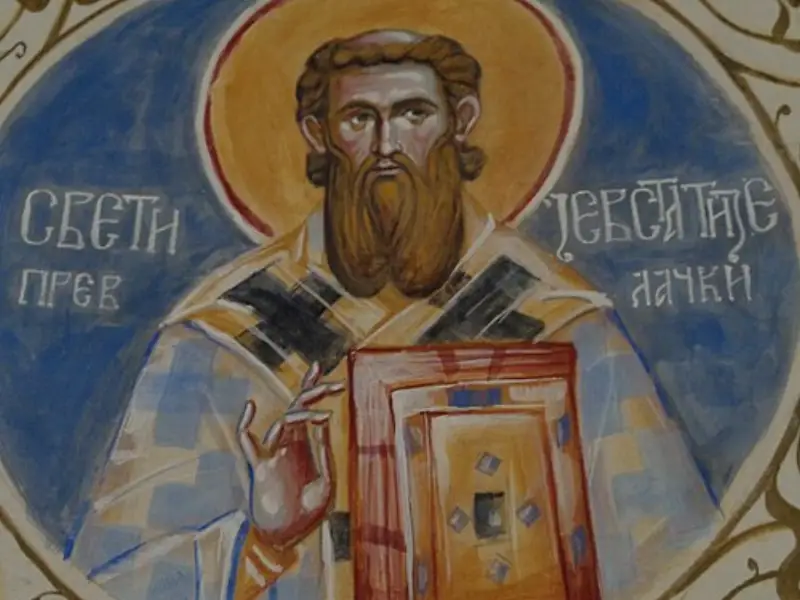
The Serbian Orthodox Church venerates Jevstatije as a saint, though the record preserves no date and no formal act of canonization; his cult belongs to the medieval tradition of the autocephalous Serbian Church, received and confirmed by the Church herself. His feast falls on 4 January by the Julian reckoning, corresponding to 17 January on the Gregorian reckoning. A fresco in the Church of Saint Jovan Vladimir at Bar preserves his likeness, a visual witness to his place in the painted hierarchy of Serbian saints. Because Danilo II wrote both his life and his service, Jevstatije was from an early period woven into the liturgical year of the Serbian Church with unusual completeness: the faithful encountered him in the synaxarion, in hymnography, and in the gathered lives of the Serbian holy hierarchs. He stands in the calendar beside Arsenije and Joanikije, the other 'generals' of the Serbian Church whose cults Danilo compiled, and in the registers of the primates his name appears among the saintly archbishops who succeeded Saint Sava. For the Serbian Church he remains the model of a bishop formed wholly by the monastery, honored each January in the monasteries and parishes of the Orthodox world.
§ Introduction
The Cult Shaped by Danilo II
During his own lifetime Jevstatije was accounted by his contemporaries a true authority of the Serbian Orthodox Church, a man who had passed through every principal state of the monastic vocation. After his death the shaping of his memory fell to Archbishop Danilo II of Peć, a gifted monk, a patient church leader, and a wise counselor of the Serbian rulers. Danilo composed both the prose biography and the liturgical service for the saint, gathering his hagiographic compositions into the collection known as the Monograph. In these writings he made decisive contributions to the cults of several Serbian rulers, and he added to the 'Serbian Saints Council' the cults of the Church's 'generals' — Arsenije, Jevstatije, and Joanikije — composing both biography and service for the first two of them. Through this literary labor Danilo moved with the dominant currents of his era and gave liturgical shape to one of the central ideas of his age: the presentation of the holy archpriests as worthy successors upon the seat of Saint Sava. The prose and poetic works devoted to Jevstatije belong to a period of significant change in the spiritual life of the Serbian nation, and they fixed the image of the sixth archbishop as a model of monastic completeness.
§ Introduction
Timeline
- 1162
Takes up the abbacy of the Hilandar monastery, succeeding Joanikije, an office the article dates to 1162–65
§ Introduction
- 1279
Succeeds Joanikije I as Serbian archbishop, after earlier service as the fourth bishop of Zeta
§ Introduction
- 4 Jan 1286
Dies in office; his body is laid to rest in the church of the Lord's Ascension at Žiča
§ Introduction
- 1289
His relics are moved from the ruined Žiča monastery and buried at the Monastery of Peć
§ Introduction
The Record
- Canonization
- Venerated as a saint by the Serbian Orthodox Church; the article records no date of canonization
Prayer
Bibliography
Show 6 sources
- Dušan T. Bataković (2005). Histoire du peuple serbe. L'Age d'Homme. ISBN 978-2-8251-1958-7.
- Jakov Sirotković; Ivo Cecić; Jugoslavenski leksikografski zavod (1990). Enciklopedija Jugoslavije. Vol. 6. Jugoslavenski leksikografski zavod. p. 46. ISBN 978-86-7053-024-9.
- Upadhya, Om Datt (1994). The Art of Ajanta and Sopoćani: A Comparative Study: An Enquiry in Prāṇa Aesthetics. Motilal Banarsidass Publ. ISBN 9788120809901.
- Dimitrije Bogdanović; Vojislav J. Đurić; Dejan Medaković; Miodrag Đorđević (1997). Chilandar. Monastery of Chilandar. p. 42. ISBN 9788674131053.
- Radivoje Ljubinković (1975). The Church of the Apostles in the Patriarchate of Peć. Jugoslavija. p. viii.
- Убипарип, Миланка (2019). "The Himnographic Character of the Jevstaty I, the Archbishop of the Serbs". Church Studies. 2 (16): 635–645.
Profile text adapted from the Wikipedia article, licensed CC BY-SA 4.0.
Pray with this saint every day
Save St. Jevstatije I to your favorites, read the full profile, and get feast-day reminders in the Saints app.
Get the Saints AppFree on the App Store for iPhone and iPad