
1773 – 1838·Feast August 26
St. Joan Elizabeth Bichier des Âges
Foundress of the Sisters of the Cross of Poitou
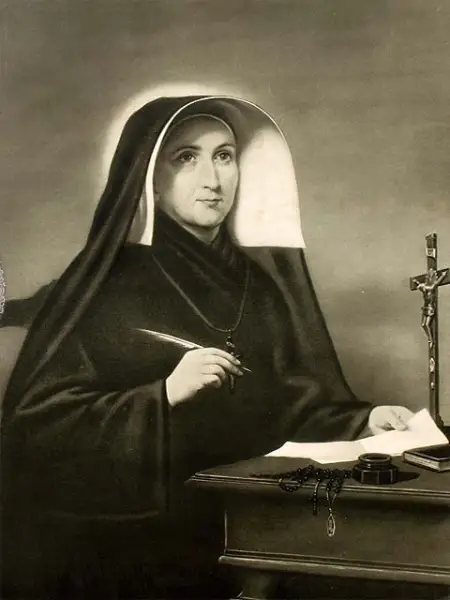
Overview
Joan Elizabeth Lucy Bichier des Âges, commonly called Elizabeth Bichier, was a French religious sister born into an aristocratic family of Poitou in 1773 and tested from youth by the upheavals of the French Revolution. Under the Civil Constitution of the Clergy her émigré brother's property was threatened, and she and her mother endured daily harassment by the revolutionary surveillance committee and a brief imprisonment at Châteauroux before another brother secured their release. Deprived of the Eucharist and of pastoral care in the persecuted countryside, she found her path when the underground priest Andrew Fournet challenged her presumptions and invited her to turn her own house into a school for village children; a school soon grew at La Guimetière in Béthines. After the Concordat of 1801 restored public worship, Fournet proposed that she gather companions for the mission, and in February 1807 five women professed vows, founding the Sisters of the Cross — a congregation established to serve the poor and teach the children of the countryside in the Diocese of Poitiers. The community spread with astonishing speed: approved by Church authority in 1816, housed from 1820 at La Puye, it counted more than sixty houses within ten years and about six hundred sisters in a hundred communities when Bichier died at her birthplace on 26 August 1838. She also helped inspire the founding of the Congregation of the Sacred Heart of Jesus of Betharram, a missionary society of priests.
The Complete Life
An Aristocratic Childhood Broken by Revolution
Elizabeth Bichier was born in 1773 at the Château des Âges, the seat of her noble lineage close to the village of Le Blanc in the old province of Poitou, now part of the department of Indre in the Loire Valley. One of four children, she was baptized on the day of her birth at the local Church of Saint-Génitour and given the name by which her family would call her. Her mother, a religious woman, taught her to pray and grounded her in the Catholic faith; the child proved a ready student and felt drawn to prayer from her earliest years. The French Revolution shattered this world. When the Civil Constitution of the Clergy declared the property of the Church to be national goods and applied the same rule to émigrés, her oldest brother Laurent's departure from France put the ancestral castle at risk of confiscation, and Elizabeth and her mother withdrew to their house in the village. The local revolutionary surveillance committee, armed with the Law of Suspects, harassed the two women with daily visits, pressing them to swear loyalty to the Civil Constitution. They refused. When weapons belonging to their father were discovered in the attic, mother and daughter were briefly imprisoned at Châteauroux, until another brother, who had joined the revolutionary forces, obtained their release.
§ Early life
A Midnight Ride to a Hidden Mass
In 1796 mother and daughter settled at La Guimetière, the family's country house at Béthines. There Elizabeth keenly felt the loss of the Eucharist: the local church was served by a priest who had accepted the revolutionary oath, and the people rejected him. From childhood she had been drawn to contemplation and had consecrated herself to the Virgin Mary; her secret desire was to give her life to God in an enclosed order, though she told no one. Meanwhile she began to gather her neighbors for common prayer. The turning point came the next year, when a former servant quietly told them that a refractory priest would celebrate a secret Mass at a farm some sixteen kilometers away. This was Andrew Fournet, the hunted priest of Maillé, who would give Bichier's longing its direction. Setting out by night on a donkey, guided by the same servant, she arrived after three hours of travel. As the peasants gave way before the aristocrat at the confessional, Fournet taxed her with presumption — yet she stepped back and let him hear the confessions of the whole crowd, presenting herself last as the sun came up. When she opened her heart to him, he urged her to make her house a school for the village's children; with her mother's consent a small school slowly took shape at La Guimetière.
§ A new direction
Founding the Sisters of the Cross
The Concordat of 1801 between France and the Holy See allowed the Church to resume public life, and Bichier used her influence to have one of the new missionary centers, established to revive the faith, placed at Béthines, where Fournet was based. After her mother's death in 1804 he proposed that she recruit women to dedicate themselves wholly to the mission. She found four companions, and the next year she and her servant Marianne Meunier entered the Congregation of Divine Providence in Poitiers to absorb the elements of consecrated life. Back at La Guimetière in 1806, two friends joined them, Véronique de Lavergne and Madeleine Moreau. Judging it wiser to live near their spiritual guide, the little community relocated to Maillé, where they acquired the local chateau and were joined by Anne Bannier. In February 1807 the five pronounced their vows, giving birth to the congregation of the Sisters of the Cross. Growth was rapid: schools multiplied where the sisters could minister to the poor, the community received ecclesiastical approval in 1816, and by 1820 a former monastery of the Order of Fontevrault had been acquired at La Puye, where the motherhouse was established and stands today. Within a decade the Sisters of the Cross counted more than sixty houses.
§ Foundress
Eucharistic Longing and Marian Consecration
The spiritual shape of Bichier's life was fixed early and never abandoned. She had been attracted to contemplation from childhood, and as a girl she consecrated herself to the Virgin Mary; the wish to belong entirely to God in an enclosed community preceded, by years, any possibility of realizing it. Revolution taught her the price of the sacraments: her grief at the loss of the Eucharist in her village, where an oath-bound priest served a hostile congregation, became the very soil of her vocation. It was characteristic that her first response was not complaint but gathering — assembling neighbors for prayer while the official church stood empty. Her encounter with Andrew Fournet married this Eucharistic and Marian piety to service: he saw his rural congregants deprived of all education by the turmoil, and her longing to belong to God found its form in teaching their children. The Rule she and Fournet shaped wedded contemplative consecration to the service of the destitute and the teaching of the young, so that her sisters would carry into the countryside the sacramental life she had once so painfully missed. Even the founding gesture of 1807 — vows professed in a borrowed chateau beside a hidden pastor — expressed a spirituality of fidelity amid dispossession.
§ A new direction
Death at the Château des Âges
Bichier lived to see the congregation she founded grow beyond every expectation. By the time of her death in 1838 there were about six hundred Daughters of the Cross serving in some hundred communities, and the motherhouse at La Puye was firmly established as the congregation's headquarters. She died where she had been born, at the Château des Âges in Poitou, on 26 August 1838, at the age of sixty-five — the aristocrat who had ridden by night to a forbidden Mass having lived long enough to see the faith she kept alive restored to public life and spreading through the villages of France. Her remains were enshrined at the motherhouse in La Puye, where the chapel of the Daughters of the Cross preserves them as a place of prayer for the congregation she left behind. She did not live to see the congregation's first foreign foundation, established at Bilbao in Spain in 1850, twelve years after her death; that expansion belonged to the sisters who had formed under her Rule. What she bequeathed them was a pattern she had herself lived: begin small, stay near the poor, obey the Church, and trust that the work is God's.
§ Foundress
Beatification and Canonization
The Church's recognition of Elizabeth Bichier came a century after her death. Pope Pius XI beatified her on 13 May 1934, and Pope Pius XII canonized her on 6 July 1947, in the solemn aftermath of the Second World War, when the Church held up witnesses of fidelity to a shattered Europe. Her feast is kept on 26 August, the anniversary of her death. The cause vindicated what her contemporaries had seen: a woman who preserved Catholic life under revolutionary persecution, founded a congregation that carried catechesis and charity into neglected villages, and did so in partnership with the priest Andrew Fournet, whose missionary vision she shared and furthered. Her memory is cherished today by two spiritual families — the Daughters of the Cross, whose motherhouse at La Puye enshrines her remains, and the Congregation of the Sacred Heart of Jesus of Betharram, the community of missionary priests she helped inspire, which honors her as the inspirer of its own origins. For the universal Church she stands among the founders of the modern age of congregations, the women and men who rebuilt Catholic education and charity in Europe after the catastrophes of the late eighteenth century.
§ Veneration
A Congregation That Circled the Globe
The measure of Bichier's legacy is the trajectory of the congregation she founded. Within ten years of the vows of February 1807 there were more than sixty communities of Sisters of the Cross; by the start of the twentieth century the sisters numbered some 3,100 in 430 houses; and in 1850 they had made their first foreign foundation at Bilbao, in Spain. Today the community counts about six hundred members, who serve or have served on every continent — in France and Spain, Italy and Hungary, Belgium and Argentina, Brazil and Canada, Uruguay, the Congo, Burkina Faso, Ivory Coast, China and Thailand. The motherhouse at La Puye still serves as the congregation's headquarters, and the sisters remain what Bichier and Fournet intended them to be: teachers and servants of the rural poor. Her influence reached beyond her own congregation, for the community of missionary priests at Betharram, the Congregation of the Sacred Heart of Jesus, counts her among the inspirers of its founding. Nearly two centuries after her death, the school begun at La Guimetière for the children of one persecuted village has become an international network of education and charity — the quiet harvest of a woman's fidelity in an age when her faith was a crime.
§ Legacy
Timeline
- 5 Jul 1773
Is born at the Château des Âges near Le Blanc in Poitou and baptized the same day at the Church of Saint-Génitour
§ Early life
- 16 Jan 1792
Her father dies after falling ill, following her brother Laurent's emigration from revolutionary France
§ Early life
- 1796
Moves with her mother to La Guimetière, the family's country home at Béthines, and begins gathering neighbors for prayer
§ Early life
- 1801
The Concordat between France and the Holy See allows the Catholic Church to resume public activity
§ A new direction
- 1804
Her mother dies; Andrew Fournet proposes that she recruit women to dedicate their lives to the mission
§ A new direction
- 1806
Returns to La Guimetière from formation in Poitiers, joined by Véronique de Lavergne and Madeleine Moreau
§ A new direction
- Feb 1807
Professes religious vows with four companions at Maillé, establishing the congregation of the Sisters of the Cross
§ Foundress
- 1816
The young community receives ecclesiastical approval
§ Foundress
- 1820
A former Fontevrault monastery is acquired at La Puye, where the congregation's motherhouse is established
§ Foundress
- 26 Aug 1838
Dies at the Château des Âges, aged sixty-five, as some six hundred Daughters of the Cross serve in about a hundred communities
§ Foundress
- 13 May 1934
Is beatified by Pope Pius XI
§ Veneration
- 6 Jul 1947
Is canonized by Pope Pius XII
§ Veneration
The Record
- Major works
- Sisters of the Cross, Sisters of St. Andrew (co-founded with Andrew Fournet, 1807)·Village school for catechesis at La Guimetière, Béthines·Motherhouse of the Daughters of the Cross at La Puye
- Canonization
- Beatified by Pope Pius XI on 13 May 1934; canonized by Pope Pius XII on 6 July 1947
Prayer
Bibliography
Show 6 sources
- "Fondatori". Figlie della Croce (in Italian). Archived from the original on 29 May 2015. Retrieved 29 May 2015.
- F. Englebert, The Lives of the Saints, David MacKay Co., New York, 1951, p. 327.
- "Our Origins: The Inspirer, St. Joan Elizabeth Bichier des Ages". Congregation of the Sacred Heart of Jesus of Betharram. Archived from the original on 29 May 2015.
- "Sainte Jeanne-Élisabeth Bichier des Ages" (in French).
- "Fraternity". Congregation of the Sacred Heart of Jesus of Betharram. Archived from the original on 15 May 2006. Retrieved 10 March 2008.
- "Historia de la Congregación". Hijas de la Cruz (in Spanish). Archived from the original on 29 May 2015. Retrieved 29 May 2015.
Profile text adapted from the Wikipedia article, licensed CC BY-SA 4.0.
Pray with this saint every day
Save St. Joan Elizabeth Bichier des Âges to your favorites, read the full profile, and get feast-day reminders in the Saints app.
Get the Saints AppFree on the App Store for iPhone and iPad