
c. 1412-1431·Feast May 30
St. Joan of Arc
Virgin, Patroness of France
Overview
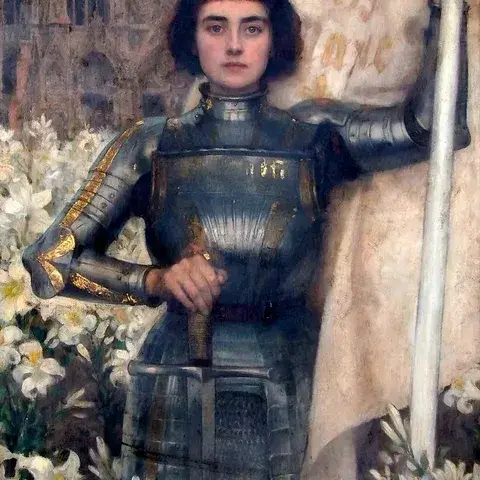
Jeanne, born around 1412 into a landowning peasant household at Domrémy, grew up spinning wool and minding animals while France tore itself apart in the Hundred Years' War. Around thirteen she began to see and hear a figure she knew as Saint Michael, with Saint Margaret and Saint Catherine, and in 1428 she pressed the garrison commander at Vaucouleurs for an escort to the Dauphin. Charles VII, after theologians at Poitiers and matrons at Tours had examined her, gave her armor, a banner, and a place in the relief of Orléans in April 1429. Within nine days of her arrival the English gave up the siege; victory at Patay opened the road to Reims, where Charles was crowned in July with Joan standing near. Attempted sieges of Paris and La Charité faltered, and in May 1430, sortying from Compiègne against the Burgundians, she was taken captive, sold to the English for ten thousand livres, and tried at Rouen for heresy before Bishop Pierre Cauchon. Trap after trap failed to snare her answers. Abjuring under threat, then retaken in male dress, she was condemned as a relapsed heretic and burned at the Vieux-Marché on 30 May 1431, aged about nineteen, a cross held before her eyes.
The Complete Life
Early Life
Joan of Arc was born in about 1412 at Domremy, a village of the Meuse valley that today falls within the Vosges department in France's north-east; no exact date of birth survives, and her own statements about her age were vague. Her parents were Jacques d'Arc and Isabelle Romee, and she had three brothers and a sister. Her father farmed about twenty hectares as a peasant, and added to what the family earned by serving as a village officer who collected taxes and led the local watch. She was born into the Hundred Years' War, in a France politically broken by it: Charles VI's recurring madness, the assassination of the Duke of Orleans in 1407, civil war between Armagnacs and Burgundians, Henry V's invasion of 1415, and the Treaty of Troyes that disinherited the Dauphin, the future Charles VII, in favor of an English succession. By Joan's childhood the Dauphin's cause was confined to the country south of the Loire, and Orléans, the key to it, was under English siege.
§ Birth and historical background
Conversion and Vocation
Joan's vocation arrived as voices. She testified that her visions told her to drive out the English and bring the Dauphin to Reims to be crowned, and in the closing days of February or the opening ones of March 1429, aged seventeen, she was presented to Charles VII at Chinon. She said she had come to lift the siege of Orléans and take him to Reims, and a private conversation left a strong impression on the twenty-six-year-old prince: her confessor Jean Pasquerel later testified that she gave him certainty that he was indeed the son of Charles VI and the rightful king. Charles's council required more, so she was sent to Poitiers for examination by theologians, who found her a good person and a good Catholic without deciding the source of her inspiration, and to Tours for a physical examination by women directed by Yolande of Aragon, which verified her virginity, the sign of the prophesied maiden. With his doubts settled, the Dauphin had plate armor made for her; her banner was of her own devising, and from beneath the altar at Sainte-Catherine-de-Fierbois she drew a sword, beginning to call herself Joan the Maiden.
§ At the royal court in Chinon
Mission and Ministry
During the final week of April 1429 Joan left Blois at the head of an army bringing provisions to relieve Orléans, entering the city on 29 April, where she met the commander Jean, the Bastard of Orléans. At first treated as a figurehead to raise morale, carrying her banner on the battlefield and sitting in no military council, she quickly won the Armagnac troops. Ahead of the march she had dictated to the Duke of Bedford a letter warning that God was sending her to drive him from France, and her conviction of a divine mission turned a dynastic war into a religious one. After the success at Orléans she insisted the army advance promptly on Reims. Charles allowed her to accompany the force under John II, Duke of Alencon, who worked with her and regularly heeded her advice. The Loire towns fell in June: at Jargeau she advocated a direct assault and was struck by a stone that split her helmet as she began scaling a ladder, banner in hand; Meung-sur-Loire and Beaugency followed, opening the road so that Charles could cross the Loire and be crowned at Reims, which he was on 17 July 1429.
§ Loire Campaign
Trial and Final Years
The following spring Joan was captured at the siege of Compiegne and sold to the English, who put her before an ecclesiastical court at Rouen under Bishop Cauchon. The trial for heresy, which opened on 9 January 1431, was politically motivated and its verdict foregone: her success argued to be of God would invalidate the English claim to France, while her guilt would compromise the king she had crowned. She was imprisoned by English soldiers instead of the church, interrogated at length without counsel, and not read the charges until after interrogations began; one cleric resigned over the coercion, another was jailed, and the records show signs of falsification. She nonetheless showed great control, famously avoiding the trap of the question whether she was in God's grace. Convicted and induced to abjure, she was sentenced to death when, after mistreatment and rape attempts recounted at the later rehabilitation trial, she resumed men's clothes and would not deny her voices. She was burned at Rouen on 30 May 1431, about nineteen years old.
§ Introduction
Canonization
The reversal began with her own side's politics. In 1450 Charles VII ordered an inquest under Guillaume Bouille, which concluded the judgment had been arbitrary and without basis, and in 1452 Cardinal d'Estouteville and the Inquisitor Jean Brehal opened a further inquiry. A papal rehabilitation trial nullified the conviction in 1456. Cult followed in time: an annual panegyric was pronounced for her at Orléans from the lifting of the siege until the 1800s, and in 1849 Bishop Felix Dupanloup's oration drew international attention, leading to a petition for her beatification in 1869. She was beatified by Pius X in 1909 and canonized by Benedict XV on 16 May 1920, with her feast on 30 May, the anniversary of her execution. In 1922 Pius XI declared her a patron saint of France. She was canonized as a virgin, not a martyr, since the court that killed her acted on her private revelation rather than her faith in Christ, though she has been venerated popularly as a martyr since her death.
§ Saint and heroic woman
Legacy
Joan's execution did not change the military situation: Armagnac morale held, the Burgundians changed sides at Arras in 1435, and the war ended in French victory at Castillon in 1453. She became, in the centuries after, the symbol of France itself, the peasant maiden sent by God for the kingdom's deliverance, enlisted successively by royalist, republican, and nationalist readings, and she remains the most painted and most filmed figure of the late medieval world. During her lifetime she was compared to Esther, Judith, and Deborah. She is commemorated also by the Church of England on 30 May and is revered in the Cao Dai religion, a rare cross-religious reach for a Catholic saint. Historians treat her trial records, with their verbatim captures of her voice, as an exceptional window onto a medieval peasant woman's mind.
§ Aftermath and rehabilitation trial
Timeline
- 1412
Born into a propertied peasant family at Domrémy in northeastern France
§ Introduction
- 1425
At about thirteen, saw a vision of Saint Michael in a garden; later added the voices of Saints Margaret and Catherine
§ Early life
- 1428
Left home for Vaucouleurs to ask Robert de Baudricourt for an escort to the Dauphin
§ Early life
- 1429
Met Charles VII at Chinon in late February or early March, then passed examination by theologians at Poitiers
§ At the royal court in Chinon
- 29 Apr 1429
Reached Orléans with a supply army and was slipped into the besieged city
§ Orléans
- 8 May 1429
English broke off the siege of Orléans after their remaining fortresses were stormed
§ Orléans
- 11 Jun 1429
Loire campaign opened as the French stormed Jargeau
§ Loire Campaign
- 18 Jun 1429
English relief army routed at the Battle of Patay
§ Loire Campaign
- 16 Jul 1429
Reims admitted the army, and Charles VII was crowned the next morning with Joan in a place of honor
§ Coronation and siege of Paris
- 8 Sep 1429
Led the assault on Paris and suffered a crossbow bolt wound to the leg
§ Coronation and siege of Paris
- 4 Nov 1429
Saint-Pierre-le-Moûtier fell after she urged a direct assault
§ Campaign against Perrinet Gressart
- Dec 1429
Returned to court and learned Charles had ennobled her family as reward for her service
§ Campaign against Perrinet Gressart
- 23 May 1430
Captured by Burgundians during a sortie against their camp at Margny, near Compiègne
§ Siege of Compiègne and capture
- Nov 1430
Ransomed to the English for 10,000 livres and transferred to their headquarters at Rouen
§ Siege of Compiègne and capture
- 9 Jan 1431
Heresy trial opened at Rouen under Bishop Pierre Cauchon
§ Trial
- 24 May 1431
Submitted and signed an abjuration at the abbey of Saint-Ouen
§ Trial
- 30 May 1431
Burned at the stake in Rouen's Old Marketplace as a relapsed heretic, aged about nineteen
§ Execution
- 15 Feb 1450
Charles ordered the theologian Guillaume Bouillé to open the first inquest into her conviction
§ Aftermath and rehabilitation trial
- 7 Nov 1455
Rehabilitation trial opened at Notre Dame Cathedral on her mother's formal petition
§ Aftermath and rehabilitation trial
- 7 Jul 1456
Court sitting at Rouen nullified her abjuration, execution and their consequences
§ Aftermath and rehabilitation trial
- 18 Apr 1909
Beatified by Pope Pius X
§ Introduction
- 16 May 1920
Canonized by Pope Benedict XV
§ Introduction
In Their Own Words
Children say that people are hanged sometimes for speaking the truth.
I do not fear men-at-arms; my way has been made plain before me. If there be men-at-arms my Lord God will make a way for me to go to my Lord Dauphin. For that am I come.
If I am not, may God place me there; if I am, may God so keep me.
Of the love or hatred God has for the English, I know nothing, but I do know that they will all be thrown out of France, except those who die there.
The Record
- Patron of
- France (declared patroness by Pope Pius XI, 1922)·The French nation and its armed forces (venerated as its defender)
- Symbols
- Banner of her own design·Plate armor·Sword from Sainte-Catherine-de-Fierbois
- Canonization
- Beatified by Pope Pius X in 1909; canonized by Pope Benedict XV on 16 May 1920 (as a Virgin, not a martyr); declared a patron saint of France by Pope Pius XI on 2 March 1922; her 1431 conviction was annulled by a rehabilitation trial in 1456
Prayer
Bibliography
Show 7 sources
- ↑ This historiated initial from the Archives Nationales has been dated to the second half of the 15th century , but it is now regarded as an art forgery , [ 1 ] most likely produced at the turn of the 19th and 20th centuries by an anonymous
- ↑ Her birthday is sometimes given as 6 January. This is based on a letter by Perceval de Boulainvilliers [ fr ] , a councillor of Charles VII, stating that Joan was born on the feast of the Epiphany , [ 14 ] but his letter is filled with li
- ↑ Fauquembergue's doodle on the margin of a Parliament's register is the only known contemporary representation of Joan. It is an artist's impression depicting her with long hair and a dress rather than with her hair cut short and in armor.
- ↑ The woman in this saying is assumed to refer to Isabeau of Bavaria, [ 59 ] but this is uncertain. [ 60 ]
- ↑ The details of Joan's abjuration are unclear because the original document, which may have been only eight lines long, [ 242 ] was replaced with a longer one in the official record. [ 243 ] Quicherat 1841a , pp. 446–448 provides the offic
- ↑ In the foreground of this allegorical work, Guillaume Bouillé, who opened the inquest, is handing Joan, who died twenty years previously but is symbolically present, the text of her rehabilitation. The figures in the background are Jean B
- ↑ For example, Mackowiak 2007 , pp. 138–139 points out problems with assuming Joan had schizophrenia, ergot poisoning or temporal lobe issues; Hughes 2005 , abstract disputes the conjecture that she had epilepsy; Nores & Yakovleff 1995 , ab
Profile text adapted from the Wikipedia article, licensed CC BY-SA 4.0.
Pray with this saint every day
Save St. Joan of Arc to your favorites, read the full profile, and get feast-day reminders in the Saints app.
Get the Saints AppFree on the App Store for iPhone and iPad