
1464 – 1505·Feast February 4
St. Joan of France
Queen of France and Foundress of the Annonciade
Overview
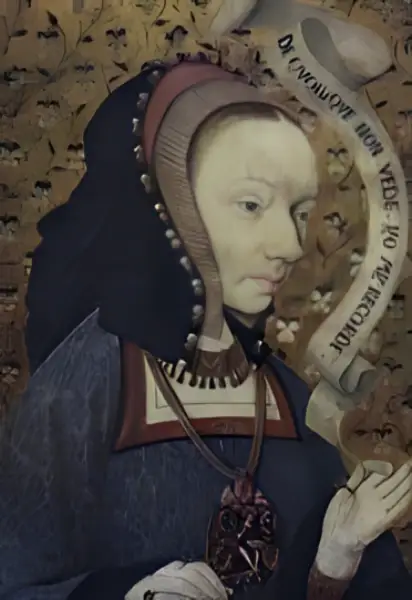
Joan of France, briefly Queen of France, was born at Nogent-le-Roi on 23 April 1464, the second daughter of King Louis XI and Charlotte of Savoy. Born sickly and deformed, she was betrothed while still an infant to her cousin Louis of Orléans, a match her father designed to extinguish the Orléans line; the marriage, contracted in 1476, was unhappy, yet Joan bore the neglect with a patience that astounded her age. Educated by the baron de Linières and his wife, she embraced a deep life of prayer, joined the Third Order of Saint Francis, and attached herself from girlhood to the Hail Mary, the prayer her father had commanded to be recited across the kingdom. When Louis ascended the throne in 1498 he obtained an annulment on humiliating grounds; Joan stepped aside without bitterness, declaring that she would pray for him, and retired as Duchess of Berry to Bourges. There, with her confessor Gabriel Mary, she founded the Order of the Annunciation of the Virgin Mary, an enclosed congregation honoring the mystery of the Incarnation, whose Rule was approved in 1502. She died at Bourges on 4 February 1505. Canonized by Pope Pius XII on 28 May 1950, she is remembered as a royal woman who converted humiliation into holiness.
The Complete Life
The Sickly Daughter of Louis XI
Joan entered the world on 23 April 1464 in the fortress of Pierre de Brézé — a loyal servant of her grandfather Charles VII — at Nogent-le-Roi in the County of Dreux. Her parents were King Louis XI and his second wife, Charlotte of Savoy, and her surviving siblings were the future Charles VIII and Anne of France. Almost before she could be weaned, her father promised her in marriage to his second cousin Louis of Orléans, then aged two — a political design conceived, the sources say, because Joan's malformation made her expected to be childless, and a sterile bride would end the Orléans cadet branch of the House of Valois. She was born sickly and deformed; the modern writer Kathleen Jones describes a curvature of the spine that gave her a hunched back and a limping walk. Often absent on royal business, Louis XI entrusted Joan and her sister Anne to Baron François de Linières and his wife Anne de Culan, a childless couple who lavished affection on the princess and educated her in poetry, mathematics, painting, embroidery and the lute. In their faithful Catholic household Joan's religious instincts took root and grew.
§ Family
A Princess of Prayer
The Linières household formed Joan's soul as carefully as her mind. Asked by her father to name the confessor she wanted, the girl could give only one name she knew: Jean de La Fontaine, guardian of the Franciscan friary at Amboise. The king approved, and the friar traveled regularly across the distance to hear the princess's confession. Under his direction Joan developed a deep delight in prayer, passing long hours in the castle chapel, and the baron out of kindness had a paved path laid between castle and chapel so that the lame girl could reach it in bad weather. She was admitted to the Third Order of Saint Francis. In 1471 Louis XI ordered the Hail Mary recited throughout his kingdom for peace, and Joan's attachment to that prayer became lifelong; she would later write that in that same year the Virgin Mary gave her a prophecy — that one day she would raise up a religious community in Mary's honor. Thus the two threads of her destiny were spun in girlhood: the marriage arranged to extinguish a dynasty, and the promise of a foundation made in prayer, both held together by a spirituality of the Annunciation long before the Order existed.
§ Family
Queen Against Her Will, Duchess by Grace
On 8 September 1476, aged twelve, Joan married Louis of Orléans at Montrichard. The groom resented the forced union, and his treatment of his wife showed it. When Louis XI died in 1483, his son Charles VIII took the throne under the regency of Anne de Beaujeu; by 1484 Louis of Orléans had launched a series of military campaigns against the crown, which ended in his capture in 1488. In those years he fathered an illegitimate son, Michel de Bussy, later Bishop of Bourges. Joan, governing his domains during his imprisonment — above all the Italian territories of Milan and Asti — attributed virtues to her husband that he did not possess and labored to ease his sufferings and obtain his freedom, which came in 1491. In April 1498 Charles VIII died in an accident, and Louis ascended the throne; Joan became Queen of France for a reign of barely eight months. Seeking to annex Brittany by wedding its duchess, the king sought an annulment on grounds never before used for such a case — under-age consent and non-consummation — in proceedings later judged among the age's most disreputable. Joan defended herself vigorously, producing witnesses against his claims, but Pope Alexander VI, committed for political reasons, voided the marriage on 15 December 1498. Joan withdrew without protest, promising to pray for him, and accepted the Duchy of Berry, retiring to Bourges.
§ Marriage
From Humiliation to the Annunciation
Joan's spirituality was forged in the school of contempt. The child whose body was judged worthless, the wife whose husband scorned her, the queen discarded for a political marriage — each humiliation was received without rebellion and converted into prayer. From girlhood her devotions centered on Mary: the consecration of her earliest years, the prophecy received when her father's kingdom recited the Hail Mary, and finally the foundation through which that promise ripened. Settled in Bourges, she confided to her spiritual director, Friar Gabriel Mary — born Gilbert Nicolas in Riom — her call to the monastic life. Together they planned a new enclosed congregation in honor of the Annunciation, the angel's message to the Virgin that she would bear the Savior: God entering history through a humble and hidden yes. For a woman whose own body had been dismissed as useless, the mystery had obvious and profound resonance. The congregation was established as an autonomous branch of the Poor Clares. By May 1500 eleven postulants had gathered to her; her Rule of Life received papal approval on 12 February 1502; on Pentecost Sunday 1504 she and Gabriel Mary made private commitments to the Rule as co-founders, and on 21 November, the feast of the Presentation of Mary, Joan and her women publicly and legally bound themselves to the Order.
§ Religious life and sainthood
Death, Incorruptibility, and Desecration
Joan did not long survive the foundation she had brought to birth. She died at Bourges on 4 February 1505, not yet forty-one, and her burial took place in the chapel of the Annonciade, the community she had founded in honor of the Annunciation. Soon afterward, wonders and cures were being reported through her intercession. Her posthumous story, however, took a violent turn: during the French Wars of Religion her grave was violated, and when the Huguenot troops sacked Bourges on 27 May 1562 they burned the body of the saintly duchess — found, according to the tradition, incorrupt when her tomb was opened. The destruction of her relics did not extinguish her memory; it gave it the character of a martyrdom after death, and the report of her incorruptibility became part of the evidence her cause would later cite. The cathedral city that had sheltered her as a repudiated queen kept her as its patroness, and the Order she founded continued to pray where her ashes had been scattered. In the annals of French royalty she occupies a singular place: a queen whose reign lasted months, whose body was burned, and whose sanctity outlasted both the throne and the fire.
§ Religious life and sainthood
From Cause to Altar
Recognition of Joan's holiness followed the slow path of her patience. The formal cause was opened in 1631, little more than a century after her death, and Pope Benedict XIV — the great scholar of the canonization process — beatified her on 21 April 1742. Full canonization came on 28 May 1950, when Pope Pius XII enrolled her among the saints, holding her up to a France rebuilding after war as an example of dignity in humiliation. Her feast is kept on 4 February, the day of her death. The cause had drawn on a life abundantly documented for once: the annulment proceedings preserved the words of both king and princess, the Rule of her Order survived, and the tradition of her incorrupt body had been recorded at the sack of Bourges. With her canonization the woman once dismissed as a deformed political instrument was proclaimed a saint of the universal Church, and the sanctuary at Bourges, where her monastery stood, became a center of her cult. She is invoked today by those who suffer contempt for their bodies, by couples in failed marriages, and by founders of religious communities — the three great trials her life embraced and transfigured.
§ Religious life and sainthood
An Order That Still Announces
Joan's most living legacy is the congregation she founded with Gabriel Mary. The Order of the Annunciation of the Virgin Mary, born at Bourges in the first years of the sixteenth century, still maintains its contemplative way of life in monasteries in Belgium, France, Costa Rica and Poland, while the sisters of its expanded branches labor in Burundi and Cameroon, in Guatemala and the Democratic Republic of the Congo, in France and Belgium. From her Order there later sprang the Apostolic Sisters of the Annunciation, a teaching congregation established in 1787 to educate the children of the poor — the very promise, some would say, of the prophecy she received in 1471. In her own kingdom's history she remains a figure of pathos and principle: the reign of eight months, the annulment that legal scholars still cite, the dignity with which she yielded. Spiritually, she belongs to that company of royal founders — Elizabeth of Hungary, Hedwig of Silesia, Margaret of Scotland — who turned the burdens of dynasty into works of mercy. Five centuries after her death, the prayer her father commanded for peace and the promise she treasured in girlhood meet in the communities that bear her Order's name and announce, with her, the great yes of the Annunciation.
§ Legacy
Timeline
- 23 Apr 1464
Is born at Nogent-le-Roi, in the castle of Pierre de Brézé, daughter of King Louis XI and Charlotte of Savoy
§ Family
- 1471
Receives what she later described as a prophecy of the Virgin Mary, in the year her father ordered the Hail Mary recited throughout the kingdom
§ Family
- 8 Sep 1476
Marries Louis of Orléans at Montrichard, aged twelve, in a union arranged because her deformity was expected to leave her childless
§ Marriage
- 1483
Her father Louis XI dies and is succeeded by her brother, King Charles VIII
§ Marriage
- 1488
Her husband is taken captive by royal forces after four years of campaigning against the crown
§ Marriage
- 1491
Louis of Orléans is released from prison, having been defended and ransomed through Joan's efforts
§ Marriage
- 7 Apr 1498
Becomes Queen of France when her husband ascends the throne after the accidental death of Charles VIII
§ Introduction
- 15 Dec 1498
Her marriage is annulled by papal decree; she accepts the verdict, is made Duchess of Berry, and retires to Bourges
§ Marriage
- May 1500
Has gathered eleven postulants by May, the nucleus of her new Order of the Annunciation
§ Religious life and sainthood
- 12 Feb 1502
The Rule of Life she wrote for the Order is approved by Pope Alexander VI
§ Religious life and sainthood
- 1503
Construction of the first monastery of the new order is begun at Bourges
§ Religious life and sainthood
- 1504
On Pentecost Sunday Joan and Friar Gabriel Mary make private commitments to the Rule as co-founders of the Order
§ Religious life and sainthood
- 21 Nov 1504
On the feast of the Presentation of Mary, Joan and her companions publicly and legally bind themselves to the Order
§ Religious life and sainthood
- 4 Feb 1505
Dies at Bourges; burial follows in the chapel of her Annonciade monastery
§ Religious life and sainthood
- 27 May 1562
During the sack of Bourges, Huguenot troops burn her body, found incorrupt when her desecrated grave is opened
§ Religious life and sainthood
- 1631
The cause of her canonization is formally begun
§ Religious life and sainthood
- 21 Apr 1742
Is beatified by Pope Benedict XIV
§ Religious life and sainthood
- 28 May 1950
Is canonized by Pope Pius XII
§ Religious life and sainthood
The Record
- Major works
- Order of the Annunciation of the Virgin Mary (the Annonciade)·Rule of Life for the Order of the Annunciation, approved 12 February 1502·First monastery of the Annunciation at Bourges
- Canonization
- Beatified by Pope Benedict XIV on 21 April 1742; canonized by Pope Pius XII on 28 May 1950
Prayer
Bibliography
Show 6 sources
- Capes, Florence (1913). "St. Jeanne de Valois". In Herbermann, Charles (ed.). Catholic Encyclopedia. New York: Robert Appleton Company.
- Vauchez, André; Lapidge, Michael, eds. (2000). Encyclopedia of the Middle Ages. Vol. 1. Fitzroy Dearborn Publishers. p. 776. ISBN 978-1-57958-282-1.
- "St. Joan of Valois". AmericanCatholic.org. Archived from the original on 20 January 2012.
- "Chronologie de la vie de sainte Jeanne de France". L'Annonciade (in French). Order of the Annunciation of the Blessed Virgin Mary. 8 July 2013.
- Gibson, Mary Lou (8 February 2013). "Saints for our times: French saint endured much torment from her family". Catholic Spirit. Vol. 31, no. 2. Diocese of Austin.
- Hale, J. R. (1972). Renaissance Europe: Individual and Society, 1480–1520. New York: Harper & Row. ISBN 0-06-012904-2.
Profile text adapted from the Wikipedia article, licensed CC BY-SA 4.0.
Pray with this saint every day
Save St. Joan of France to your favorites, read the full profile, and get feast-day reminders in the Saints app.
Get the Saints AppFree on the App Store for iPhone and iPad