
1st century·Feast June 27
St. Joanna, Wife of Chuza
Myrrhbearer and Witness of the Empty Tomb
Overview
Joanna — Iōanna in the Greek of the Gospels — belongs to the earliest circle of Jesus' disciples, named by Luke as the wife of Chuza, steward of the household of Herod Antipas, tetrarch of Galilee. Cured by Jesus of sickness and spiritual affliction, she joined the company of women who accompanied him and the Twelve as they traveled from town to town, supporting the mission out of their own means — a patroness of the Gospel drawn from the very court that would condemn its Lord. She appears again at the supreme moment of the Christian story: in Luke 24 she is named, together with Mary Magdalene and Mary of Clopas, among the women who brought spices to the tomb of Jesus, found the stone rolled away, and became the first heralds of the resurrection. From the second century onward the Church has honored her among the Myrrhbearing Women, and the Anglican, Catholic, Eastern Orthodox and Lutheran communions all reckon her a saint — a pre-congregation saint whose canonization is the apostolic witness itself. Scholars such as Richard Bauckham have argued that her name's placement at the literary center of Luke's resurrection narrative marks her out as a uniquely important witness, and some have even proposed identifying her with Junia, greeted by Paul as prominent among the apostles.
The Complete Life
Healed and Set Free
All that can be known of Joanna comes from the Gospel of Luke, and it begins with her healing. She is identified as the wife of Chuza, the steward who managed the household of Herod Antipas, when Luke lists her among the women delivered from demonic torment and bodily ailments and who then accompanied Jesus and the Twelve on their journeys. The Greek text names her Iōanna, a Hellenized form of the Hebrew Yohanan, meaning 'the Lord is gracious' — a name whose sense the Gospel narrative quietly enacts, for the grace she received in healing became the grace she dispensed in service. Her husband's position at the Tetrarch's court makes her healing and her following of Jesus all the more remarkable: she came from the social world of the ruler who would behead John the Baptist and deliver Jesus to Pilate, yet she attached herself to the pilgrim band from Galilee and, together with Mary Magdalene, Susanna and many others, provided for Jesus and his disciples out of her substance. In her, Luke shows the Gospel crossing the boundary between palace and peasantry, drawing a noblewoman of the Herodian administration into the company of itinerant preachers and their supporters.
§ In the Gospels
Witness of the Empty Tomb
Joanna's second appearance in Scripture places her at the heart of the resurrection. In Luke 24 she is named — alongside Mary Magdalene and Mary of Clopas — among the women who took spices to the tomb of Jesus on the first Easter morning, found the stone rolled away and the grave empty, and carried the angels' message back to the Eleven. Luke's is the only synoptic account to give her name in this company, a distinction the tradition has never forgotten. Because she is numbered among those who saw the risen Lord's empty tomb and told the disciples, the Church counts her among the first witnesses of the resurrection — a ministry that, as Paul says of the apostolic office, no one could hold who had not seen the Lord. Richard Bauckham observes that in Luke 24 Joanna's name stands at the literary midpoint of a chiastic pattern, the A-B-C-B-A pattern by which ancient writers marked what mattered most; he argues that such placement deliberately presents her as a centrally important witness to the empty tomb. The woman from Herod's court thus became, in the Church's memory, one of the apostles to the apostles — the bearer of news that transformed grief into mission.
§ In the Gospels
Her Name and Her Significance
The spirituality the tradition reads in Joanna is one of grateful service and quiet constancy. Her name, derived from the Hebrew for 'the Lord is gracious', summed up her history: healed by Jesus, she gave herself to his service, and her patronage from Herod's palace sustained the preaching mission of the Master and his disciples. Later Christian reflection filled out her portrait. Though not named in Acts, she is counted among the women who prayed alongside the apostles and the mother of Jesus in the upper room at prayer; one of the company of one hundred and twenty who chose Matthias to fill the place of Judas; and present in Jerusalem on the day of Pentecost, when the Spirit descended upon the infant Church. If Bauckham's reading of Luke's literary structure is right, the evangelist himself intended her to be remembered as a principal witness. His further proposal — that Joanna the wife of Chuza is the same person as Junia, whom Paul greets in Romans 16 as his fellow prisoner and as prominent among the apostles, Joanna being her Jewish name and Junia its Latin sound-alike — remains debated, but it measures the importance early Christians attached to her: a woman whose discipleship ran from healing, to patronage, to the empty tomb itself.
§ Significance
The Myrrhbearer of East and West
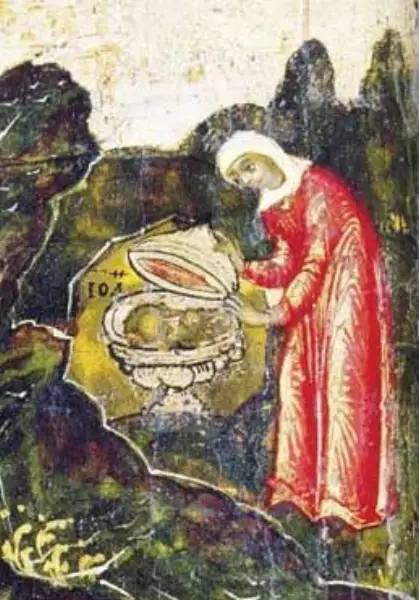
In Orthodox tradition Joanna is honored as Saint Joanna the Myrrhbearer, commemorated among the eight women who brought myrrh to the tomb, on the Sunday of the Myrrh-Bearing Women two weeks after Pascha; her own feast falls on June 27, with the Roman-rite Catholic calendar keeping her on May 24. The Lutheran Church–Missouri Synod, in its revised calendar, commemorates her on August 3 with the other women at the tomb, among them Mary of Clopas and Salome; the Episcopal Church keeps the same date with the Lesser Feasts and Fasts observance of 2022, 'Joanna, Mary, and Salome, Myrrh-Bearing Women'. An ancient tradition, pictured in icons, holds that Joanna recovered the head of John the Baptist after Herodias had cast it away — the courtly convert honoring the prophet her world had silenced. Archaeology may even touch her name: a first-century ossuary found in Jerusalem belonged to a woman named Yehohanah, granddaughter of the high priest Theophilus, to whose family Luke may have written, and the coincidence has fueled speculation about her identity. Her memory has also reached modern culture, from Lesya Ukrainka's verse drama of 1909 to her speaking role in the television series The Chosen — enduring testimony to the steward's wife who stood at the tomb.
§ Holy Myrrhbearer traditions
The Record
- Symbols
- depicted with the recovered head of John the Baptist
- Canonization
- Pre-congregation; recognized as a saint in the Anglican, Catholic, Eastern Orthodox and Lutheran traditions
Prayer
Bibliography
Show 9 sources
- "Saint Joanna the Myrrhbearer". The Orthodox Church in America. Retrieved 22 January 2023. Commemorated on June 27.
- ΚΑΤΑ ΛΟΥΚΑΝ 24 [Luke 24:10]. Nestle-Aland. Novum Testamentum Graece. 27th edition.
- Douglas, J. D. and Tenney, Merrill C. (2011). Zondervan Illustrated Bible Dictionary. p. 742. ISBN 0310229839.
- Yonge, Charlotte Mary (1884). "Names from 'Chanani'". History of Christian Names. London: Macmillan. pp. 39–46.
- Hanks, Patrick; Hardcastle, Kate; Hodges, Flavia (2006). A Dictionary of First Names. 2nd ed. Oxford Paperback Reference. Oxford University Press. p. 356. ISBN 978-0-19-861060-1.
- Bauckham, Richard (2002). "Joanna the Apostle". Gospel Women: Studies of the Named Women in the Gospels. London; Grand Rapids, MI: T&T Clark; Eerdmans. pp. 109–202. ISBN 978-0567088703.
- Pfatteicher, Philip H. (2008). The New Book of Festivals and Commemorations: A Proposed Common Calendar of Saints. Minneapolis: Fortress Press. p. 376. ISBN 9780800621285.
- Lesser Feasts and Fasts (PDF). New York: Church Publishing. 2022. ISBN 9781640656277.
- Barag, Dan; Flusser, David (1986). "The Ossuary of Yehohanah Granddaughter of the High Priest Theophilus". Israel Exploration Journal. 36 (1/2): 39–44. JSTOR 27926007.
Profile text adapted from the Wikipedia article, licensed CC BY-SA 4.0.
Pray with this saint every day
Save St. Joanna, Wife of Chuza to your favorites, read the full profile, and get feast-day reminders in the Saints app.
Get the Saints AppFree on the App Store for iPhone and iPad