
762 – 846·Feast November 4
St. Joannicius the Great
Byzantine hermit and prophet of icon veneration
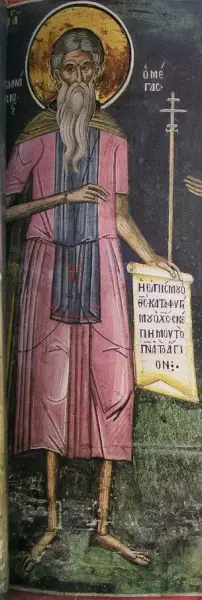
Overview
Joannicius the Great was a Byzantine ascetic, sage, and prophet whose long life became inseparable from the struggle over the veneration of icons. Born in Bithynia in 762 to a poor household that may have leaned toward iconoclasm, he first made his name as a soldier in the imperial guard, reportedly saving the young Emperor Constantine VI from capture at the Battle of Marcellae. Around 792 he abandoned the army, entered the monastery of Antidion, and after two years withdrew to Mysian Olympus near what is now Bursa, Turkey, where he spent roughly half a century as a hermit given to reciting the Psalms and contemplating the life of Christ. Hagiographers credited him with prophecies and wonders, including the foretelling that the Byzantine Church would one day return to the veneration of icons, a hope fulfilled under Empress Theodora; he is also remembered for blessing the future Patriarch Photios. He died in solitude at Antidium on 3 or 4 November 846 and was buried at the monastery there. Orthodox, Catholic, and Anglican Christians commemorate him on 4 November.
The Complete Life
A Poor Household in Bithynia
Almost nothing survives about Joannicius apart from pious literature. Byzantine scholars depend chiefly on two hagiographical accounts when reconstructing his life, a caution worth remembering with every detail that follows. Within that tradition, he was born in 762, or by another reckoning 754, to Myritzikios and Anastaso, members of the Boïlas family, and he had at least one sister. The household was poor, and its sympathies may even have been iconoclast, the position Joannicius would later spend his life opposing. What the sources agree on is temperament: from his earliest years the boy showed a bent toward the things of God, repeatedly seeking out empty places where he could pray and think without interruption. In an age when sanctity was often born in courts and cities, his formation began in rural obscurity among people of little account. That obscurity, combined with the shortage of independent documentation, makes him a representative figure of the many Byzantine ascetics whose lives reached historians only through the devoted memory of their monasteries. The two Lives on which scholars lean disagree on basics, one tradition placing his birth in 762 and another in 754, and modern reference works such as the Prosopographie der mittelbyzantinischen Zeit have had to arbitrate between them. Reading his story therefore demands a certain humility: every episode that follows reaches us through monks writing decades later, eager less for documentary precision than for edification.
§ Early life
From Soldier to Monk
In his late teens or early twenties, around 772 or 773, Joannicius was conscripted into the Excubitors, an elite imperial regiment, under Emperor Leo IV. He served for roughly two decades, until 792, and his defining moment came at the Battle of Marcellae, where, according to his biographers, he rescued Emperor Constantine VI himself, though one version of the story makes the rescued man an officer rather than the sovereign. Soon after Marcellae he walked away from military service, in plain terms a deserter, and presented himself at the monastery of Antidion. He yearned immediately for the wilderness, but the brothers kept him two years, time he spent committing the entire Psalter to memory. Those two years proved to be a long preparation: when at last he slipped away to Mysian Olympus, he carried with him both the soldier's endurance and the monk's daily bread of psalmody, and there he remained a hermit for the rest of his days. Leo IV, who conscripted him, reigned barely five years, and the Marcellae disaster fell under his son Constantine VI, whose humiliation at the hands of the Bulgars the guard could not prevent. In that defeat the sources find the young soldier at his best, and in his immediate withdrawal from glory they find the monk already formed.
§ Early life
Hermit of Mysian Olympus
The hagiographies give the remainder of Joannicius's life to solitude, study, and prayer on Mysian Olympus. His days centered on the recitation of the psalms and meditation on the earthly life of Jesus, but tradition also attaches to him a whole book of marvels: he is said to have rid the island of Thasos of its snakes, to have led Greek captives out of prison, and to have taken upon himself the pains of a sin when he found a nun from a nearby cloister running away to marry, allowing her to return and persevere in her vow. His biographers even claim a gift of self-effacement so complete that he could become invisible. Beyond the miraculous, his historical weight lies in the iconoclast controversy. Though born into a family of possible iconoclast sympathies, he became a convinced defender of the holy images, and during the reign of the iconoclast emperor Theophilos he prophesied that the Byzantine Church would re-embrace icon veneration. Devotees saw that word fulfilled when Empress Theodora restored the practice. He is likewise credited with blessing the young Photios, who would become one of the most celebrated patriarchs of Constantinople.
§ Life as an Ascetic
Memory and Prayer
Most sources place Joannicius's death in the solitude he had chosen, on 3 or 4 November 846, and his burial at the Antidion Monastery where his monastic life had begun. From there his cult spread across confessional lines: his cult spans the Roman Catholic, Eastern Orthodox, and Anglican traditions, each keeping his feast, which falls on 4 November in the Byzantine rite and 17 November on the Old Calendar. His most enduring possession is a single short prayer, traditionally ascribed to him, which Christian worship still places on the lips of the faithful after the reading of the Psalms: an act of trust in the Father as hope, the Son as refuge, and the Holy Spirit as shelter, closing with doxology to the Trinity. For a man who left no writings of his own, the survival of that prayer and of the mountain hermitage's memory has kept his voice present in the Church's daily praise for more than eleven centuries. The Turkish name of his mountain tells its own story: until the 1930s Uludağ was still called Keşiş Dağı, the Mountain of the Monks, a memorial in geography to the ascetics who made it holy. Few careers span the distance his does, from conscripted guardsman to prophetic father of monks, and fewer still leave behind a single verse of prayer that the whole Church still repeats.
§ Death and legacy
Timeline
- 762
Bithynian birth into the Boïlas household of Myritzikios and Anastaso
§ Early life
- 772
Drafted as a young adult into the elite Excubitor regiment under Emperor Leo IV
§ Early life
- 792
Saved the emperor from capture at the Battle of Marcellae and then left the army for monastic life
§ Early life
- 4 Nov 846
Died in solitude at Antidium on 3 or 4 November and was buried at the Antidion Monastery
§ Death and legacy
In Their Own Words
My hope is the Father, my refuge is the Son, my shelter is the Holy Spirit. O Holy Trinity, Glory to You.
The Record
- Canonization
- Pre-congregation saint; venerated by the Eastern Orthodox Church, the Roman Catholic Church, and the Anglican Communion
Prayer
Bibliography
Show 7 sources
- "Venerable Joannicius the Great". Orthodox Church In America. Retrieved July 3, 2019.
- Treadgold, Warren (January 2002). "Photius Before His Patriarchate". Journal of Ecclesiastical History. 53: 1–17. doi:10.1017/S0022046901008727. S2CID 162542349 – via Cambridge.
- Cyril Mango, "The Two Lives of St Ioannikios and the Bulgarians", Harvard Ukrainian Studies VII (1983) (Okeanos: Essays presented to Ihor Ševčenko), 393–404.
- Lilie, Ralph-Johannes; Ludwig, Claudia; Pratsch, Thomas; Zielke, Beate (2013). "Ioannikios (#3389/corr.)". Prosopographie der mittelbyzantinischen Zeit Online. Berlin-Brandenburgische Akademie der Wissenschaften. Berlin and Boston: De Gruyter.
- Butler, Rev. Alban (2010). The Lives of the Saints. New York: Bartelby.
- "Saint Joannicius of Devic | Serbian Orthodox Church [Official web site]". www.spc.rs.
- "Joannicius the Great – Greek Orthodox Archdiocese of America". www.goarch.org. Retrieved 2019-07-03.
Profile text adapted from the Wikipedia article, licensed CC BY-SA 4.0.
Pray with this saint every day
Save St. Joannicius the Great to your favorites, read the full profile, and get feast-day reminders in the Saints app.
Get the Saints AppFree on the App Store for iPhone and iPad