
1783 – 1854·Feast August 28
St. Joaquina Vedruna de Mas
Widow and founder of the Carmelite Sisters of Charity
Overview
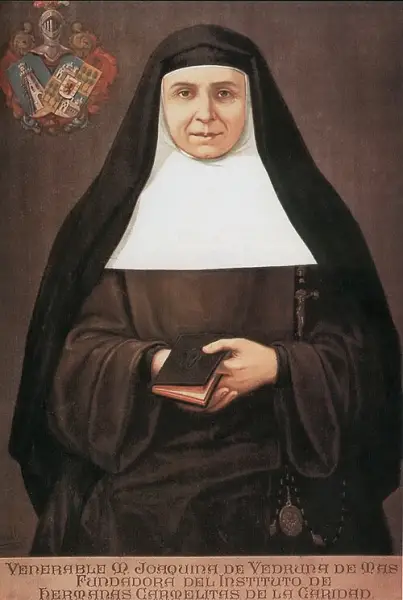
Joaquina Vedruna Vidal de Mas, in religion Joaquina of Saint Francis of Assisi, was a Spanish religious sister who founded the Carmelite Sisters of Charity. Born into the Catalan nobility in Barcelona in 1783, she wanted to enter the Carmel as a girl but was judged too young by her parents, and in 1799 she instead married the lawyer Teodoro de Mas, bearing him nine children. Napoleon's invasion of Spain scattered the family: she fled with her children while her husband stayed to fight as a volunteer and died in 1816, leaving her a widow free to follow her earlier calling. Settling at the family estate in Vic, she took up charitable work among the sick and poor women, and at the urging of her spiritual director, with the support of the Bishop of Vic and the collaboration of Anthony Mary Claret, she founded a Carmelite-inspired congregation dedicated to education and charity, professing vows with eight companions in 1826. Driven into France by the First Carlist War from 1836 to 1842, and later forced by illness to resign as superior, she died in Barcelona on 28 August 1854 during a cholera epidemic. She was beatified in 1940 and canonized by Pope John XXIII in 1959.
The Complete Life
A Noble Daughter of Barcelona
The future founder first saw light in Barcelona on 16 April 1783, in a noble household headed by Lorenzo de Vedruna, an official of the government, and Teresa Vidal; the parish church of Santa Maria del Pi baptized her within hours of her birth. Her childhood was marked by piety and a particular devotion to the Infant Jesus, along with a reputation, remembered with some amusement, for almost obsessive cleanliness. She received her First Communion in 1792. Three years later, at twelve, she asked to become a Carmelite; her parents, judging the request the product of a still-immature judgment, refused. The refusal set the pattern of her early life: a vocation deferred but not destroyed. It would take a marriage, nine children, war, and widowhood before the door she had knocked on as a girl finally opened, and when it did, the congregation she founded would bear the Carmelite mark she had longed for since childhood. The Barcelona of her girlhood was a city of old noble families and older parishes, and the Vedruna household belonged to both worlds. That biographers preserved the year of her First Communion, 1792, and even her fastidious habits as a child, says something about the intensity of a piety that expressed itself in the smallest ordering of daily life.
§ Life
Marriage, Motherhood, and Widowhood
On 24 March 1799 Joaquina married Teodoro de Mas, a barrister and landowner who had been a friend of her father. Family legend records how he chose her: unable to decide among Lorenzo's three daughters, he offered them a box of almonds, and while the two elder girls dismissed the gift as childish, Joaquina accepted it gladly, saying she loved almonds. The couple had nine children, four daughters who eventually entered convents, two sons who married, and three who died young, and both husband and wife joined the Third Order of Saint Francis, she taking the name Joaquina of Saint Francis of Assisi. Napoleon's invasion of Spain broke the household: she fled with the children while Teodoro remained to serve as a volunteer and died on 6 March 1816. A few months later she moved from Barcelona to the family estate, Manso Escorial, in Vic, put on the habit of a tertiary, and turned her energies to the sick and to poor women, guided by the Capuchin Esteban de Olot, who urged her to found an apostolic congregation for education and charity.
§ Life
Founding the Carmelite Sisters of Charity
The Bishop of Vic, Pablo Jesus Corcuera, directed that the new institute should be Carmelite in inspiration, and on 6 January 1826 Joaquina made her vows into his hands; on 6 February he set the rule before them on 6 February, and at morning Mass on 26 February Joaquina's vows were professed alongside eight companions, bringing the Carmelite Sisters of Charity into being. That morning the little community attended Mass in a Capuchin church and then walked to her estate to begin its common life. She also collaborated with Anthony Mary Claret in drafting the rule. Trouble followed: during the First Carlist War the hospital she had opened in the Carlist-held town of Berga was endangered by the fighting, and from 1836 to 1842 she lived in exile across the border in Roussillon, France. In spite of civil war and secular hostility the institute took root across Catalonia, then spread through Spain and later Hispanic America; Pius IX granted it the decree of praise on 5 August 1857, the Carmelites aggregated it to themselves on 14 September 1860, and Leo XIII bestowed final approbation on 20 July 1880.
§ Life
Sickness and Death
Joaquina's last years were a longVia crucis of failing health. A first apoplectic stroke came in September 1849, with further attacks following, and from around 1850 she lived with progressive paralysis. Obliged to resign as superior of the congregation she had founded, she bore the retreat from activity as she had borne every other trial, in patience and abandonment to God. She died in Barcelona on 28 August 1854, as a cholera epidemic swept the city, at the age of seventy-one. Her remains were eventually laid to rest in the motherhouse of her congregation in Vic, where they remain. The institute she left behind outgrew its Catalan origins: it now works in countries from Japan to Eritrea, and in 2008 counted 2,012 religious in 280 houses, a quiet vindication of the founding the widow of Vic had begun in a morning Mass at a Capuchin church. Paralysis after 1850 did not silence her; the sisters record that she remained a reference point for the congregation she could no longer govern, receiving superiors and shaping its spirit from her sickroom. Cholera found her in the epidemic that swept Barcelona in the summer of 1854, and she died on 28 August, at seventy-one, her institute already surviving exile, civil war, and anticlerical politics.
§ Life
Raised to the Altars
The cause of Joaquina Vedruna opened under Pope Benedict XV, who on 14 January 1920 set the beatification process in motion. The recognition of her heroic virtue allowed Pope Pius XI to declare her venerable on 16 June 1935, and after two miracles were confirmed through her intercession, Pius XII beatified her on 19 May 1940 in Saint Peter's Basilica. The canonization cause was formally opened on 14 May 1952, and on 12 April 1959 Pope John XXIII canonized her in Saint Peter's Basilica, completing a process that had run from the widow's death in cholera-stricken Barcelona to the great basilica in barely more than a century. Her feast is kept on 28 August, the anniversary of her death, while the Discalced Carmelites, whose spirit shaped her institute, commemorate her on 22 May. Reports of the incorrupt state of her remains accompanied her growing veneration among the sisters who inherited her congregation. Her remains, kept at the motherhouse in Vic, were found incorrupt, a sign that fed devotion in the years between her death and the solemn acts of 1940 and 1959. The opening of the canonization process on 14 May 1952, barely twelve years after beatification, moved with unusual speed by Roman standards, and the crowning ceremony of 12 April 1959 fell in the first months of John XXIII's pontificate.
§ Sainthood
A Congregation for the Poor
Joaquina's enduring monument is the Carmelite Sisters of Charity, the congregation born in 1826 from eight women's vows at a widow's estate. Founded to teach and to serve the sick, it proved resilient through the very turmoils that had tested its founder: civil war, exile, and secular opposition did not stop its spread through Catalonia and then across Spain to Hispanic America, and eventually to Asia and Africa. The congregation's growth numbers, from her nine children to thousands of religious, tell only part of the story; the deeper legacy is a model of holiness lived successively as daughter, wife, mother, widow, religious founder, and patient sufferer, demonstrating that no state of life is a barrier to sanctity. In her own person she bridged the cloistered Carmelite tradition she had yearned for as a girl and the active apostolate the nineteenth century demanded, and the Church's recognition of that union, from beatification in 1940 to canonization in 1959, made her a patron for families and founders alike. The dates of the congregation's growth, houses across Catalonia within her lifetime, then Spain and Hispanic America, and finally Japan and Eritrea, chart a nineteenth-century foundation with a twentieth-century reach; the figures of 2008, more than two thousand sisters in two hundred eighty houses, measure how far the eight women of 1826 traveled.
§ Life
Timeline
- 16 Apr 1783
Born in Barcelona to Lorenzo de Vedruna and Teresa Vidal and baptized the same day at Santa Maria del Pi
§ Life
- 24 Mar 1799
Married the barrister and landowner Teodoro de Mas, with whom she had nine children
§ Life
- 6 Mar 1816
Left a widow by the death of Teodoro, she moved with her children to the family estate in Vic and began charitable work
§ Life
- 26 Feb 1826
Professed vows with eight other women and founded the Carmelite Sisters of Charity at her estate near Vic
§ Life
- 1836
Forced by the First Carlist War to flee Spain for Roussillon in France, where she remained until 1842
§ Life
- Sep 1849
Suffered the first of a series of apoplectic attacks that eventually left her paralyzed
§ Life
- 28 Aug 1854
Died in Barcelona during a cholera epidemic, paralyzed since around 1850
§ Life
- 19 May 1940
Beatified by Pope Pius XII in Saint Peter's Basilica after confirmation of two miracles
§ Sainthood
- 12 Apr 1959
Canonized by Pope John XXIII in Saint Peter's Basilica
§ Sainthood
In Their Own Words
I love almonds
The Record
- Major works
- Carmelite Sisters of Charity (congregation founded 1826)
- Canonization
- Beatified 19 May 1940 by Pope Pius XII; canonized 12 April 1959 by Pope John XXIII in Saint Peter's Basilica
Prayer
Bibliography
Show 4 sources
- "Saint Joaquina Vedruna Vidal de Mas". Saints SQPN. 11 June 2015. Retrieved 12 January 2017.
- "St. Joaquina de Vedruna". Spread Jesus. 16 October 2011. Archived from the original on 13 January 2017. Retrieved 12 January 2017.
- "Joachima de Vedruna de Mas (1783-1854)" (PDF). CarmelNet. Archived from the original (PDF) on 23 August 2021. Retrieved 12 January 2017.
- Index ac status causarum beatificationis servorum dei et canonizationis beatorum (in Latin). Typis polyglottis vaticanis. January 1953. p. 106.
Profile text adapted from the Wikipedia article, licensed CC BY-SA 4.0.
Pray with this saint every day
Save St. Joaquina Vedruna de Mas to your favorites, read the full profile, and get feast-day reminders in the Saints app.
Get the Saints AppFree on the App Store for iPhone and iPad