
1550 – 1621·Feast July 7
St. Job of Manyava
Athonite monk and founder of the Manyava Skete
Overview
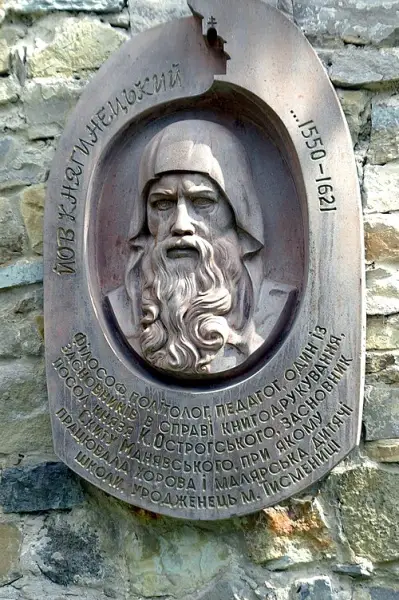
Job of Manyava, baptized Ivan Knyahynytskyi and known in monastic life as Ezekiel, was a Ukrainian Orthodox monk and church activist whose lasting work was the founding of the Manyava Skete, a celebrated cell monastery in the Carpathian foothills. Born at Tysmenytsia in 1550 and educated at monastery schools in Uhniv and Ostroh, he taught for a time at the Ostroh academy under the patronage of Prince Konstanty Wasyl Ostrogski before making two pilgrimages to Mount Athos. Tonsured there as Ezekiel, he returned to his homeland with other Athonite monks, first to collect alms and then, around 1600, to rebuild Orthodox monastic life in Ukraine. In 1606 he settled near Krasnopol beneath the Carpathians, gathering companions around him, and in 1611 he established the Maniavskyi Skyt near the village of Manyava. Because he was not a priest, he had his nephew Theodosius consecrated hieromonk to serve as the community's first hegumen, while he himself remained its spiritual father. He maintained friendships with leading defenders of Orthodoxy, including Ivan Vyshenskyi, and died on 30 December 1621. His monastery, closed by the Austrian authorities in 1785, was revived after Ukrainian independence.
The Complete Life
A Ruthenian Youth in Ostroh
The man the Church would remember as Job of Manyava entered the world as Ivan Knyahynytskyi, born in 1550 in the town of Tysmenytsia, in what is now Ivano-Frankivsk Oblast in western Ukraine. His education followed the path open to a talented Ruthenian boy of his generation: the monastery school at Uhniv, in present-day Lviv Oblast, and then the celebrated intellectual center at Ostroh. There his gifts attracted the attention of the nobleman Konstanty Wasyl Ostrogski, the great Orthodox patron of his age, who invited him to teach at the Ostroh school. But scholarship did not hold him. In his youth he twice made the journey to Mount Athos, the monastic heart of the Orthodox world, and on one of his stays in Ostroh a meeting with an Athonite monk impressed him so deeply that he abandoned his teaching career and left for the Holy Mountain altogether. In one of the Athonite monasteries he received the tonsure and a new name, Ezekiel, marking his passage from Ruthenian schoolmaster to Greek-trained monk. Uhniv and Ostroh stood at opposite ends of the Ruthenian cultural world, the one a small border town with an old monastery school, the other the new seat of Prince Ostrozki's academy; that the boy passed through both shows he had been marked out early by patrons who saw his promise.
§ Birth and early years
From Athos to the Carpathians
Ezekiel's return from Athos came in stages. In 1598 he traveled back to Ukraine in the company of other Athonite monks on an alms-collection mission, the customary errand that tied the monasteries of the Holy Mountain to their Slavic benefactors. He then went back to Athos, but in 1600 and 1601 he returned to Ukraine once more, and this time he stayed, resolved to transplant something of Athonite monasticism into his native land. The years that followed were given to reorganizing a number of Orthodox monasteries that had fallen into decline. In 1606 he withdrew from institutional work to a hillside near Krasnopol, at the foot of the Carpathians, to live as a hermit; other monks, drawn by his reputation and their own search for spiritual ideals, gathered around him. When the brotherhood had grown, a problem emerged: Job was not a priest and could not celebrate the liturgy. The remedy came by lot, which fell upon deacon Theodosius, Job's own nephew, consecrated hieromonk to shepherd the growing community. The alms journey of 1598 was routine Athonite practice, but the second homecoming, in 1600 and 1601, was not: Ezekiel came back this time to stay, resolved to pour the rest of his strength into rebuilding the monasteries of his own people.
§ Return to Ukraine (1600)
Founding the Manyava Skete
In 1611 Job established the Maniavskyi Skyt, a cell monastery near the village of Manyava in what is now Ivano-Frankivsk Raion, giving permanent form to the community that had formed around his hermitage. He installed Theodosius as its first hegumen with words of striking humility, naming him pastor and teacher of the flock and promising his own help for as long as he lived. The skete became one of the famous strongholds of Orthodox life in the western Ukrainian lands during the era of church unions and confessional pressure. Job kept close friendships with the leading ascetics and churchmen of his day, among them Ivan Vyshenskyi and Zakhariya Kopystenskyi, and people sought him out on questions of the purity of the faith, as the surviving letter of Cyril Tranquillion shows. A decade after Theodosius died, Metropolitan Petro Mohyla of Kyiv could point inquirers to the skete with the words that there, in Pokuttya, they would find two hundred angels living in bodies. His preference for the skete form, hermits' cells gathered about a common church rather than a single large coenobium, reflects the Athonite ideal he carried home, and it explains why the monks of Maniava were remembered as ascetics rather than landlords.
§ Return to Ukraine (1600)
Veneration Restored
Job's cult matured slowly across the centuries and was formally recognized twice, in two jurisdictions. In 1994 the Ukrainian Orthodox Church under the Moscow Patriarchate canonized Job and Theodosius of Manyava together, restoring their public veneration as the Soviet order collapsed and monastic life revived. Ten years later, on 15 July 2004, the National Church Council of the Ukrainian Orthodox Church (Kyiv Patriarchate) in Kyiv canonized the two saints in its own turn, making them among the few figures honored across the divided jurisdictions of Ukrainian Orthodoxy. Their joint feast falls on 24 June in the church calendar, which corresponds to 7 July in the civil calendar, and is kept by the Ukrainian Orthodox Church in memory of both the founder and his successor. The manyava Skete itself, shut by the Austrian authorities on 1 July 1785 and left in ruins through the nineteenth and twentieth centuries, was reestablished in the 1990s after Ukraine's independence, so that the community Job planted four hundred years ago prays there again. That two jurisdictions divided by the ecclesiastical conflicts of our own century should each have enrolled him is a measure of how uncontroversial his memory stands: Job belongs to no party in the Ukrainian church disputes, only to its history.
§ Canonization and observances
The Angel Flock of Pokuttya
The measure of Job's legacy is the endurance of the institution he founded and the memory of the counsel he gave. The Manyava Skete became a byword for rigorous monastic life, so much so that within a generation of Job's death the Metropolitan of Kyiv could recommend it to pilgrims as a place where two hundred angels walked in bodies. Though the monastery was closed in 1785 by the Austrian state, its rebirth after the fall of communism confirmed how deep the foundation had been laid: monks returned to the Carpathian valley, and the names of Job and Theodosius returned to the Church's calendar in both major Ukrainian jurisdictions. Job's friendships with figures such as Ivan Vyshenskyi place him among the circle of Ruthenian churchmen who defended Orthodox identity in the Commonwealth, and the questions of faith that people brought him in his lifetime became, after his canonization, part of his intercession. He stands in Ukrainian church memory as the schoolmaster who left books for the desert and gave his nation a house of prayer. The lot that chose Theodosius, the counsel Job spoke over him, and the metropolitan's tribute to his monks entered Ukrainian church lore together, a small trilogy of humility, obedience, and sanctity bound to one Carpathian valley.
§ Canonization and observances
Timeline
- 1550
Entered the world at Tysmenytsia under the baptismal name Ivan Knyahynytskyi, in what is now Ivano-Frankivsk Oblast
§ Birth and early years
- 1598
Arrived in Ukraine with other monks of Mount Athos to collect alms
§ Return to Ukraine (1600)
- 1600
Returned to Ukraine a second time, this time staying to build up Orthodox monastic life
§ Return to Ukraine (1600)
- 1606
Took up a hermit's life beneath the Carpathians by Krasnopol, where companions soon gathered
§ Return to Ukraine (1600)
- 1611
Founded the Maniavskyi Skyt monastery near the village of Manyava
§ Return to Ukraine (1600)
- 30 Dec 1621
Died at the Manyava Skete aged about seventy
§ Canonization and observances
- 1 Jul 1785
The monastery he founded was shut down by the Austrian authorities
§ Return to Ukraine (1600)
- 1994
Canonized by the Ukrainian Orthodox Church under the Moscow Patriarchate, together with Theodosius of Manyava
§ Canonization and observances
- 15 Jul 2004
Canonized by the National Church Council of the Ukrainian Orthodox Church (Kyiv Patriarchate) in Kyiv
§ Canonization and observances
In Their Own Words
Be pastor and teacher of this flock, gathered by God. You are our hieromonk and confessor, you are worthy to be hegumen and I will help you after my strength as long as I live
The Record
- Major works
- Manyava Skete (Maniavskyi Skyt monastery, founded 1611)
- Canonization
- Canonized in 1994 by the Ukrainian Orthodox Church (Moscow Patriarchate) and again on 15 July 2004 by the Ukrainian Orthodox Church – Kyiv Patriarchate
Prayer
Bibliography
Show 2 sources
- Hayday L. Istoriia Ukrainy v osobakh, terminakh, nazvakh i poniattiakh. Lutsk: Vezha, 2000. (Ukrainian)
- Dovidnyk z istorii Ukrainy. Za redaktsiieiu I. Pidkovy ta R. Shusta. Kyiv: Geneza, 1993. (Ukrainian)
Profile text adapted from the Wikipedia article, licensed CC BY-SA 4.0.
Pray with this saint every day
Save St. Job of Manyava to your favorites, read the full profile, and get feast-day reminders in the Saints app.
Get the Saints AppFree on the App Store for iPhone and iPad