
c. 1551 – 1651·Feast October 28
St. Job of Pochayev
Hegumen of Pochayiv Lavra and champion of Orthodoxy
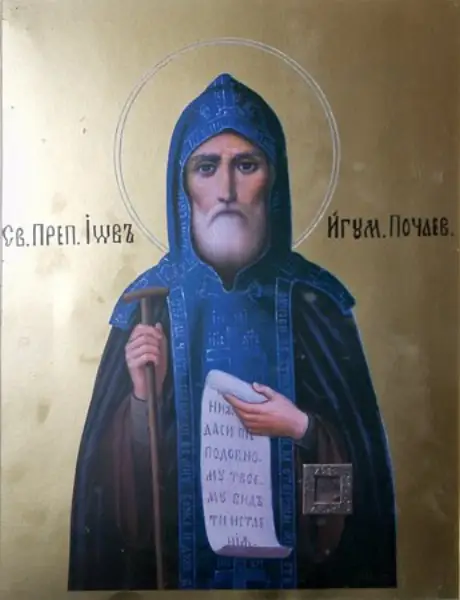
Overview
Job of Pochayev, in the world Ivan Zalizko and in the Great Schema John, was an Eastern Orthodox monk, abbot, and writer who led the Pochayiv Lavra to glory as a fortress of Orthodoxy in the Polish-Lithuanian Commonwealth. Born around 1551 near Kolomyia in Galicia to the pious Zalizko family, he entered the Transfiguration Uhorniki Monastery as a boy, was tonsured at twelve, and accepted priestly ordination at thirty-one. At the request of Prince Konstanty Ostrogski, the great Orthodox patron, he took charge of the monastery of the Exaltation of the Cross on an island off Dubno, governing it for two decades as abbot and composed the teachings later gathered as The Book of the Venerable Job of Pochayev, Written by His Own Hand, a defense of Orthodox doctrine against Protestant and Roman Catholic polemic after the Union of Brest. In 1604 he withdrew to the cave monastery at Pochayiv, whose hegumen he became, ruling it for nearly half a century with strict discipline and ceaseless prayer. He attended the Synod of Kyiv in 1628, received the Great Schema after 1642, and died on 28 October 1651. His relics, uncovered incorrupt in 1659, remain at the Lavra, whose defense during the Turkish siege of 1675 his apparition was believed to have secured.
The Complete Life
The Boy of the Iron Family
Around 1551, in the Galician countryside close to Kolomyia and under the Polish crown, the future abbot was born, to John and Agapia of the Zalizko family, whose name means "Iron." They named their son Ivan after John the Baptist. Three books shaped his boyhood imagination: the lives of Rastko Nemanjic and John of Damascus, and The Ladder of Divine Ascent by John Climacus. His biographer and disciple Dositheus remembered him as a child perfect in wisdom beyond his years, whose words, knowledge, and actions never contradicted one another, and who stood apart from other children by the height of his spiritual aspirations. From such beginnings, in a borderland where Orthodox, Catholic, and Protestant missions competed for souls, came the monk who would spend a century defending the Orthodox inheritance of the Ruthenian lands. The family name, iron, proved prophetic: nothing in the long conflicts of his lifetime, not lawsuits, not raids, not the pressure of princes and prelates, bent the constancy of the abbot of Pochayiv. Named for the Forerunner and raised on the lives of desert saints and the Ladder of Climacus, the boy grew up inside a web of monastic references that would steer every later choice, from his first flight to the cloister to his final schema.
§ Childhood and early years
The Boy Who Left for the Monastery
At the age of ten Ivan slipped away from home in secret and presented himself at the Transfiguration Uhorniki Monastery, asking the hegumen to accept him into the brothers' service. Two years later, at twelve, he was tonsured a monk and given the name Job, after the biblical patriarch whose patient endurance would become the pattern of his own life. He remained at Uhorniki through his youth, and at thirty-one he accepted priestly ordination. The turning point came through the repeated invitations of Konstantin Ostrozhsky, the prince and defender of Orthodoxy, who transferred him to the monastery of the Exaltation of the Cross kept on an island off Dubno, a ducal foundation ordered after the canons of Theodore the Studite. There Job served for twenty years as hegumen, combining the government of a monastery with the writing of the theological works that would make his name. A childhood oblation, a boyhood tonsure, and a prince's summons had carried him, step by step, toward the work waiting in Volhynia. Uhorniki trained him in exactly the tradition Dubno would demand: the Studite canons he absorbed there underlay the observance he later imposed at Pochayiv, so that his whole monastic career ran along a single line of discipline learned in childhood.
§ Joining Uhornytskyi monastery
Abbot, Author, Apologist
At Dubno Job's pen found its cause. The Union of Brest of 1596 had placed the Orthodox of the Polish-Lithuanian Commonwealth under crushing pressure: many were deprived of their rights, pressure was applied to force them toward Catholicism, and more than one Orthodox bishop deserted to Uniatism. Job answered with books. He wrote against the Protestant errors spreading through western Ukraine, especially Socinianism, treating the Trinity, the divinity of Christ, the Mother of God, and baptism, and he took issue with the Latin practice of celebrating the Eucharist with unleavened bread. Together with others he copied and disseminated Orthodox books to hold the line, in the same current that had produced Prince Ostrozhsky's Ostroh Bible of 1581, the first printed Church Slavonic Bible. The collection of his own works, gathered as The Book of the Venerable Job of Pochayev, Written by His Own Hand, held eighty teachings, conversations, and sermons with excerpts he had compiled from the Fathers; translated into Russian, it reappeared in 1881 as The Bee of Pochayev, edited by Professor N. Petrov of the Kyiv Theological Academy.
§ Transfer to Dubno monastery and literary work
The Cave at Pochayiv
Growing fame drove Job to a harder path. He withdrew as a hermit to the mountain cave monastery at Pochayiv in the Kremenets district, joining it in 1604 and rising in time to be elected its hegumen. His disciple Dosyfey preserves the portrait: a man of few words, whose lips carried only the Jesus Prayer, who would shut himself for days and weeks in a cave so narrow entry was difficult and so small no posture of rest was possible. years of kneeling left his knees wounded and their marks pressed into the rock beneath; Dosyfey once saw supernatural light shining from the cave's depths for two hours onto the far side of the church, and fell to the ground in terror. As abbot Job joined this contemplative core to firm governance, introducing strict discipline and reforming monastic life. The monastery's trials were legal and physical: the Castellan of Belz, Andrzej Firlej, brought suit over the lands and wonderworking icon his grandmother had left the brothers, and in 1623 he raided the cloister and seized the icon, which a court decision only restored in 1641.
§ Hermit withdrawal to Pochayev
Death and Incorrupt Relics
Sometime after 1642 Job was tonsured into the Great Schema, taking the name John, a final ascent for a monk of ninety. His death came on 28 October 1651, and the Church soon enrolled him among her saints. Then came the strange episode that fixed his cult: he appeared three times in vision to Dionysius Balaban, Metropolitan of Kyiv, commanding him to uncover the relics. Twice the metropolitan hesitated; only when the third vision carried a threat of misfortune did he obey, traveling the same day to Pochayiv to order the grave opened. That took place on 28 August 1659. The body lay incorrupt, breathing a wonderful heavenly fragrance, and the relics were enthroned for veneration in the Trinity Cathedral of the Lavra. A second uncovering followed on 28 August 1833, when the relics were solemnly moved to a church consecrated in his honor at the Lavra. Ever since, pilgrims crowd the monastery each 28 August to venerate the saint and beg his intercession, and in 1902 the Holy Synod added a yearly procession of the relics around the Dormition Cathedral after the Divine Liturgy.
§ Death and canonization
The Lavra's Deliverance
The miracles attached to Job's name center on the fortress he left behind. In 1675, during the Zbarazh War, Turkish forces besieged the Lavra and reputedly broke off the assault upon seeing the Theotokos appear above the monastery with angels and St. Job; numerous Turkish Muslims who witnessed the sight converted to Christianity afterward, and one of the monastery's chapels commemorates the deliverance. In 1759 the nobleman Mikolaj Bazyli Potocki, whose coach overturned by the walls and whose pistol failed three times against his own driver, attributed his preservation to God, settled at Pochayiv, and poured gifts on the cloister; in 1773 the Roman Catholic Potocki petitioned the Pope to recognize the Pochayiv icon as miraculous, which was granted, and Job as a Catholic saint, which was not. On the feast of 28 October 1908 the Bishop of Volhynia reported Job appearing before him and blessing the Holy Mysteries. His cult crossed the ocean too: the press of St. Job of Pochayev at Holy Trinity Monastery in Jordanville, New York, became the principal printing house of the Russian Orthodox Church Outside Russia.
§ Healings and miracles
Timeline
- 1604
Withdrew from Dubno to the cave monastery at Pochayiv, where he was later elected hegumen
§ Hermit withdrawal to Pochayev
- 1623
Endured the raid of Andrzej Firlej, who carried off the wonderworking icon of the Mother of God
§ Hermit withdrawal to Pochayev
- 1628
Attended the Synod of Kyiv, convoked to defend the Orthodox Church against Uniatism
§ Hermit withdrawal to Pochayev
- 1642
Received the Great Schema sometime after this year, taking the new monastic name John
§ Hermit withdrawal to Pochayev
- 28 Oct 1651
Died at the Pochayiv monastery and was soon glorified as a saint
§ Death and canonization
- 28 Aug 1659
Metropolitan Dionysius Balaban uncovered his grave at Pochayiv after three visions; the body was found incorrupt
§ Death and canonization
- 1675
During the Zbarazh War, Turkish besiegers of the Lavra fled after an apparition of the Theotokos with angels and St. Job
§ Healings and miracles
- 1759
Count Mikołaj Bazyli Potocki, after his coach overturned nearby and his gun thrice failed to fire, became the Lavra's great benefactor
§ Healings and miracles
- 1773
Potocki petitioned the Pope to recognize the Pochayiv icon as miraculous, which was granted, and Job as a Catholic saint, which was not
§ Healings and miracles
- 28 Aug 1833
Relics solemnly transferred to a church consecrated in his honor at the Pochayiv Lavra
§ Death and canonization
- 1881
His collected teachings republished in Russian as Pchela Pochayevskaya (The Bee of Pochayiv), edited by Professor N. Petrov
§ Transfer to Dubno monastery and literary work
- 1902
The Holy Synod decreed an annual procession of his relics around the Dormition Cathedral of the Lavra
§ Feast Days
- 28 Oct 1908
On his feast, the Bishop of Volhynia reported Job appearing in vision and blessing the Holy Mysteries
§ Healings and miracles
The Record
- Major works
- The Book of the Venerable Job of Pochayev, Written by His Own Hand (eighty teachings, conversations, and sermons)
- Symbols
- Vested as a monk, holding an abbot's crozier
- Canonization
- Glorified as a saint shortly after his death in 1651; venerated by the Eastern Orthodox Church
Prayer
Bibliography
Show 4 sources
- "Prepodobnyi Iov, igumen Pochaevskii + Pravoslavnyi Tserkovnyi kalendar" [Venerable Job, Hegumen of Pochayiv + Orthodox Church Calendar].
- Bogomolets O. Radomysl Castle-Museum on the Royal Road Via Regia. Kyiv, 2013. ISBN 978-617-7031-15-3.
- "Uncovering of the relics of the Venerable Job, Abbot and Wonderworker of Pochaev".
- "Synaxis of the Saints of Volhynia".
Profile text adapted from the Wikipedia article, licensed CC BY-SA 4.0.
Pray with this saint every day
Save St. Job of Pochayev to your favorites, read the full profile, and get feast-day reminders in the Saints app.
Get the Saints AppFree on the App Store for iPhone and iPad