
1815 – 1888·Feast January 31
St. John Bosco
Priest, educator of poor youth, founder of the Salesians
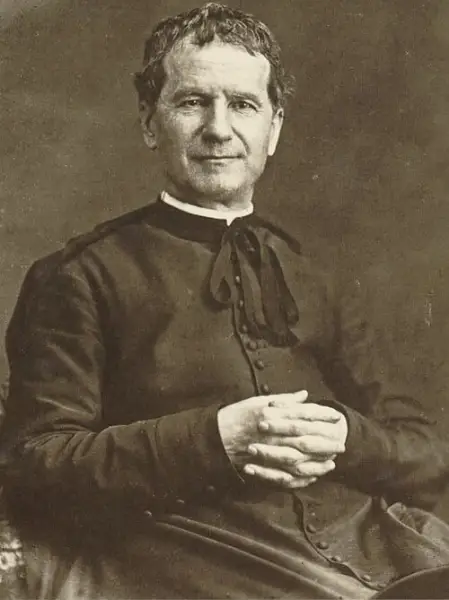
Overview
John Melchior Bosco, universally known as Don Bosco, was an Italian Catholic priest, educator, and writer who devoted his life to the abandoned boys of industrial Turin. Born a poor farmer's son in the Becchi hamlet of Piedmont in 1815, orphaned of his father at two, he worked as a shepherd, taught himself tricks and juggling to gather children for prayer, and struggled against poverty and family opposition to reach the seminary, entering Chieri in 1835 and ordaining in 1841. In Turin, a city swollen by migration and scarred by early industrialization, he began meeting boys where they worked, in shops and squares, founding the Oratory of Saint Francis de Sales at Valdocco, where he sheltered, schooled, and apprenticed hundreds. From his conviction that children should be educated with love rather than punishment came the Salesian Preventive System of reason, religion, and loving kindness. He founded the Salesians of Don Bosco in 1859, the Daughters of Mary Help of Christians with Maria Domenica Mazzarello in 1871, the Salesian Cooperators in 1876, and the Association of Mary Help of Christians in 1869, and sent the first Salesian missionaries to Patagonia in 1875. A prolific popular author, he died at Turin on 31 January 1888, was beatified in 1929, and canonized by Pope Pius XI on Easter Sunday 1934.
The Complete Life
The Shepherd of the Becchi
On 16 August 1815, in the Becchi, a hamlet on the hills of Castelnuovo d'Asti in Piedmont, Margherita Occhiena bore her youngest son, Giovanni Melchiorre Bosco, into a family of farmhands; the Piedmontese countryside was then reeling from the Napoleonic wars and the great drought of 1817. His father Francesco died when the boy was barely two, leaving three sons to their mother Margherita Occhiena, a woman of strong faith whose influence on her youngest son's formation his biographers never tire of recording. Poverty shut the schoolhouse door: John's early years were spent shepherding, and his first real teacher was the parish priest Don Calosso, impressed by the boy's memory for sermons. His elder brother Antonio resented his ambition to study, protestingly that John was just a farmer like the rest of them; the quarrels drove John from home in February 1827 to hire out as a farm servant. Yet even as a child he showed the instincts of his future: at ten he was already the referee of his companions' fights, and when traveling entertainers came to the local fair he studied their juggling and acrobatics until he could repeat the acts himself, collecting his audiences with a prayer before and after each performance.
§ Life
Dreams, Studies, and Ordination
In 1825, at nine, Bosco had the first of the dreams that marked his life: a crowd of poor boys playing and blaspheming, and a majestic stranger who told him he must win those boys by gentleness and kindness instead of blows, teaching them how ugly sin is and how beautiful virtue. He recalled the dream all his days as the charter of his work. Schooling came late and hard: his mother scraped together the money, helpers like the priest Joseph Cafasso, whom he met around 1830, opened doors, and at twelve he had left home altogether. In 1835 he entered the seminary at Chieri, by the church of the Immacolata Concezione, and there, along with theology, he learned practical trades, carpentry, shoemaking, cooking, farming, that he would one day teach his boys. On the eve of Trinity Sunday 1841, aged twenty-six, he was ordained a priest of Turin by Archbishop Franzoni. His first assignment took him to the ecclesiastical institute where Cafasso taught, and with him on visits to the city's prisons, where the sight of young offenders locked up with hardened criminals awakened the purpose of his life.
§ Life
The Oratory at Valdocco
Turin, a city of some 117,000 souls, was receiving wave upon wave of poor rural migrants, and Bosco judged the ordinary parish machinery useless for reaching their children. He went to find the boys where they were, in the workshops and squares, among the pavers, stonecutters, masons, and plasterers far from home. The work took shape as the Oratory, and it was never merely a Sunday institution: Bosco hunted jobs for the unemployed, and when he found boys sleeping under bridges he took them into his own lodgings, twice losing blankets and hay to their roughness before persevering. In May 1847 he sheltered a homeless boy in the three rooms he rented in the slums of Valdocco, and with his mother Margherita beside him the house grew into a vast orphanage: thirty-six boys by 1852, one hundred fifteen by 1854, four hundred seventy by 1860, six hundred by 1861, and eight hundred at its peak. Authorities were suspicious, the police chief saw politics in the open-air catechism, and the little community was evicted from one lodging after another, but royal protection kept the work alive. From this labor came practical inventions too: among the first apprenticeship contracts in Turin, signed by employer, apprentice, and Don Bosco together, guaranteeing the boys their trade, verbal correction only, feast-day rest, and an annual holiday.
§ Priesthood and first apostolates
The Preventive System
Bosco's educational doctrine grew out of his disgust for the punitive schooling of his day, which he called a repressive system. On 12 March 1877, addressing the opening of a youth center in Nice, he put a name to his alternative: the Preventive System. Back in Turin he wrote the address out as a polished essay, The Preventive System in the Education of the Youth, published that year and woven into the draft Rule of his congregation. Its pillars were reason, religion, and loving kindness, and its declared aim to form good Christians and honest citizens. He preferred to teach by story, pouring his pedagogy into educational novels and narrative works rather than treatises. Behind the method stood his spirituality: a follower of Francis de Sales, whose gentle optimism he made his own, and an ardent devotee of Mary under the title Help of Christians, whose basilica he raised at Valdocco and whose association, the ADMA, he founded in 1869 to bind ordinary people into the Salesian mission. His politics were ultramontane and frankly polemical, calling Rousseau and Voltaire the two vicious leaders of incredulity; his visions and dreams, recorded from boyhood, were as famous in his lifetime as his schools.
§ Salesian Preventive System and other works
Founder and Apostle
The orphanage became a congregation. Among the older boys who stayed to share his work were Michael Rua, John Cagliero, and John Baptist Francesca; in 1857 Bosco drafted rules for his helpers, and in 1859 he gathered Vittorio Alasonatti, fifteen seminarians, and one high-school boy into the Society of Saint Francis de Sales, the seed of the Salesians, whose Rule Pope Pius IX approved definitively in 1873. With Mary Mazzarello and the girls of Mornese he founded in 1871 the Daughters of Mary Help of Christians, doing for poor girls what the Salesians did for boys, and in 1876 the Salesian Cooperators carried the same mission among the laity. The missions obsessed him: after years of collecting information, letters from Argentina convinced him that Patagonia was the field of his old dreams, and in 1875 the first Salesians sailed for Buenos Aires. He poured out popular books, catechisms, lives of the popes, school histories, biographies of Dominic Savio and Joseph Cafasso, over two hundred twenty titles in all, printed by his own boys in the press workshop he built so that learning a trade and learning the faith went hand in hand. Weakened by age and labor, he died at Turin on 31 January 1888, mourned by thousands.
§ Foundation of Salesians of Don Bosco
Father and Teacher of Youth
The Archdiocese of Turin opened Bosco's cause soon after his death, gathering testimony from the Salesians, the Daughters, and the Cooperators. Pope Pius XI, who had known the priest in life, pressed the process forward, beatified him on 2 June 1929, and canonized him on Easter Sunday, 1 April 1934, conferring the title Father and Teacher of Youth. In 1949 Pope Pius XII named him patron of Catholic publishers, in honor of the enormous body of writing, more than two hundred twenty works collected in thirty-eight volumes, that issued from his press. Popular devotion had long called him the patron of illusionists for the juggling and magic tricks of his boyhood, and in 2002 the priest Silvio Mantelli formally petitioned Pope John Paul II to declare him patron of stage magicians; Catholic gospel magicians still offer free shows for poor children on his feast. He is remembered with a commemoration on 31 January even in the Church of England's calendar. Michael Rua, his first collaborator, succeeded him as rector major of the Salesians by appointment of Pope Leo XIII. Few canonizations have followed a founder's death so rapidly, and fewer still have had a pope who remembered the saint alive presiding at both ceremonies.
§ Death and canonization
A Global Family
Few founders have left so vast an institutional family. The Salesians of Don Bosco and the Salesian sisters staff schools, technical institutes, and missions across every continent; the Salesian Bulletin he founded in the 1870s still appears in some fifty editions and thirty languages; the Cooperators keep his educational charism among the laity. Schools across Australia, Belgium, Canada, Colombia, India, Pakistan, Lebanon, the Philippines, and the United States carry his name, and by churches from the Church of Saint Jean Bosco in Paris to parishes in Engadine, New South Wales. Brasília claims him as patron because he is said to have foreseen in a dream an extraordinary civilization arising in central Brazil. Cinema has retold his life from the 1935 Italian biopic with Gian Paolo Rosmino to later films of 1988, 1993, 2004, and 2012, and monuments from Castelnuovo to Ronda, Funes, Makati, and Turin mark the geography of his cult. The Salesian story is not without shadow, the order has faced abuse scandals like other congregations, but the Preventive System of reason, religion, and loving kindness remains his most exportable work, studied wherever educators weigh love against punishment.
§ Monuments and memorials to Bosco
Timeline
- 16 Aug 1815
Born in the hillside hamlet of the Becchi, in Castelnuovo d'Asti, Piedmont, to farmer Francesco Bosco and Margherita Occhiena
§ Life
- 1825
At nine years old, had the first of the recurring dreams of poor boys and a majestic figure that shaped his whole work
§ Life
- Feb 1827
Left home to work as a farm servant after quarrels with his older brother Antonio made studying impossible
§ Life
- 1830
Met the young priest Joseph Cafasso, who recognized his talent and backed his first schooling
§ Life
- 1835
Entered the seminary at Chieri
§ Life
- 1841
Ordained a priest in Turin by Archbishop Franzoni, aged twenty-six, after six years of study
§ Life
- May 1847
Gave shelter to a homeless boy in his rented rooms at Valdocco, beginning the orphanage that became his life's work
§ Priesthood and first apostolates
- 1850
Drew up regulations for a mutual aid society to support apprentices who lost work or fell ill
§ Life
- Nov 1854
Wrote an unanswered letter to King Victor Emmanuel II urging him not to suppress religious orders or confiscate church property
§ Priesthood and first apostolates
- 1857
Drafted the first rules for his helpers, later approved definitively as the Rule of the Society of Saint Francis de Sales
§ Foundation of Salesians of Don Bosco
- 1859
Formed a small band of priests and seminarians into the Society of Saint Francis de Sales, the nucleus of the Salesians
§ Foundation of Salesians of Don Bosco
- 18 Apr 1869
Founded the Association of Mary Help of Christians, a year after the basilica of that name rose at Turin
§ Life
- 1871
Founded with Maria Domenica Mazzarello the Daughters of Mary Help of Christians to care for poor girls
§ Foundation of Salesians of Don Bosco
- 1875
Sent the first Salesian missionaries to Argentina and began publishing the Salesian Bulletin
§ Foundation of Salesians of Don Bosco
- 12 Mar 1877
At the opening of a youth center in Nice, first named his method the Preventive System, publishing it as an essay that same year
§ Salesian Preventive System and other works
- 1881
Penned A Compendium of Italian History from the Fall of the Roman Empire, later translated by John Daniel Morell
§ Salesian Preventive System and other works
- 31 Jan 1888
Died in Turin aged seventy-two; thousands attended his funeral
§ Death and canonization
- 2 Jun 1929
Beatified by Pope Pius XI, who had known him personally
§ Death and canonization
- 1 Apr 1934
Canonized by Pope Pius XI on Easter Sunday and given the title Father and Teacher of Youth
§ Death and canonization
- 1949
Catholic publishers received him as heavenly patron by decree of Pope Pius XII
§ Death and canonization
In Their Own Words
You will have to win these friends of yours not with blows, but with gentleness and kindness. So begin right now to show them that sin is ugly and virtue beautiful.
good Christians and honest citizens
The Record
- Major works
- The Preventive System in the Education of the Youth (1877)·The Salesian Bulletin (founded 1875, still published in some 50 editions and 30 languages)·A Compendium of Italian History from the Fall of the Roman Empire (1881)·Life of the Youth Dominic Savio (1859)·Biography of Fr. Joseph Cafasso (1860)·Cattolico Provveduto (1853)·Memoirs of the Oratory of Saint Francis de Sales (written 1815-1855; published posthumously 1989)
- Patron of
- Christian apprentices·editors·publishers·students·young children·magicians·juvenile delinquents·Brasília, Brazil·Piura, Peru
- Symbols
- Cassock·Biretta
- Canonization
- Beatified 2 June 1929 by Pope Pius XI; canonized 1 April 1934 (Easter Sunday) by Pope Pius XI, who styled him Father and Teacher of Youth
Prayer
Bibliography
Show 6 sources
- Butler, Alan (1999). Butler's Lives of the Saints. Tunbridge Wells: Burns & Oates. ISBN 0860122522.
- Farmer, David Hugh (2004). The Oxford Dictionary of Saints (5th ed.). Oxford: Oxford University Press. ISBN 0198609493.
- Coulter, Michael L.; Myers, Richard S.; Varacalli, Joseph A. (2012). "Bosco, St. John (1815-1888)". Encyclopedia of Catholic Social Thought, Social Science, and Social Policy Supplement. Vol. 3. Scarecrow Press. pp. 36-38. ISBN 978-0810882669.
- Lemoyne, Giovanni Battista; Amadei, Angelo; Ceria, Eugenio (1965-1988). Borgatello, Diego (ed.). Biographical Memoirs of St. John Bosco. New Rochelle, New York: Don Bosco Publications.
- Morrison, John (1999). The Educational Philosophy of Don Bosco (Indian ed.). Guwahati, India: Don Bosco Publications. ISBN 81-87637-00-5.
- Cerrato, Natale; Ribotta, Michael (1993). "EXPO '84 and Don Bosco's peerless-to-paper-to-print presentation". Journal of Salesian Studies. IV (1). Institute of Salesian Studies, Berkeley, California: 87-98.
Profile text adapted from the Wikipedia article, licensed CC BY-SA 4.0.
Pray with this saint every day
Save St. John Bosco to your favorites, read the full profile, and get feast-day reminders in the Saints app.
Get the Saints AppFree on the App Store for iPhone and iPad