
died c. 450·Feast January 15
St. John Calybite
The Hut-Dweller who lived unrecognized at home
Overview
John Calybite — the name comes from the Greek word for a small hut, the dwelling where he spent his final years — was a Greek monk and hermit of the fifth century, honored by both the Eastern Orthodox and Roman Catholic Churches. Born in Constantinople to noble and wealthy parents, his father being the rich nobleman Eutropius, he secretly left home as a boy of about twelve to pursue monastic life near Jerusalem in one tradition, and among the Acæmetes monks on the Thracian shore in another. After roughly six years in the monastery, his abbot allowed him to revisit his family. Rather than present himself openly, he disguised himself in the rags of a beggar, and his own mother, not recognizing her son, drove him from the door. He settled in a little hut near his parents' house, living on their unwitting charity while devoting himself to prayer, humility, and mortification. Only on his deathbed, around the year 450, did he reveal himself, summoning his mother and placing in her hands the Gospel book she had once given her boy, before dying in her arms. Some traditions relocate his closing years to Rome, and the Roman Martyrology gives 469 as the year his parents finally recognized him. He is remembered in the East as John the Hut-Dweller, with a feast on 15 January.
The Complete Life
A Nobleman's Son in New Rome
John was born in Constantinople, the city then known as New Rome, into a family of rank and means. The monks of St Augustine's Abbey, Ramsgate, recording his life in their 1921 Book of Saints, describe him as the child of noble and wealthy parents; Alban Butler names his father as Eutropius, a rich nobleman of the capital. What little the sources agree on is the abruptness of his departure: at about twelve years of age he left home in secret, telling no one, to take up the monastic life. The traditions divide on where he went. The Ramsgate account places his monastery near Jerusalem; Butler locates him among the Acæmetes, the 'sleepless' monks whose house stood opposite Sosthenium on the Thracian shore, only three-score furlongs from Constantinople itself. Papebroch's suggestion of a long sea voyage is dismissed by the sources as a confusion arising from writers who mistakenly placed his birth at Rome. Whichever house received him, the pattern is the same: a boy of privilege who exchanged the expectations of his family for the discipline of the cloister, serving, as the Ramsgate monks put it, faithfully in the monastery for some six years.
§ Monks of Ramsgate account
The Beggar at His Own Door
When his abbot finally gave permission for a visit home, John made a decision that has fascinated hagiographers ever since: he would return, but not as himself. Disguised in a beggar's rags, he appeared at his parents' door as a stranger, and his mother — not recognizing the son she had given to God — drove him away. He did not correct her. Instead he took up residence in a little hut, or calybe, in the neighborhood of the family house, and from that shelter he subsisted on the charity his parents extended to an unknown poor man. The disguise was more than theater. In the hut he gave himself to what Butler enumerates as patience, meekness, humility, mortification, and prayer, receiving from his own family the alms that sustained him while concealing the one relationship that would have ended his poverty in an instant. From this dwelling came the name by which he is known: Calybite, the hut-dweller. In the East the title endures formally — he is commemorated as John the Hut-Dweller — while in the West his story survived through the martyrologies and the widely read lives of the saints.
§ Butler's account
Recognition at the Hour of Death
The concealment held for three years, until, as the Ramsgate monks narrate, Christ visited him and announced that his season of trial had ended. John then summoned his mother. At the moment of revelation he reached for a single token: the Gospel volume she had put in his hands as a child, which he had kept through every year of separation. Showing it to her, he died in her arms, about the middle of the fifth century by the standard account — Butler sets the year 450. At his own request he was buried beneath his hut, but his parents, finally knowing whom they had sheltered, raised over the tomb a stately church. Cedrenus, setting it in the city's western quarter, calls it the church of 'poor John', while Zonaras styles it the church of St. John Calybite. A parallel tradition, preserved in the Roman Martyrology under January 23, transfers the scene to Rome, where John is said to have dwelt unrecognized in one corner of his father's house and then in a cottage on the island of the Tiber, his parents recognizing him only at his death in 469, after which miracles made him celebrated and a church rose over his grave.
§ Butler's account
Veneration East and West
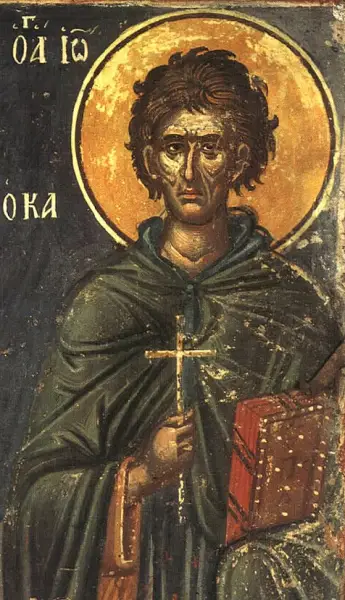
John's cult belongs to the earliest stratum of Christian saint-veneration, ratified by custom rather than by any formal canonization. The Eastern Orthodox Church keeps his memory on 15 January, styling him Venerable John Calabytes the Hut-Dweller, a title the Orthodox Church in America's calendar carries to this day. The Roman Catholic Church likewise venerates him on 15 January, and the Roman Martyrology preserves a second, Roman form of his legend under 23 January, complete with the report of the miracles that followed his death and the church built in his honor over the place of his burial. His image survives in Byzantine decoration, notably an Athonite fresco and a mosaic at Hosios Loukas, which show the aspect the West also retained: a beggar, Gospel book in hand. For the printers of 1636, whose Images De Tous Les Saincts depicted him for French readers, he was simply St. John Calabyte of January the fifteenth — a beggar with a Gospel in his hand, honored wherever the story of the hut was told. Across all these forms the essentials remain fixed — the noble birth, the secret departure, the unrecognized return, the hut.
§ Veneration
Relics, Churches, and an Enduring Story
The afterlife of John's relics traces the connections between Constantinople and medieval Europe. In Rome an old church bearing his name stood near the bridge by the Tiber island; an inscription there records that Pope Formosus, who died in 896, built it together with an hospital. From this, Du Cange inferred that the saint's body had been conveyed from Constantinople to Rome before the iconoclast controversy broke out under Leo the Isarian in 706. His head stayed longer in the Greek capital, remaining there even after the Latins took the city in 1204 — but soon afterward it too traveled west, reaching Besançon in Burgundy, where it was kept in the church of St. Stephen, its case circled by a Greek inscription. The Roman church and hospital eventually passed into the keeping of the religious men of St John of God's order, who held them into the modern era. Scholars have continued to sift the traditions: Baronius commended a manuscript life setting John under Theodosius the Younger, whose death came in 450, while Nicephorus placed him under Leo, proclaimed emperor in 457 — dates the sources themselves note may both stand. His Greek acts survive, alongside Latin versions Bollandus and Papebroch catalogued for the Acta Sanctorum.
§ Butler's account
Timeline
- 450
Revealed his identity to his mother on his deathbed and died, according to Alban Butler's account.
§ Butler's account
- 469
The Roman Martyrology records his death in Rome, where his parents recognized him only at the end.
§ Roman Martyrology
- 706
By the outbreak of iconoclasm under Leo the Isarian, his body had been brought from Constantinople to Rome.
§ Butler's account
- 896
Pope Formosus, who died this year, built the Roman church of St. John Calybite together with a hospital.
§ Butler's account
- 1204
Soon after the Latins seized Constantinople, his head was carried from the city to Besançon in Burgundy.
§ Butler's account
In Their Own Words
He sanctified his soul by wonderful patience, meekness, humility, mortification, and prayer
The Record
- Symbols
- Beggar with a Gospel in his hand
- Canonization
- Pre-congregation saint venerated by the Eastern Orthodox Church and the Roman Catholic Church
Prayer
Bibliography
Show 5 sources
- "Venerable John Calabytes 'the Hut-Dweller'", www.oca.org, retrieved 2024-10-30
- "Saint John Calabytes", CatholicSaints.info, 14 January 2013, retrieved 2021-08-08
- St. Augustine's Abbey, Ramsgate (1921), The Book of Saints: A Dictionary of Servants of God Canonized by the Catholic Church, London: A. & C. Black
- The Roman and British Martyrology: Now First Translated, Literally, from the Latin Ed., O'Neill and Duggan, 1846
- Butler, Alban (1868), The Lives of the Fathers, Martyrs, and Other Principal Saints, J. Duffy
Profile text adapted from the Wikipedia article, licensed CC BY-SA 4.0.
Pray with this saint every day
Save St. John Calybite to your favorites, read the full profile, and get feast-day reminders in the Saints app.
Get the Saints AppFree on the App Store for iPhone and iPad